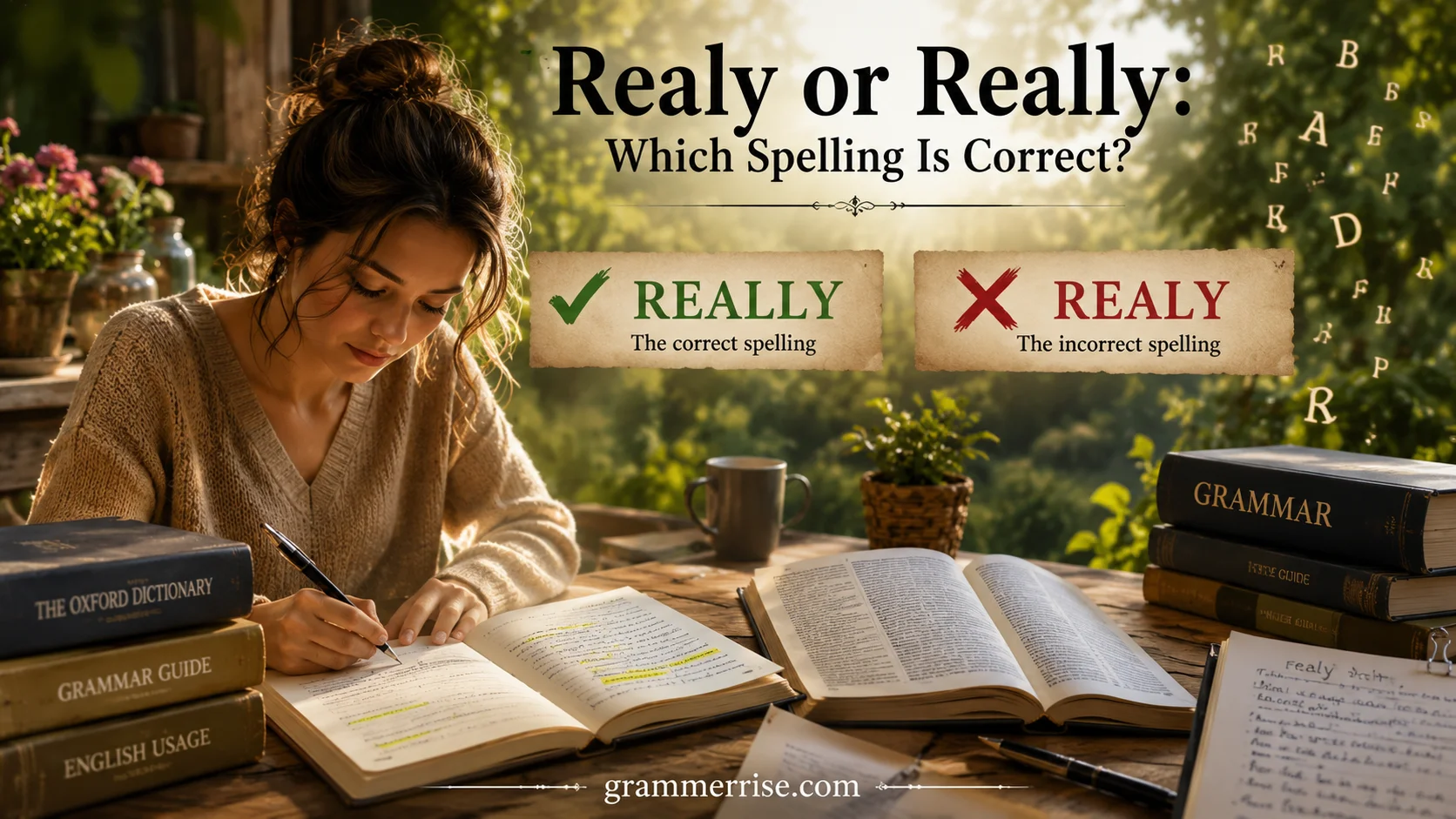
The Realy or Really spelling confusion appears when people type quickly and search for the correct spelling of this common English word online. Many people paused while typing realy instead of really because this simple-looking word creates confusion. The correct spelling is really, a recognized form in standard English, while realy remains an incorrect spelling and common misspelling.
This word works as an adverb, and understanding the grammar behind the word, word formation, spelling rule, pronunciation, and letter repetition makes it easier to remember the correct spelling forever. The missing l creates a letter difference and a one letter difference, but this small mistake can influence clarity, credibility, and writing accuracy in email, school assignment, blog post, social media update, professional report, academic writing, and professional communication.
This guide explains, explores, shows, and shares real-world examples, similar words, practical memory tricks, and practical tips to improve writing skills. English learners, native speakers, student, writer, blogger, and professional users may make this error because typing quickly, fast typing, typing speed, and unpredictable English spelling rules cause spelling errors to appear.
Quick Answer
Let’s settle the question immediately.
| Word | Correct? | Meaning |
| Really | ✅ Yes | Truly, genuinely, very |
| Realy | ❌ No | Misspelling of really |
Whenever you’re writing in English, use really.
Never use realy.
Examples
✅ I really enjoyed the movie.
✅ Her performance was really impressive.
✅ Can you really believe that?
❌ I realy enjoyed the movie.
❌ Her performance was realy impressive.
❌ Can you realy believe that?
The difference may seem small, yet using the correct spelling makes your writing look more polished and professional.
What Does Really Mean?
The word really is an adverb. It helps add meaning, emphasis, or intensity to a sentence.
Depending on context, really can mean:
- Truly
- Genuinely
- Actually
- Very
- Extremely
- Indeed
Because it serves multiple purposes, really has become one of the most frequently used words in modern English.
Definition of Really
Really means “in reality,” “truly,” “actually,” or “to a great degree.”
Common Uses of Really
People use really to:
- Emphasize a statement
- Confirm truth
- Strengthen an opinion
- Express surprise
- Modify adjectives
- Modify verbs
- Modify other adverbs
Examples
Meaning: Truly
- I really appreciate your help.
- She really wants to succeed.
- They really enjoyed the event.
Meaning: Very
- The weather is really hot today.
- That was a really good meal.
- The test was really difficult.
The exact meaning depends on the sentence.
Why Do People Write Realy Instead of Really?
This spelling mistake happens more often than many people realize.
Several factors contribute to the confusion.
The Missing Double Letter Problem
English contains many words with double letters.
Examples include:
- Address
- Success
- Parallel
- Necessary
- Really
Unfortunately, double letters often disappear when people type quickly.
A writer sees the word in their mind but accidentally drops one letter.
That leads to:
really → realy
Pronunciation Doesn’t Help
Here’s the tricky part.
When spoken aloud, really doesn’t strongly emphasize both “l” sounds.
As a result, many people assume only one “l” exists.
Compare:
- really
- realy
They sound almost identical.
Because pronunciation offers little guidance, spelling mistakes become common.
Mobile Typing Errors
Modern communication happens fast.
Many people write messages while:
- Walking
- Traveling
- Multitasking
- Using small phone keyboards
Under those conditions, dropped letters become inevitable.
English Learners Face Extra Challenges
For non-native speakers, English spelling often feels like navigating a maze.
Many words don’t sound exactly how they’re written.
The word really falls into that category.
The Rule Behind the Spelling of Really
Understanding the grammar rule makes the correct spelling much easier to remember.
Really Comes From “Real”
The word really develops from:
Real + ly = Really
At first glance, some writers assume:
Real + ly = Realy
However, English spelling rules don’t work that way.
Why the Double “L” Remains
When adding -ly to adjectives ending in l, English often preserves the existing “l” while adding another through the suffix structure.
As a result:
| Base Word | Adverb |
| Real | Really |
| Full | Fully |
| Final | Finally |
| Usual | Usually |
Notice the pattern.
The original “l” remains.
The resulting adverb contains a double “l.”
Visual Breakdown
Real
+
Ly
=
Really
Understanding the construction immediately makes the correct spelling easier to remember.
What Part of Speech Is Really?
Grammar becomes much easier when you know how a word functions.
Really Is an Adverb
An adverb modifies:
- Verbs
- Adjectives
- Other adverbs
The word really can perform all three jobs.
Modifying a Verb
Example:
I really enjoyed the concert.
Here, really modifies the verb enjoyed.
Modifying an Adjective
Example:
The book was really interesting.
Here, really modifies the adjective interesting.
Modifying Another Adverb
Example:
She ran really quickly.
Here, really modifies the adverb quickly.
Simple Grammar Table
| Sentence | What Really Modifies |
| I really care. | Verb |
| She’s really smart. | Adjective |
| He works really efficiently. | Adverb |
This flexibility explains why really appears so frequently in everyday communication.
Really Meaning “Truly” vs Really Meaning “Very”
One reason really is so popular is its versatility.
The word carries two major meanings.
Really Meaning “Truly”
In these cases, really means:
- Actually
- Genuinely
- In reality
Examples:
- I really understand your concern.
- She really loves her job.
- They really meant what they said.
The emphasis focuses on truthfulness.
Really Meaning “Very”
In other situations, really acts as an intensifier.
Examples:
- It’s really cold today.
- That was really exciting.
- The project is really important.
Here, really means “very.”
Comparison Table
| Meaning | Example |
| Truly | I really trust him. |
| Actually | Do you really think so? |
| Very | That’s really impressive. |
| Extremely | The road was really dangerous. |
Context determines which meaning applies.
How to Remember the Correct Spelling of Really
Spelling memory tricks can save you from future mistakes.
Memory Trick #1: Real + Ly
Think about the base word.
Real + ly = really
Whenever you forget the spelling, start with “real.”
Then add “ly.”
Memory Trick #2: Keep Both L’s
Remember:
Real already ends with L.
When you add the ending, the double L remains.
Memory Trick #3: Think of Similar Words
Consider:
- Finally
- Usually
- Fully
- Really
These words share a similar spelling pattern.
Memory Formula
REAL
+
LY
=
REALLY
This formula works surprisingly well.
Read more: Color or Colour: Differences, Rules, Examples and Usage Guide
Common Mistakes People Make With Really
Misspelling isn’t the only issue.
Writers frequently misuse really in other ways.
Writing Realy
The most common mistake remains:
❌ Realy
✅ Really
Overusing Really
Many writers lean heavily on really.
Consider this example:
The movie was really good. The actors were really talented. The ending was really emotional.
The repetition becomes noticeable.
A stronger version might be:
The movie was excellent. The actors were talented. The ending was emotional.
Using Really Instead of Stronger Words
Sometimes one precise word works better.
| Weak Phrase | Stronger Alternative |
| Really good | Excellent |
| Really bad | Terrible |
| Really happy | Delighted |
| Really angry | Furious |
| Really small | Tiny |
| Really large | Massive |
Good writing often depends on precision.
Really vs Similar Commonly Misspelled Words
The same spelling pattern causes mistakes in other words.
Really vs Realy
Correct: Really
Incorrect: Realy
Finally vs Finaly
Correct: Finally
Incorrect: Finaly
Fully vs Fuly
Correct: Fully
Incorrect: Fuly
Usually vs Usualy
Correct: Usually
Incorrect: Usualy
Naturally vs Naturaly
Correct: Naturally
Incorrect: Naturaly
Pattern Recognition
Notice a trend?
Many adverbs ending in -ly retain double letters.
Understanding that pattern helps prevent multiple spelling mistakes at once.
Synonyms and Alternatives for Really
Repeating really too often can weaken your writing.
Fortunately, English offers plenty of alternatives.
Alternatives Meaning “Truly”
- Truly
- Genuinely
- Actually
- Indeed
- Certainly
- Honestly
Examples:
- I genuinely appreciate your support.
- She truly cares about the project.
- He certainly deserves recognition.
Alternatives Meaning “Very”
- Extremely
- Highly
- Remarkably
- Exceptionally
- Particularly
- Incredibly
Examples:
- The results were exceptionally strong.
- The restaurant was remarkably good.
- The task proved extremely difficult.
Comparison Table
| Word | Best Used For |
| Really | Everyday emphasis |
| Truly | Sincerity |
| Indeed | Formal confirmation |
| Extremely | Strong intensity |
| Remarkably | Positive surprise |
| Genuinely | Authentic feelings |
Choosing the right synonym adds variety and sophistication.
Is Really Appropriate in Formal Writing?
The answer depends on context.
Academic Writing
Academic writing values precision.
Instead of:
The findings were really important.
Try:
The findings were significant.
Business Communication
Professional documents often benefit from stronger wording.
Instead of:
The update was really effective.
Try:
The update was highly effective.
Professional Emails
Really works fine in many emails.
Example:
We really appreciate your partnership.
The phrase sounds warm and professional.
Formal Alternatives
| Less Precise | More Precise |
| Really important | Essential |
| Really useful | Valuable |
| Really effective | Highly effective |
| Really large | Substantial |
| Really successful | Highly successful |
The goal isn’t eliminating really.
The goal is choosing the strongest word for the situation.
Examples of Really Used Correctly
Seeing real-world examples reinforces correct usage.
Everyday Conversations
- I really like this neighborhood.
- Do you really think it’ll rain?
- That’s really funny.
- We really enjoyed the trip.
Workplace Examples
- The new software really improved productivity.
- We really value customer feedback.
- This strategy really works.
School Examples
- She really studied hard for the exam.
- The lesson was really interesting.
- I really understand the concept now.
Professional Writing Examples
- Customer satisfaction really matters.
- The investment really paid off.
- Training programs really improve performance.
Social Media Examples
- I’m really excited about this announcement.
- That was really unexpected.
- The photos turned out really well.
Why Really Is One of the Most Frequently Misspelled Adverbs
Few adverbs cause as much confusion as really.
Several factors explain why.
High Frequency of Use
People use really constantly.
The more often a word appears, the more opportunities exist for mistakes.
Double Letters Cause Problems
Research into spelling errors consistently shows that double letters create confusion.
Writers frequently:
- Omit one letter
- Add an extra letter
- Reverse letters
Fast Digital Communication
Today’s communication prioritizes speed.
People often type:
- Emails
- Text messages
- Social posts
- Comments
Because speed matters, accuracy sometimes suffers.
Search Engine Data Reflects the Confusion
Millions of users search spelling questions every year.
Queries like:
- realy or really
- how to spell really
- is realy a word
- really spelling
continue appearing because the confusion remains widespread.
Case Study: How One Missing Letter Changes Perception
Consider these two emails.
Example One
We really appreciate your business and look forward to working with you.
Example Two
We realy appreciate your business and look forward to working with you.
The difference is only one letter.
Yet the second version appears less polished and less professional.
In business communication, small spelling mistakes can influence credibility.
That’s why mastering commonly confused words matters.
Quick Cheat Sheet
Correct and Incorrect Forms
| Correct | Incorrect |
| Really | Realy |
| Finally | Finaly |
| Fully | Fuly |
| Usually | Usualy |
| Naturally | Naturaly |
Instant Memory Trick
Remember:
Real + ly = really
Or think:
If it’s real, it’s really real.
That phrase helps many writers remember the double “l.”
FAQs
1. Is “realy” a correct spelling in English?
No, “realy” is not a correct spelling in standard English. The correct form is “really” with a double “l.” The incorrect version often appears because people type quickly and accidentally leave out one letter.
2. Why do people confuse “really” and “realy”?
The confusion happens because both words look almost identical, and English spelling rules are not always predictable. When writing quickly, texting, or creating online content, many people accidentally miss the second “l.”
3. What does “really” mean?
Really is an adverb used to show truth, emphasis, surprise, or a strong feeling. For example, “I really enjoyed the movie” means the person enjoyed it a lot or genuinely felt that way.
4. How can I remember the correct spelling of really?
A simple memory trick is to remember that really has two l’s because it comes from the word real with the ending -ly added. Keeping the double “l” pattern in mind helps prevent the common spelling mistake.
5. Is “realy” accepted in British or American English?
No, realy is not accepted as a correct spelling in either British English or American English. Both varieties use really as the standard spelling.
6. How can I avoid making the “realy” spelling mistake?
You can avoid this error by slowing down while typing, using spell-check tools, and reviewing your writing before publishing emails, essays, reports, or online content. Regular practice also improves spelling accuracy.
Conclusion
The difference between realy or really may seem like a tiny spelling issue, but using the correct form makes a big difference in clear communication. Really is the only accepted spelling in standard English, while realy is simply a common misspelling caused by typing habits and confusion with English spelling patterns. By remembering the double “l” in really and practicing accurate writing, you can easily avoid this mistake.
Whether you are writing an email, school assignment, blog post, social media update, or professional document, choosing the correct spelling helps improve your confidence and credibility. A small change in spelling can make your writing look more polished, professional, and reliable.