Color or Colour creates spelling confusion because writers explore why both forms exist, and this guide explains their meaning and regional use.
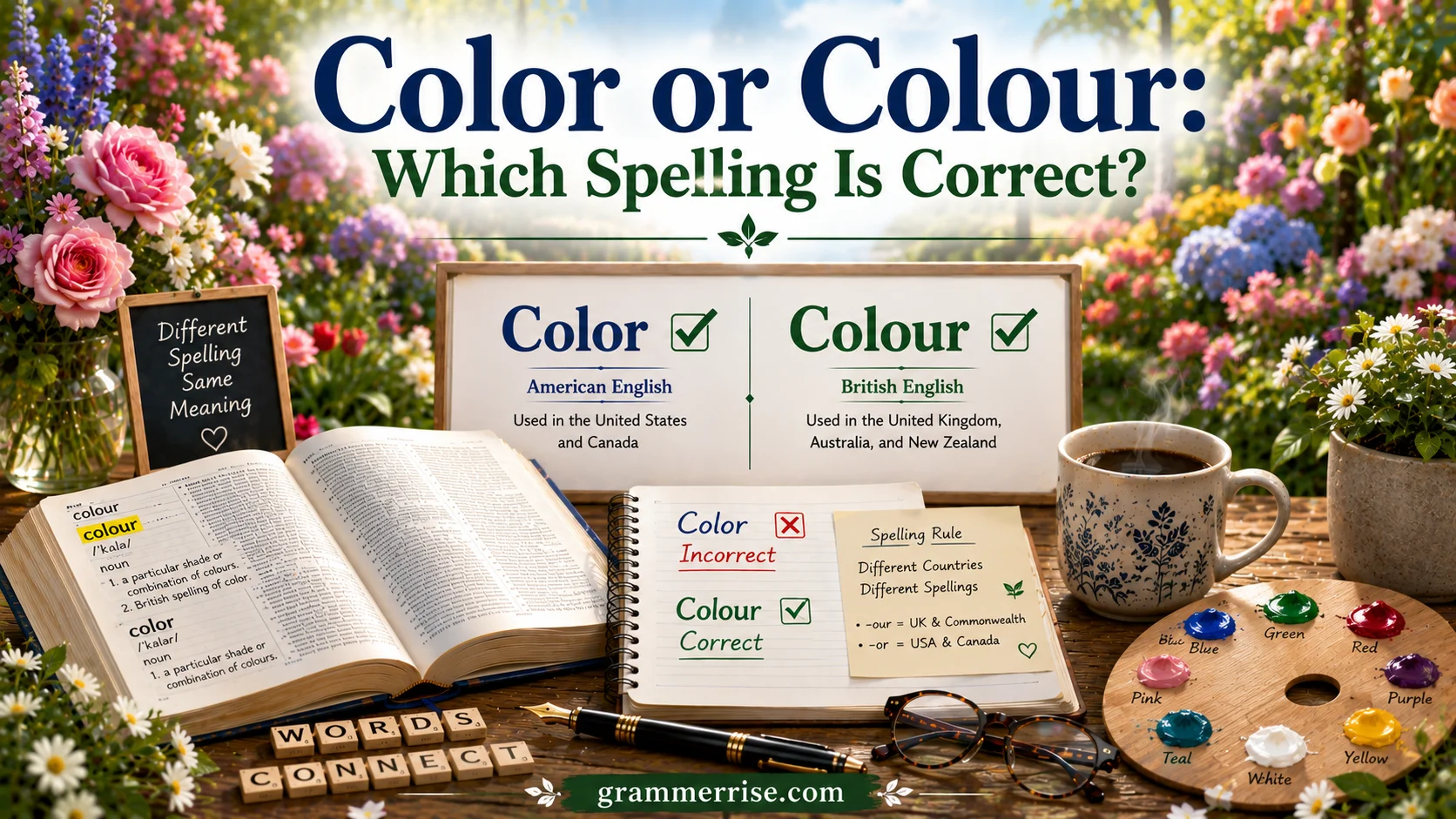
Many writers wonder why color and colour appear different when they describe the same thing. The simple answer depends on the type of English you are using. American English uses color as a standard spelling, while British English prefers colour. Both forms have the same meaning and refer to a visible shade, hue, or appearance created by light. Whether people write red, blue, green, black, or white, these colors and colours express the same visual idea.
The main difference is regional spelling, not grammar or meaning. Writers need to understand their audience because readers in the United States often expect color, while the United Kingdom, Australia, New Zealand, and other British-style English regions commonly use colour. The important rule is consistency choose one form and use it throughout your writing.
The history behind this spelling variation shows how language traditions, regional spelling habits, and cultural changes shape communication. After the American Revolution and American independence from Britain, a clear cultural split developed between US cultures and British cultures. Noah Webster introduced major language reform efforts to differentiate the growing American language from traditional British English.
Quick Answer
If you’re deciding between color and colour, here’s the simple answer.
Both spellings are correct.
- Color is the standard spelling in American English.
- Colour is the standard spelling in British English and most Commonwealth countries.
The meaning, pronunciation, and usage are exactly the same. Only the spelling changes depending on the regional variety of English.
| Audience | Preferred Spelling |
| United States | Color |
| United Kingdom | Colour |
| Canada | Colour |
| Australia | Colour |
| New Zealand | Colour |
| Ireland | Colour |
| International Audience | Choose one spelling and use it consistently |
Quick Examples
American English
- My favorite color is blue.
- The designer selected a bright color palette.
- This app lets you change the background color.
British English
- My favourite colour is blue.
- The designer selected a bright colour palette.
- This app lets you change the background colour.
The only difference is the extra “u” in the British spelling.
Color or Colour: What’s the Difference?
At first glance, color and colour look like different words. In reality, they mean exactly the same thing.
Both refer to the visual appearance created when light reflects off an object. Whether you’re describing a rainbow, a painting, clothing, or a company’s brand identity, the meaning doesn’t change.
The only distinction is regional spelling.
Think of it this way. It’s similar to driving on opposite sides of the road in different countries. The destination stays the same even though the route changes slightly.
What Does Color Mean?
In American English, color refers to the appearance of something based on the light it reflects or emits.
People also use the word in broader contexts.
For example, color can describe:
- The appearance of an object
- Artistic design
- Digital graphics
- Branding
- Photography
- Fashion
- Interior decoration
- Scientific observations
Examples include:
- The sunset displayed beautiful colors across the sky.
- She chose a calming wall color for the bedroom.
- The company’s logo uses three primary colors.
What Does Colour Mean?
The British spelling colour carries the exact same definition.
It appears throughout British books, newspapers, schools, government publications, and everyday conversations.
Examples include:
- The autumn leaves changed colour overnight.
- Artists often experiment with different colours.
- The room needs more natural colour.
Although the spelling differs, readers understand both words instantly.
Why Are There Two Different Spellings?
Many people assume American English changed the word randomly. The real story is much more interesting.
The difference between color and colour developed over hundreds of years as English evolved.
Language constantly changes. New spellings appear, pronunciations shift, and dictionaries eventually standardize those changes.
The spelling of this word followed exactly that path.
The Latin Origin
The history begins with the Latin word color.
Ancient Romans used color to describe appearance, hue, complexion, and artistic shading.
Notice something interesting.
The original Latin spelling didn’t include the letter u.
That surprises many people because they often assume the British spelling came first.
In reality, the story becomes more complex after Latin influenced French and later English.
Old French Influence
Following the Norman Conquest of England in 1066, French had an enormous influence on English vocabulary.
The Old French word evolved into colour, adding the extra u.
For centuries, English writers adopted many French spellings.
Other examples include:
- Honour
- Labour
- Favour
- Neighbour
These spellings eventually became standard throughout Britain.
Early English Wasn’t Standardized
Before dictionaries existed, spelling varied dramatically.
One writer might spell the word color, while another preferred colour.
Sometimes the same author used both spellings within a single manuscript.
Printing presses improved consistency, yet true standardization didn’t happen until dictionaries became widely accepted.
Noah Webster and American English
One person influenced American spelling more than anyone else.
His name was Noah Webster.
Webster believed American English should develop its own identity instead of following every British convention.
When he published An American Dictionary of the English Language in 1828, he simplified many spellings.
Among those changes:
| British English | American English |
| Colour | Color |
| Honour | Honor |
| Labour | Labor |
| Favourite | Favorite |
| Neighbour | Neighbor |
| Rumour | Rumor |
Webster argued that shorter spellings were simpler, easier to teach, and better reflected pronunciation.
Over time, American schools, newspapers, publishers, and government agencies adopted these spellings.
Meanwhile, Britain continued using the traditional forms.
That’s why both spellings survive today.
A Brief Timeline of the Word
Understanding the history makes the spelling difference much easier to remember.
| Time Period | Development |
| Ancient Rome | Latin color appears. |
| Middle Ages | Old French influences English with colour. |
| 1400s–1700s | Both spellings appear in English writing. |
| 1828 | Noah Webster promotes color in American English. |
| Modern Day | Color dominates American English, while colour remains standard in Britain and most Commonwealth countries. |
The timeline shows that neither spelling is newer or more “correct.” They simply reflect different stages in the history of English.
Which Countries Use Color and Which Use Colour?
Although the spelling rule seems simple, regional preferences matter more than many writers realize.
Here’s a quick reference.
| Country | Preferred Spelling |
| United States | Color |
| United Kingdom | Colour |
| Canada | Colour |
| Australia | Colour |
| New Zealand | Colour |
| Ireland | Colour |
| South Africa | Colour |
| India | Colour |
| Pakistan | Colour |
| Most international organizations | Depends on editorial style |
If you’re writing for an American audience, color looks natural.
If you’re writing for readers in London, Sydney, Toronto, or Dublin, colour feels more familiar.
Understanding your audience is often more important than the spelling itself.
Why Consistency Matters More Than the Spelling
One of the biggest mistakes writers make isn’t choosing color instead of colour.
It’s mixing both spellings in the same document.
Imagine reading these sentences:
The company’s brand color is blue.
A few paragraphs later:
The website allows users to customize the colour scheme.
Although both spellings are technically correct, switching between them feels inconsistent and distracts readers.
Professional writing should follow one regional standard from beginning to end.
A simple rule helps.
- Writing for Americans? Use color everywhere.
- Writing for British readers? Use colour throughout the entire article.
Maintaining consistency strengthens your credibility and creates a smoother reading experience.
Read more: Fortreen or Fourteen: Which Spelling Is Correct?
Color vs Colour in American and British English
Although color and colour share the same meaning, each spelling belongs to a different variety of English. Understanding where each version is used helps you write naturally for your audience.
Color in American English
If you’re writing for readers in the United States, color is the correct spelling.
You’ll see color in:
- American schools
- Government publications
- Newspapers
- Business documents
- Websites
- Product packaging
- Marketing campaigns
- University textbooks
Examples:
- Choose your favorite color from the menu.
- The designer updated the website’s color palette.
- This paint comes in more than fifty colors.
Major American style guides, including AP Style and The Chicago Manual of Style, recommend color.
Colour in British English
In the United Kingdom and most Commonwealth countries, colour is the standard spelling.
You’ll commonly find it in:
- British schools
- Newspapers
- Government documents
- Books
- Academic journals
- Advertising
- Television subtitles
Examples:
- The flowers add colour to the garden.
- Please select a colour before continuing.
- The painting contains vibrant colours.
Although the spelling changes, readers understand the word exactly the same way.
How to Choose the Correct Spelling
Choosing between color and colour isn’t difficult once you know who you’re writing for.
Here are practical guidelines.
Writing for an American Audience
Always use color if your readers are primarily in the United States.
Examples include:
- American businesses
- U.S. universities
- Local newspapers
- American blogs
- Product descriptions
- Marketing campaigns
Consistency makes your writing feel natural to American readers.
Writing for a British Audience
Use colour when your audience lives in:
- England
- Scotland
- Wales
- Northern Ireland
- Australia
- New Zealand
- Canada
- Ireland
- South Africa
Readers expect British spelling in these regions.
Academic Writing
Universities usually specify which variety of English they expect.
Before submitting a paper:
- Check the institution’s style guide.
- Use one spelling consistently.
- Don’t mix American and British English.
Business Communication
Businesses should match the spelling to their customers.
For example:
- A company selling only in the United States should use color.
- A retailer serving the United Kingdom should use colour.
Large international companies sometimes create separate websites for different regions to match local spelling preferences.
Examples of Color in Sentences
Seeing real examples makes the difference easier to remember.
Everyday Conversation
- My favorite color is green.
- What color is your new car?
- That dress comes in every color imaginable.
School
- The teacher asked students to color the map.
- Every student chose a different color for the project.
Business
- The company’s brand color appears on every product.
- Marketing experts carefully select each color to match the brand.
Technology
- Change the background color in the settings menu.
- The software lets you customize button colors.
Interior Design
- A lighter wall color makes small rooms feel larger.
- Neutral colors create a calm atmosphere.
Science
- Scientists measure color to study stars and distant galaxies.
- Certain minerals change color under ultraviolet light.
Examples of Colour in Sentences
Now let’s look at British English.
Everyday Conversation
- Blue has always been my favourite colour.
- Which colour would you like?
Education
- Pupils learn primary colours during their first years of school.
- The teacher explained how warm colours affect emotions.
Newspapers
- The article described the changing colours of autumn.
- Local artists celebrated the city’s vibrant colour.
Government Publications
- Drivers should understand the colour coding used on road signs.
- Emergency exits are marked with a distinctive colour.
Travel
- Every season brings a different colour to the countryside.
- The festival fills the streets with bright colours.
Creative Writing
- The evening sky burst into brilliant colours as the sun disappeared.
- Her scarf added a splash of colour to the quiet room.
Common Words Related to Color and Colour
The spelling difference doesn’t stop with one word. Several related words also change depending on whether you’re using American or British English.
| American English | British English |
| Color | Colour |
| Colored | Coloured |
| Coloring | Colouring |
| Colorful | Colourful |
| Colorless | Colourless |
| Discolor | Discolour |
| Discoloration | Discolouration |
Colored vs Coloured
Both words describe something that has color.
Examples:
- American English: Colored pencils.
- British English: Coloured pencils.
Coloring vs Colouring
These words refer to the act of adding color.
Examples:
- American English: Coloring book.
- British English: Colouring book.
Colorful vs Colourful
Both describe something bright, vivid, or visually appealing.
Examples:
- American English: A colorful garden.
- British English: A colourful garden.
Colorless vs Colourless
Both mean lacking color.
Examples:
- American English: A colorless liquid.
- British English: A colourless liquid.
Common Mistakes Writers Make
Although the difference is simple, many writers still make avoidable mistakes.
Mixing Both Spellings
This is the most common error.
Incorrect example:
The company’s color guide includes every colour option.
Instead, choose one spelling and use it throughout the entire document.
Ignoring Your Audience
A spelling that feels natural in one country may seem unusual in another.
Always consider who will read your content before deciding which version to use.
Switching Between Style Guides
Some writers copy information from American and British sources without editing the spelling.
As a result, one paragraph uses color, while the next uses colour.
That inconsistency makes the content look less polished.
Letting Autocorrect Change Your Spelling
Many writing programs automatically switch between American and British English.
Before publishing your work, check your language settings to make sure they match your intended audience.
Assuming One Spelling Is Wrong
Perhaps the biggest misconception is believing that color or colour is incorrect.
Both spellings are valid. The right choice depends entirely on the variety of English you’re using.
Case Study: Why Consistency Builds Trust
Imagine two online paint stores.
The first website writes:
- Interior Color Guide
- Exterior Colour Options
- Wall Color Calculator
- Popular Paint Colours
Customers quickly notice the inconsistent spelling.
Now compare that with a second website that uses color consistently across every page because it serves American customers.
The content feels more professional, the branding stays consistent, and readers move through the website without distraction.
That small detail creates a stronger first impression and reinforces credibility.
Color vs Colour at a Glance
Need a quick answer before you continue reading? This table summarizes the key differences between color and colour.
| Feature | Color | Colour |
| Correct spelling | ✅ | ✅ |
| American English | ✅ | ❌ |
| British English | ❌ | ✅ |
| Canadian English | Sometimes | ✅ Preferred |
| Australian English | ❌ | ✅ |
| New Zealand English | ❌ | ✅ |
| Same pronunciation | ✅ | ✅ |
| Same meaning | ✅ | ✅ |
| Accepted in dictionaries | ✅ | ✅ |
The table makes one thing clear. The choice isn’t about correctness. It’s about writing for the right audience.
Color or Colour in Popular Style Guides
Professional writers don’t guess which spelling to use. Instead, they follow a style guide that matches their audience.
Here’s how the most widely used style guides handle the word.
| Style Guide | Preferred Spelling |
| AP Style | Color |
| Chicago Manual of Style | Color |
| MLA | Follow the language variety required by your institution or audience |
| APA | Use one variety of English consistently |
| Oxford Style | Colour |
AP Style
The Associated Press (AP) Stylebook follows American English.
If you’re writing for American newspapers, news websites, or media organizations, use color.
Chicago Manual of Style
The Chicago Manual of Style also follows American English.
You’ll typically use color in books, magazines, academic publications, and professional writing produced in the United States.
MLA Style
The Modern Language Association (MLA) doesn’t force one spelling over the other.
Instead, it recommends matching the variety of English expected by your instructor, publisher, or audience.
APA Style
The American Psychological Association (APA) encourages consistency.
If you begin with American English, continue using color throughout your paper.
If your institution requires British English, use colour consistently instead.
Oxford Style
Oxford University Press generally follows British English conventions, making colour the preferred spelling.
The lesson across all style guides is simple.
Choose one spelling based on your audience and use it consistently from beginning to end.
Related American and British Spelling Differences
The difference between color and colour isn’t unique.
American and British English contain dozens of spelling variations that follow similar patterns.
Here’s a helpful comparison.
| American English | British English |
| Color | Colour |
| Favorite | Favourite |
| Honor | Honour |
| Labor | Labour |
| Neighbor | Neighbour |
| Humor | Humour |
| Flavor | Flavour |
| Behavior | Behaviour |
| Center | Centre |
| Theater | Theatre |
| Gray | Grey |
| Jewelry | Jewellery |
| Traveling | Travelling |
| Canceled | Cancelled |
Recognizing these patterns makes it much easier to switch between American and British English when needed.
Memory Trick to Remember the Difference
You don’t need to memorize a long grammar rule.
Instead, remember these simple tips.
Memory Trick #1
America drops the “U.” Britain keeps the “U.”
Examples:
- Color → United States
- Colour → United Kingdom
Memory Trick #2
Think of the word United.
The United Kingdom contains the letter U, and so does colour.
The United States prefers the shorter spelling color.
Memory Trick #3
Imagine you’re packing for a trip.
If you’re flying to New York, leave the U at home.
If you’re heading to London, bring the U with you.
Simple images like these make the spelling much easier to remember.
FAQs
1. Why are color and colour spelled differently?
Color and colour are spelled differently because of regional English variations. American English uses color, while British English and many Commonwealth countries use colour. Both words have the same meaning and describe the appearance of something created by light.
2. Is color or colour the correct spelling?
Both color and colour are correct spellings. The right choice depends on your audience and the type of English you are following. Use color for American English writing and colour for British English, Australian English, and other British-style English regions.
3. Do color and colour have different meanings?
No, color and colour have exactly the same meaning. They both refer to shades, hues, or visual appearances such as red, blue, green, black, and white. The only difference is the spelling style used in different regions.
4. Why does the US use color instead of colour?
The United States adopted color because of spelling reforms led by Noah Webster. His language reform efforts aimed to create a simpler American English style by removing unnecessary letters from words like colour, programme, and catalogue.
5. Should I use color or colour for my website and content?
You should choose the spelling based on your target audience. If your readers are mainly from the United States, use color. If your audience includes people from the UK, Canada, Australia, or other Commonwealth regions, colour may be more suitable. The most important thing is to stay consistent.
6. Does Canada use color or colour?
Canada uses a mix of both English styles because it has influences from British and American English. Many Canadians prefer colour because of their connection with British spelling traditions, although American English has also influenced Canadian writing.
Conclusion
Understanding the difference between color or colour helps you communicate more clearly with readers from different parts of the world. Both spellings are correct, and the choice depends on the type of English you follow and the audience you want to reach. Whether you are writing a blog, email, academic paper, or professional content, using the right spelling style shows attention to detail and improves consistency.
Language continues to evolve with culture, history, and communication. While American English follows color and British English prefers colour, neither version changes the meaning. The best approach is simple: choose one spelling style, use it consistently, and focus on creating content that connects with your readers.