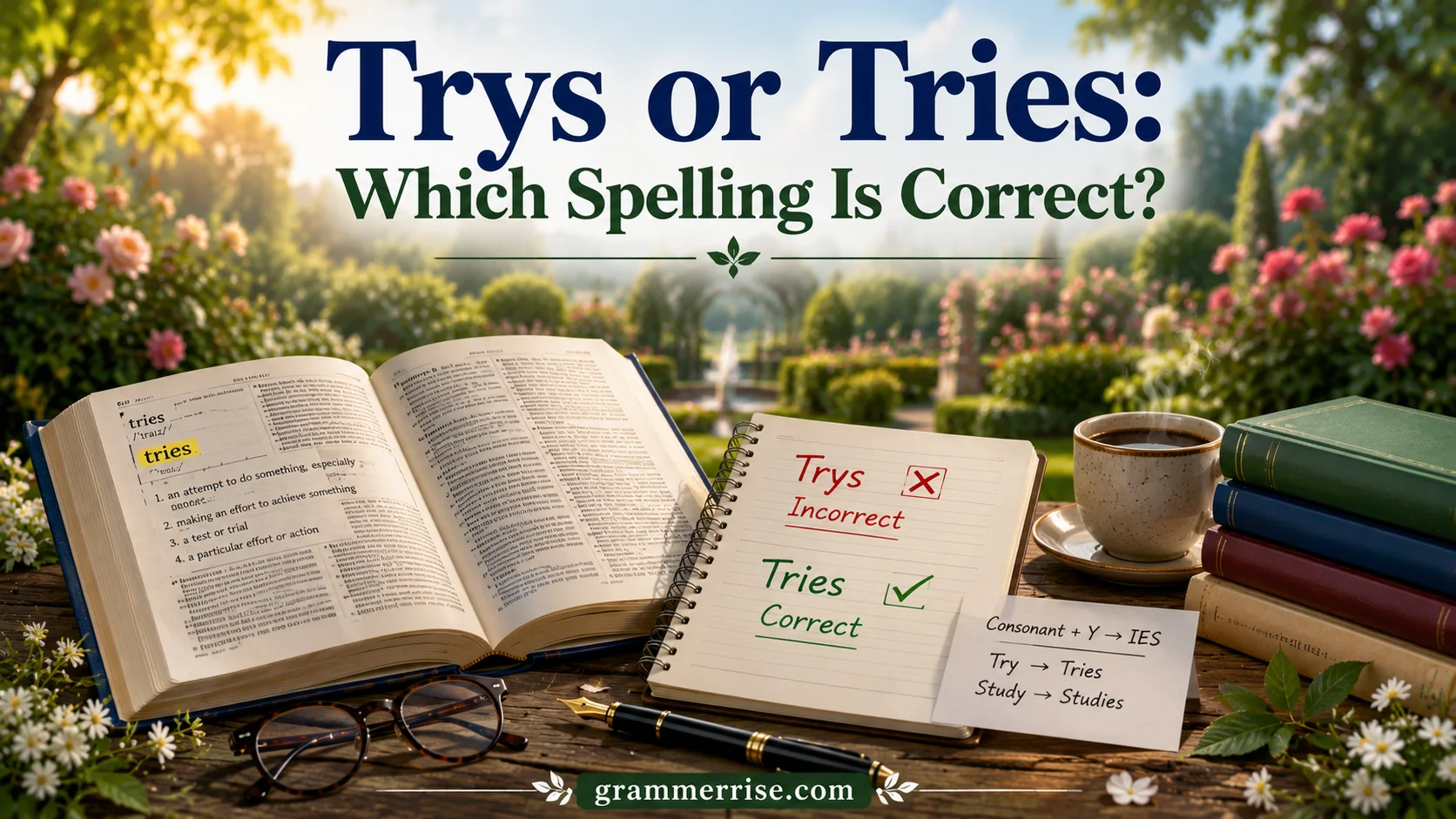
The Trys or Tries confusion affects many writers because they wonder which spelling is correct when using the verb try in everyday English sentences.
Many English learners, students, content writers, and native speakers face this confusion because both words may seem possible. I once typed “he trys hard” in a sentence and stopped to wonder if it looked correct. Later, my grammar tools highlighted the incorrect spelling in an email, helping me understand the difference. The correct form is tries, which is the third-person singular form of the verb try. In standard English, trys is an incorrect English word because verbs that end in y follow special spelling rules. The letter changes before we add s, making tries the right choice.
The rule becomes easier to understand through simple explanations, practical examples, and regular checking. The base verb is try, and the third person singular form follows a clear pattern where the change happens before adding the ending. After reviewing grammar rules and practicing examples daily, I understood why tries is correct and trys is wrong. This guide explains the real-world and real world usage of the word for bloggers, professional writers, and anyone who wants to write with confidence. It covers British, American, and regional usage, including emails, essays, exams, and everyday conversation.
Quick Answer
Tries is the correct spelling. It is the third-person singular present tense of the verb try.
Trys is incorrect and is not recognized as a standard English word by major dictionaries or style guides.
Correct Examples
- She tries her best every day.
- He tries to arrive early.
- The company tries new marketing strategies each quarter.
Incorrect Examples
- ❌ She trys her best.
- ❌ He trys again tomorrow.
- ❌ My friend trys every solution.
Simple Rule: When a verb ends in a consonant + y, change the y to ies before adding the third-person singular ending.
Try → Tries
That same spelling rule also applies to words like cry → cries, study → studies, carry → carries, and reply → replies.
The Short Answer: Trys or Tries?
If you’re choosing between trys and tries, the answer is simple.
Tries is always the correct spelling in modern English.
Trys is a spelling mistake. You shouldn’t use it in school assignments, business emails, academic papers, professional reports, published articles, or everyday writing.
Here’s a quick comparison.
| Word | Correct? | Standard English | Dictionary Accepted |
| Tries | ✅ Yes | ✅ Yes | ✅ Yes |
| Trys | ❌ No | ❌ No | ❌ No |
Although trys occasionally appears online, those instances almost always result from typing errors or misunderstandings of English spelling rules. Reputable dictionaries, grammar references, and educational resources recognize only tries as the correct present-tense form of try.
Think of it this way. English changes certain words before adding a new ending. Instead of simply attaching -s, the language adjusts the spelling to preserve pronunciation and follow established grammar conventions.
That’s exactly what happens here.
- Base verb: try
- Third-person singular: tries
Once you recognize this pattern, choosing the correct spelling becomes automatic.
Why Tries Is the Correct Spelling
English follows consistent spelling patterns for most verbs. The verb try belongs to a group that changes its ending before adding -s.
Whenever the subject is he, she, it, or any singular noun in the present tense, the verb must change from try to tries.
Consider these examples.
- She tries a new recipe every weekend.
- Daniel tries to stay positive.
- The software tries to detect errors automatically.
- Every student tries to improve before the exam.
Notice that every sentence has one singular subject. That subject requires the verb tries, not try.
This isn’t an exception. It’s a predictable grammar rule that appears throughout English.
Many learners initially assume adding -s works for every verb because they see examples like:
- run → runs
- walk → walks
- read → reads
However, verbs ending in consonant + y behave differently.
Instead of adding -s, they replace the y with ies.
That small spelling change keeps English consistent and easier to pronounce.
Understanding the Verb Try
Before learning the spelling rule, it’s helpful to understand how try functions in English.
The verb try means to:
- Make an effort to accomplish something.
- Test or examine something.
- Attempt to achieve a goal.
- Experiment with a new idea or method.
You can use try in casual conversations, academic writing, professional communication, journalism, and literature.
For example:
- I’ll try to finish today.
- We should try another solution.
- Scientists try different methods before reaching conclusions.
- Athletes try to improve every season.
The meaning remains the same. Only the verb form changes depending on the subject.
The Grammar Rule Behind Try → Tries
The confusion disappears once you understand one simple spelling rule.
When a verb ends with:
Consonant + Y
change the y to ies before adding the third-person singular ending.
Here’s the rule in action.
| Base Verb | Correct Form |
| Try | Tries |
| Cry | Cries |
| Carry | Carries |
| Study | Studies |
| Reply | Replies |
| Worry | Worries |
| Copy | Copies |
| Hurry | Hurries |
| Marry | Marries |
| Fly | Flies |
Notice the pattern.
Every verb ends with a consonant immediately before the letter y.
Because of that, English changes the ending to ies.
This rule appears so often that teachers introduce it during elementary grammar lessons. Even advanced writers rely on it every day without thinking about it.
Why Doesn’t English Simply Add -S?
At first, you might wonder why English doesn’t spell the word trys.
The answer comes down to historical spelling conventions and pronunciation.
English evolved over centuries, borrowing vocabulary from several languages. During that process, certain spelling patterns became standardized to make words easier to read and pronounce consistently.
Changing y to ies helps preserve the expected sound.
Imagine seeing these words:
- trys
- studys
- carrys
- replys
They look awkward because they don’t follow standard English spelling conventions.
Now compare them with:
- tries
- studies
- carries
- replies
These instantly look familiar because they’re the accepted forms you’ve seen throughout books, newspapers, classrooms, and professional writing.
Language often values consistency over simplicity. This spelling rule is a perfect example.
Why People Write Trys
Even though tries is the only correct spelling, trys still appears surprisingly often.
Several factors explain why.
People Assume Every Verb Takes -S
Many beginners learn examples such as:
- works
- eats
- jumps
- sings
Naturally, they assume:
- try → trys
Unfortunately, that assumption ignores the special rule for verbs ending in consonant + y.
Fast Typing
Typing quickly often leads to small spelling mistakes.
Someone may know the correct spelling but accidentally type trys without noticing.
Fortunately, most grammar checkers catch this error immediately.
English Isn’t Always Predictable
English contains many exceptions.
Because learners regularly encounter irregular verbs, they sometimes overgeneralize simple patterns and forget the y → ies rule.
Influence From Informal Writing
Social media, text messages, and online comments often contain spelling errors.
Seeing trys repeatedly doesn’t make it correct. It simply reflects how easily spelling mistakes spread across the internet.
When to Use Tries
You’ll use tries whenever you’re writing about one person, one thing, or one organization performing an action in the present tense.
Common subjects include:
- He
- She
- It
- Someone
- Everyone
- A company
- A school
- A team
- A student
- A teacher
Examples include:
- She tries every new restaurant in town.
- The doctor tries several treatments before surgery.
- Every applicant tries to make a strong first impression.
- The software tries to recover lost files automatically.
- My brother tries to exercise every morning.
Each sentence follows standard English grammar because the singular subject pairs with tries.
Why Trys Is Incorrect
Although trys may look reasonable, it isn’t a valid English word. You’ll never find it listed as the correct third-person singular form of try in modern dictionaries or grammar references.
The mistake happens because many writers assume every verb simply adds -s in the present tense. That works for many verbs, but try follows a different spelling rule.
Here’s the difference:
| Incorrect | Correct |
| Trys | Tries |
Whenever you write for school, work, or publication, always choose tries.
Why Spell Check Flags “Trys”
Most grammar and spelling tools immediately mark trys as incorrect because it doesn’t follow standard English spelling rules.
For example, if you type:
She trys to finish her homework.
Most writing tools suggest:
She tries to finish her homework.
That’s because tries is the accepted spelling in both American English and British English.
Is “Trys” Ever Accepted?
No.
There isn’t a recognized grammar rule that makes trys correct in standard English.
You shouldn’t use it in:
- Academic writing
- Business emails
- News articles
- Books
- Professional reports
- Blog posts
- School assignments
- Formal letters
Even in casual writing, tries remains the correct choice.
The Complete Spelling Rule
Understanding one simple rule will help you spell hundreds of English verbs correctly.
Rule: Change Y to IES
If a verb ends with:
Consonant + Y
change the y to ies when forming the third-person singular present tense.
Here’s a quick reference.
| Base Verb | Third-Person Singular |
| Try | Tries |
| Cry | Cries |
| Fly | Flies |
| Carry | Carries |
| Study | Studies |
| Reply | Replies |
| Copy | Copies |
| Worry | Worries |
| Marry | Marries |
| Hurry | Hurries |
Notice something important.
Every one of these verbs has a consonant immediately before the y.
That’s what triggers the spelling change.
The Exception: Verbs Ending in a Vowel + Y
Not every verb ending in y changes to ies.
If the letter before y is a vowel, simply add -s.
This is where many learners get confused.
Examples
| Base Verb | Correct Form |
| Play | Plays |
| Stay | Stays |
| Enjoy | Enjoys |
| Buy | Buys |
| Obey | Obeys |
| Convey | Conveys |
| Employ | Employs |
Notice that each word has a vowel before y.
- Play
- Stay
- Enjoy
- Buy
Because of that vowel, the spelling stays the same.
You simply add -s.
Compare the Two Rules
| Verb Ending | Rule | Example |
| Consonant + Y | Change Y to IES | Try → Tries |
| Vowel + Y | Add S | Play → Plays |
This small distinction eliminates most spelling mistakes involving y-ending verbs.
What Does Tries Mean?
The word tries comes from the verb try, which means to make an effort, test something, or attempt to achieve a result.
Depending on the context, tries can describe many different actions.
Making an Effort
Someone works toward a goal.
Example
Maya tries to improve her pronunciation every day.
Testing Something
Someone experiments to see what works.
Example
The chef tries a new recipe before adding it to the menu.
Attempting a Task
Someone begins or repeats an action.
Example
He tries to solve the puzzle without any hints.
Although the situations differ, the spelling remains exactly the same.
How to Pronounce Tries
Many spelling mistakes happen because people rely on pronunciation instead of grammar.
Fortunately, tries is easy to pronounce.
| Feature | Details |
| IPA | /traɪz/ |
| Number of syllables | One |
| Rhymes with | Eyes, skies, flies |
Say it aloud:
tries
The ending sounds like “eyes.”
That pronunciation also explains why tries looks natural to fluent English speakers, while trys feels unusual.
Read more: Wholistic or Holistic: Meaning, Difference and Proper Usage
When Should You Use Tries?
You’ll use tries whenever the subject is singular and the sentence is written in the present tense.
Everyday Conversation
People use tries naturally in daily speech.
Examples:
- She tries to stay positive.
- Dad tries every new barbecue recipe.
- My neighbor tries to help everyone.
Academic Writing
Students and researchers often describe repeated actions.
Examples:
- The researcher tries multiple approaches before reaching a conclusion.
- Every student tries to improve their writing skills.
Business Communication
Companies regularly describe strategies and goals.
Examples:
- The company tries to reduce waste each year.
- Our manager tries to answer every customer within one business day.
Journalism
News articles frequently describe ongoing actions.
Examples:
- The governor tries to gain support for the proposal.
- The organization tries to expand community programs.
Creative Writing
Authors use tries to reveal a character’s actions and emotions.
Example:
Every morning, Liam tries to forget the events of the previous night, yet the memories always return before breakfast.
Real-Life Examples of Tries
Seeing the word in different situations makes the grammar much easier to remember.
School
- Emma tries her best on every assignment.
- The teacher tries to make science fun.
- Every student tries to finish before the bell rings.
Workplace
- Our supervisor tries to solve problems quickly.
- The designer tries several layouts before making a decision.
- Each employee tries to meet the monthly goals.
Sports
- The striker tries another shot from outside the box.
- Every athlete tries to improve each season.
- The coach tries different formations during practice.
Technology
- The application tries to reconnect automatically.
- The system tries to detect unusual activity.
- The software tries to repair damaged files.
Healthcare
- The doctor tries a less invasive treatment first.
- Every therapist tries to create a comfortable environment.
- The hospital tries to reduce waiting times.
Customer Service
- The representative tries to resolve every complaint politely.
- Each agent tries to answer calls promptly.
These examples demonstrate how often tries appears in everyday English.
Incorrect Sentences and Their Corrections
One of the fastest ways to master a grammar rule is to compare mistakes with correct usage.
| Incorrect Sentence | Correct Sentence |
| She trys every day. | She tries every day. |
| He trys again tomorrow. | He tries again tomorrow. |
| The company trys new software. | The company tries new software. |
| My brother trys to help. | My brother tries to help. |
| The child trys hard in school. | The child tries hard in school. |
| Our team trys different strategies. | Our team tries different strategies. |
Every correction follows the exact same grammar rule.
Once you recognize the pattern, you’ll spot the mistake immediately whenever you see trys.
Common Verbs That Follow the Same Rule
Once you understand why try becomes tries, you’ll recognize the same spelling pattern in many other English verbs. Instead of memorizing each word individually, you can apply one grammar rule to an entire group of verbs.
Every verb below ends with a consonant + y, so the y changes to ies in the third-person singular present tense.
| Base Verb | Third-Person Singular | Example Sentence |
| Try | Tries | She tries to stay organized. |
| Cry | Cries | The baby cries every morning. |
| Fly | Flies | The bird flies south each winter. |
| Carry | Carries | He carries his laptop everywhere. |
| Study | Studies | Olivia studies English daily. |
| Reply | Replies | She replies within an hour. |
| Hurry | Hurries | Ethan hurries to catch the train. |
| Worry | Worries | My mother worries about everyone. |
| Copy | Copies | The printer copies documents quickly. |
| Marry | Marries | She marries her longtime partner next month. |
If you can remember one example—try → tries—the rest become much easier.
Try in Different Verb Forms
Many writers focus only on tries, but learning every form of try helps you write more naturally.
Here’s the complete verb chart.
| Verb Form | Word | Example |
| Base Form | Try | I try to exercise daily. |
| Third-Person Singular | Tries | She tries every morning. |
| Present Participle | Trying | They are trying a new method. |
| Past Tense | Tried | We tried our best yesterday. |
| Past Participle | Tried | They have tried everything. |
Notice something interesting.
The spelling changes differently depending on the verb form.
- Try → Tries
- Try → Trying
- Try → Tried
Each follows its own spelling rule.
Why Doesn’t “Trying” Become “Triing”?
This question surprises many English learners.
When adding -ing, you keep the letter y.
Examples include:
- Try → Trying
- Cry → Crying
- Study → Studying
- Carry → Carrying
The y changes only when forming the third-person singular or certain plural noun forms. It stays in place before -ing.
Why Does “Tried” Lose the Y?
The past tense follows another common spelling rule.
When a verb ends with consonant + y, replace the y with i before adding -ed.
Examples:
- Try → Tried
- Cry → Cried
- Study → Studied
- Carry → Carried
- Reply → Replied
Understanding these patterns makes English spelling much more predictable.
Common Mistakes Writers Make
Even experienced writers occasionally make mistakes with tries. Most errors happen because people confuse similar spelling rules.
Here are the mistakes to avoid.
Writing Trys
This is by far the most common error.
❌ She trys to improve.
✅ She tries to improve.
Always remember that trys isn’t a standard English word.
Forgetting the Consonant + Y Rule
Many people simply add -s to every verb.
That approach works for words like:
- Runs
- Walks
- Eats
However, it doesn’t work for try.
Mixing Up Singular and Plural Subjects
Look at these examples.
✅ Your daily efforts show that you are trying to grow.
✅ Their commitment proves they are willing to keep trying.
✅ Our teamwork helps us try new approaches.
✅ Her passion motivates her to keep trying every day.
Only he, she, it, and singular nouns require tries.
Confusing Verb Forms
Some writers accidentally mix present and past tense.
Incorrect:
Yesterday she tries to call me.
Correct:
Yesterday she tried to call me.
Pay attention to the time reference in your sentence.
Relying Only on Pronunciation
English spelling doesn’t always match pronunciation perfectly.
That’s why reading widely helps you recognize correct spellings naturally.
A Simple Memory Trick You’ll Never Forget
Grammar rules become much easier when you attach them to a memorable phrase.
Here’s an easy trick.
If a consonant stands before Y, wave goodbye to the Y and welcome IES.
Think of the letter Y stepping aside to make room for IES.
For example:
- Try → Tries
- Study → Studies
- Reply → Replies
- Carry → Carries
Now compare that with verbs ending in a vowel.
- Play → Plays
- Stay → Stays
- Enjoy → Enjoys
Since a vowel comes before Y, nothing changes except adding -s.
Many teachers use this trick because it helps students remember the rule in seconds.
Trys vs. Tries at a Glance
Need a quick reference?
This table summarizes everything discussed so far.
| Feature | Trys | Tries |
| Correct spelling | ❌ | ✅ |
| Standard English | ❌ | ✅ |
| Found in dictionaries | ❌ | ✅ |
| Used in professional writing | ❌ | ✅ |
| Accepted in academic papers | ❌ | ✅ |
| Grammatically correct | ❌ | ✅ |
| Third-person singular verb | ❌ | ✅ |
Whenever you hesitate, this comparison gives you the answer instantly.
Related Grammar Rules You Should Know
Mastering tries becomes even easier when you understand a few related grammar rules.
Tried or Tryed
The correct spelling is tried.
Since try ends with a consonant followed by y, the y changes to i before adding -ed.
✅ She tried her best.
❌ She tryed her best.
Trying or Trying
The correct spelling is trying.
Unlike tries and tried, the y stays when adding -ing.
✅ They are trying something new.
❌ They are triing something new.
Try vs. Tries
Use try with plural subjects and the pronouns I and you.
Examples:
- I try every day.
- You try your best.
- They try to stay focused.
Use tries only with singular third-person subjects.
Examples:
- He tries every day.
- The student tries to improve.
- My dog tries to catch every ball.
Try vs. Attempt
Although these words are similar, they aren’t always interchangeable.
| Word | Typical Use |
| Try | Everyday conversations and informal writing |
| Attempt | Formal, academic, legal, and technical writing |
For example:
- I’ll try again tomorrow.
- Scientists attempt to verify their results through repeated experiments.
Both words describe effort, but try sounds more natural in everyday English.
Case Study: A Small Spelling Mistake With Big Consequences
Imagine a hiring manager reviewing two job applications.
The first applicant writes:
Our team trys to solve customer problems quickly.
The second applicant writes:
Our team tries to solve customer problems quickly.
The difference is only one letter, yet it creates a completely different impression.
The second sentence demonstrates strong attention to detail. The first suggests the writer overlooked a basic grammar rule.
In competitive situations such as college admissions, scholarship essays, business proposals, or job applications, even minor spelling mistakes can affect credibility.
That’s why mastering small grammar rules like Trys or Tries matters more than many people realize.
Expert Tip
“Strong writing isn’t just about big ideas. It’s also about getting the small details right every single time.”
Professional editors often say that readers notice mistakes much faster than they notice flawless grammar. Choosing tries instead of trys helps your writing appear polished, accurate, and trustworthy.
FAQs
1. Is “trys” a correct English word?
No, “trys” is not a correct English word in standard English. The correct spelling is “tries” when you use the third-person singular form of the verb try. The spelling changes because verbs ending in a consonant followed by y usually change y to i before adding -es.
2. Why is “tries” correct but “trys” wrong?
Tries is correct because English spelling rules require a change when a verb ends with -y after a consonant. For example, try becomes tries, carry becomes carries, and study becomes studies. Simply adding s to create “trys” breaks the standard grammar rule.
3. When should I use the word “tries”?
You should use tries when talking about a person, animal, or thing that performs an action in the present tense. For example, “She tries to improve every day” or “The dog tries to catch the ball.” It is used with he, she, it, or any singular noun.
4. What is the difference between try and tries?
Try is the base form of the verb, while tries is the third-person singular form. You use try with subjects like I, you, we, and they. You use tries with he, she, it, or a singular name. For example, “They try hard” but “He tries hard.”
5. Do British and American English use “tries” the same way?
Yes, both British English and American English follow the same spelling rule. In both forms of English, tries is correct and trys is considered incorrect. The grammar rule remains the same across both regions.
6. How can I remember whether to write “trys or tries”?
A simple memory trick is to remember: verbs ending in consonant + y change y into i before adding -es. Think of examples like try tries and fly flies. This pattern will help you avoid the common mistake of writing “trys” in your emails, essays, and everyday writing.
Conclusion
Understanding the difference between Trys or Tries becomes simple once you learn the basic spelling rule for verbs ending in -y. Although trys may look natural at first, it is not the correct spelling in English. The correct form is always tries when you are writing about he, she, it, or any singular subject.
By remembering that the letter y changes to i before adding -es, you can avoid this common grammar mistake in your writing. Whether you are a student, blogger, professional writer, or English learner, using the correct spelling helps you communicate clearly and confidently. With regular practice and attention to grammar patterns, choosing between trys and tries will become an easy habit in your everyday writing.

Hussain Abid is an English language writer with over 10 years of experience in grammar, spelling, vocabulary, and writing. He specializes in creating clear, well-researched content that helps readers improve their English with confidence. At GrammarRise, Hussain writes practical guides, grammar explanations, and word comparison articles based on trusted language sources and real-world usage. His mission is to make English learning simple, accurate, and accessible for everyone