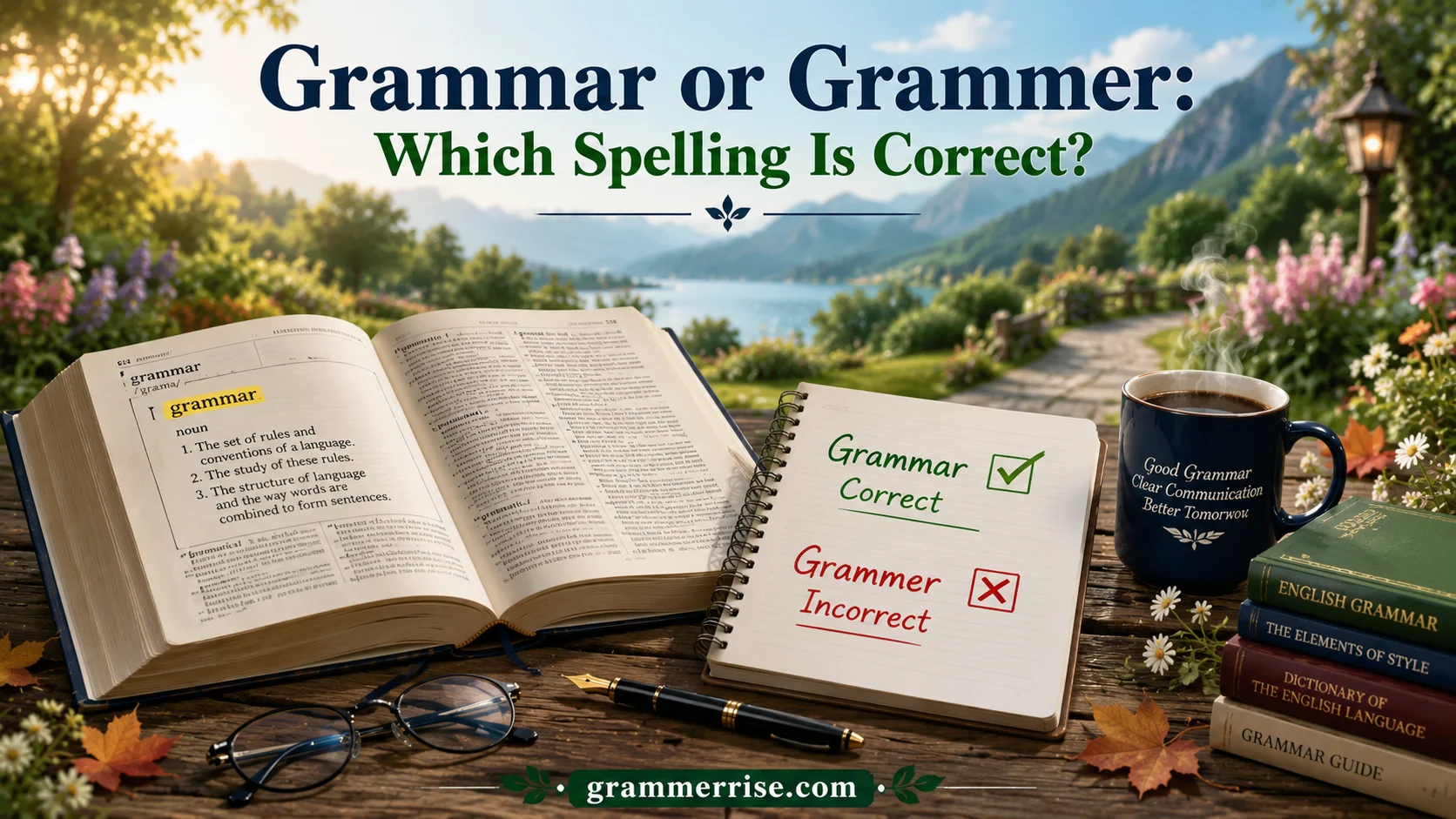
Grammar or Grammer explains a common spelling confusion where learners compare the correct word grammar with the incorrect form grammer in English.
Many learners become confused during writing because grammar and grammer look similar and sound almost identical when spoken quickly. Many writers, students, bloggers, and professionals make this common mistake while typing too quickly. The correct spelling is grammar, and it is the only form accepted in standard English. The word grammer is an incorrect spelling created by pronunciation, habit, and tricky English spelling patterns.
Understanding the difference makes this spelling mistake easier to avoid because grammar meaning connects with the rules of a language that help people form correct sentences, improve sentence formation, maintain sentence structure, and communicate clearly through proper words usage.
A simple guide helps beginners and language learners remember the correct word forever. English grammar teaches grammar rules, word structure, and how sentences work in writing correctly and speaking correctly. People often use Google and search queries for grammar vs grammer when they need a quick answer before preparing emails, exams, school assignment, blog posts, social media captions, or a resume. This article explains the topic using practical examples, helpful examples, and helpful tips to improve writing skills, speaking skills, and communication.
Quick Answer
If you’re deciding between grammar and grammer, the answer is simple.
Grammar is the correct spelling.
Grammer is a misspelling and isn’t recognized as a standard English word by dictionaries, educational institutions, publishers, or style guides.
| Word | Correct? | Meaning |
| Grammar | ✅ | The system of rules that governs a language |
| Grammer | ❌ | Incorrect spelling |
Correct Examples
- She studies English grammar every day.
- Good grammar improves communication.
- This book explains English grammar clearly.
- The teacher corrected several grammar mistakes.
Incorrect Examples
- ❌ English grammer is difficult.
- ❌ I bought a grammer book.
- ❌ Good grammer helps writers.
- ❌ He teaches grammer at school.
Whenever you write about the rules of a language, always choose grammar.
Grammar or Grammer: Which Spelling Is Correct?
The answer is straightforward.
Grammar is the only correct spelling in modern English.
You’ll find grammar in dictionaries, textbooks, universities, newspapers, professional publications, and official documents around the world.
By contrast, grammer is simply a spelling mistake. Although you might occasionally see it online, those examples almost always result from typing errors or confusion about the word’s spelling.
Here’s a quick comparison.
| Feature | Grammar | Grammer |
| Correct English spelling | ✅ | ❌ |
| Found in dictionaries | ✅ | ❌ |
| Used in schools | ✅ | ❌ |
| Accepted in professional writing | ✅ | ❌ |
| Used in academic papers | ✅ | ❌ |
If you’re writing for school, work, publishing, or the web, grammar is always the correct choice.
What Does Grammar Mean?
Before learning why grammer is incorrect, it’s helpful to understand what grammar actually means.
At its core, grammar is the system of rules that explains how a language works. These rules determine how words combine to form meaningful sentences.
Grammar covers much more than punctuation or spelling.
It includes:
- Sentence structure
- Word order
- Verb tenses
- Subject-verb agreement
- Pronouns
- Articles
- Clauses
- Sentence types
- Word forms
Think of grammar as the blueprint for language.
Just as a house needs a solid framework before builders add walls and windows, every sentence needs grammar before readers can understand its meaning.
Without grammar, communication quickly becomes confusing.
Compare these two sentences.
✅ The student finished the assignment before class.
❌ Student assignment before finished class the.
Both sentences contain similar words, but only the first follows English grammar rules.
Dictionary Definition of Grammar
Most dictionaries define grammar in similar ways.
In simple terms, grammar refers to:
The rules that govern how words are used and arranged in a language.
Those rules help speakers and writers communicate clearly.
They also allow readers to understand ideas without confusion.
Read more: Kindergarten or Kindergarden: What Is Difference?
The Origin of the Word “Grammar”
The word grammar has a long history.
It comes from the Greek word grammatikē, which referred to the study of letters and writing.
Later, the word entered Latin as grammatica before eventually becoming grammar in English.
Over hundreds of years, its meaning expanded.
Today, grammar refers to the complete system that organizes a language.
Different Types of Grammar
Grammar isn’t limited to one set of rules.
Linguists study several branches of grammar, each focusing on a different aspect of language.
Descriptive Grammar
Descriptive grammar explains how people actually speak and write.
Instead of judging language as right or wrong, it observes real usage.
For example, descriptive grammar recognizes that language changes over time.
Prescriptive Grammar
Prescriptive grammar teaches the rules people are expected to follow in formal writing.
Schools usually focus on this type of grammar.
Examples include:
- Use complete sentences.
- Match subjects with verbs.
- Avoid double negatives in formal writing.
Traditional Grammar
Traditional grammar classifies words into familiar categories such as:
- Nouns
- Verbs
- Adjectives
- Adverbs
- Pronouns
- Prepositions
This approach forms the foundation of grammar lessons in many classrooms.
Functional Grammar
Functional grammar examines how language works in real communication.
Instead of asking only whether a sentence is correct, it also considers why a speaker chooses a particular structure.
Comparative Grammar
Comparative grammar studies similarities and differences between languages.
For example, researchers compare English grammar with Spanish, French, Arabic, or Japanese to understand how languages evolve.
Why Do People Spell Grammar as Grammer?
If grammar is the only correct spelling, why do so many people write grammer?
Several factors contribute to the confusion.
Similar Pronunciation
The biggest reason is pronunciation.
When spoken naturally, grammar and grammer sound almost identical.
Many people simply write the word the way they hear it.
Fast Typing
Typing quickly increases the chance of small spelling mistakes.
Even experienced writers occasionally type grammer before correcting it.
English Isn’t Always Phonetic
English spelling doesn’t always match pronunciation.
Consider these words:
- Enough
- Through
- Though
- Tough
Each word uses similar letters but produces different sounds.
Because English contains many irregular spellings, people often assume grammer might also be acceptable.
ESL Learners
People learning English as a second language often rely on pronunciation when spelling unfamiliar words.
Since grammar doesn’t sound exactly the way it’s spelled, beginners sometimes replace -ar with -er.
Habit
Sometimes a spelling mistake simply becomes a habit.
If someone writes grammer repeatedly without correction, they may continue using it until they learn the proper spelling.
Fortunately, once you remember the correct form, the mistake usually disappears for good.
How to Use Grammar Correctly
Knowing the correct spelling is only the first step.
You should also understand how the word grammar fits naturally into different situations.
Everyday Conversation
People often mention grammar while discussing writing or speaking skills.
Examples:
- Your grammar has improved a lot.
- Good grammar makes messages easier to understand.
- I need to practice my English grammar.
School and Education
Students encounter grammar throughout their education.
Examples include:
- Today’s lesson focuses on English grammar.
- The teacher assigned several grammar exercises.
- Every student completed the grammar worksheet.
Professional Writing
Clear grammar creates a strong first impression in the workplace.
Examples:
- Strong grammar improves business communication.
- Employers value applicants with excellent writing and grammar skills.
- Careful grammar helps avoid misunderstandings in emails.
Academic Papers
Universities expect students to use accurate grammar in essays, reports, and research papers.
Examples:
- Proper grammar strengthens academic writing.
- Editors review both facts and grammar before publication.
- Professors often deduct marks for repeated grammar errors.
Digital Communication
Even short messages benefit from good grammar.
Examples:
- Good grammar makes online posts easier to read.
- Clear grammar improves customer support responses.
- Businesses use correct grammar to build trust with their audience.
Examples of Grammar in Sentences
Seeing a word in context makes it much easier to remember. Here are examples of grammar used correctly in different situations.
School
- Our teacher explained English grammar before the writing test.
- She earned high marks because her grammar was excellent.
- Every student completed the grammar workbook.
- The class practiced grammar through short exercises.
Workplace
- Good grammar helps employees write professional emails.
- The manager appreciated the report because its grammar was accurate.
- Strong grammar makes business communication more effective.
- Clear grammar reduces misunderstandings in the workplace.
Publishing
- Editors carefully review every article for grammar before publication.
- Excellent grammar improves the reader’s experience.
- Publishers expect writers to follow standard grammar rules.
Journalism
- Journalists rely on proper grammar to maintain credibility.
- Newspapers correct grammar mistakes before printing each edition.
- Accurate grammar helps readers understand complex stories.
Technology
- Many writing apps check grammar automatically.
- Grammar-checking software helps writers catch common mistakes.
- Developers improve AI tools to recognize grammar errors more accurately.
Literature
- Great authors understand grammar, even when they intentionally bend the rules for style.
- Strong grammar supports clear storytelling.
Everyday Conversation
- Your grammar sounds much better than it did last year.
- I want to improve my English grammar before the interview.
- Good grammar makes conversations easier to follow.
Incorrect Uses of Grammer
Many people accidentally replace grammar with grammer.
Although the mistake looks small, it’s still incorrect in standard English.
Use the table below to spot and correct common errors.
| Incorrect | Correct |
| English grammer | English grammar |
| Good grammer | Good grammar |
| Grammer rules | Grammar rules |
| Grammer lesson | Grammar lesson |
| Grammer mistakes | Grammar mistakes |
| Grammer book | Grammar book |
| Learn grammer | Learn grammar |
| Check my grammer | Check my grammar |
A simple habit can prevent this mistake.
Whenever you type grammer, pause and ask yourself whether you’re referring to language rules. If the answer is yes, the correct spelling is always grammar.
Common Grammar Terms You Should Know
Grammar includes many related concepts. Understanding these terms helps you become a stronger writer.
| Term | Meaning |
| Grammar | Rules that organize a language |
| Syntax | Arrangement of words in sentences |
| Spelling | Correct sequence of letters in words |
| Punctuation | Marks such as commas, periods, and question marks |
| Vocabulary | Collection of words you know |
| Morphology | Study of word formation |
| Semantics | Study of word meanings |
| Phonetics | Study of speech sounds |
Although these subjects work together, each serves a different purpose.
For example, you might spell every word correctly while still making grammar mistakes.
Grammar vs Spelling
Many people think grammar and spelling mean the same thing.
They don’t.
Grammar focuses on how words work together in sentences.
Spelling focuses on arranging letters correctly within individual words.
Here’s an easy comparison.
| Grammar | Spelling |
| Sentence structure | Correct letter order |
| Verb tenses | Word formation |
| Subject-verb agreement | Correct spelling of words |
| Word relationships | Individual word accuracy |
| Complete sentences | Correct letter sequence |
Example
Correct spelling but poor grammar:
She go to school every day.
Every word is spelled correctly.
However, the sentence contains a grammar mistake because go should be goes.
Correct version:
She goes to school every day.
Now both the grammar and spelling are correct.
Grammar vs Syntax
Grammar and syntax often appear together, yet they aren’t identical.
In language studies, grammar refers to the complete system of rules that guide how words, phrases, and sentences are formed.
Syntax focuses specifically on the order of words within a sentence.
Think of grammar as the entire instruction manual.
Syntax represents one chapter in that manual.
Example
Correct syntax:
The cat sat on the chair.
Incorrect syntax:
Sat chair the cat on.
Both sentences contain the same words.
Only one follows English sentence structure.
Grammar vs Punctuation
Grammar tells you how sentences should work.
Punctuation helps readers understand those sentences.
Without punctuation, even grammatically correct writing becomes difficult to read.
Compare these examples.
Incorrect:
Let’s eat Grandma.
Correct:
Let’s eat, Grandma.
One comma completely changes the meaning.
Other punctuation marks also support grammar.
| Punctuation Mark | Purpose |
| Period (.) | Ends a statement |
| Comma (,) | Separates ideas within a sentence |
| Question Mark (?) | Ends a question |
| Exclamation Point (!) | Shows strong emotion |
| Apostrophe (‘) | Shows possession or contractions |
| Colon (:) | Introduces information |
| Semicolon (;) | Connects closely related independent clauses |
Good grammar and good punctuation always work together.
Common Grammar Mistakes Writers Make
Even experienced writers make grammar mistakes from time to time.
Learning these common errors helps you avoid them.
Subject-Verb Agreement
The subject and verb should always match.
Incorrect:
She go to work every morning.
Correct:
She goes to work every morning.
Run-on Sentences
Run-on sentences combine two complete thoughts without proper punctuation.
Incorrect:
I finished my homework I watched television.
Correct:
I finished my homework. Then I watched television.
Sentence Fragments
Every sentence needs a subject and a verb.
Incorrect:
Because I was tired.
Correct:
I went to bed early because I was tired.
Pronoun Errors
Pronouns should clearly refer to the correct noun.
Incorrect:
When Sarah met Emily, she smiled.
Who smiled?
Correct:
Sarah smiled when she met Emily.
Misplaced Modifiers
Place descriptive words close to the words they describe.
Incorrect:
She almost drove her kids to school every day.
Correct:
She drove her kids to school almost every day.
Apostrophe Mistakes
Incorrect:
The dogs bone.
Correct:
The dog’s bone.
Or, if several dogs share one bone:
The dogs’ bone.
Confusing Homophones
English contains many words that sound alike but have different meanings.
Examples include:
- Their / There / They’re
- Your / You’re
- Its / It’s
- To / Too / Two
- Than / Then
Always choose the correct word based on its meaning rather than its pronunciation.
Case Study: One Small Grammar Mistake, Big Professional Impact
Imagine two job applicants.
Both have similar qualifications and experience.
The first applicant submits a resume with clear grammar, consistent punctuation, and polished writing.
The second applicant submits a resume filled with spelling mistakes and repeated uses of grammer instead of grammar.
Which candidate creates the stronger first impression?
Most hiring managers associate clear writing with attention to detail, professionalism, and strong communication skills.
A single spelling mistake won’t necessarily cost someone a job. However, repeated grammar errors can weaken credibility before an interview even begins.
That’s why mastering simple words like grammar matters more than many people realize.
Tips to Improve Your Grammar
Improving your grammar doesn’t happen overnight. Like learning any skill, it takes consistent practice. The good news is that small daily habits can make a noticeable difference.
Here are practical ways to strengthen your grammar.
Read Every Day
Reading exposes you to correct sentence structure, punctuation, and vocabulary.
Try reading:
- Books
- Newspapers
- Blogs
- Magazines
- Professional websites
The more you read, the more naturally correct grammar becomes.
Write Regularly
Writing helps you apply grammar rules instead of simply memorizing them.
You don’t need to write long essays every day.
Even writing:
- A journal entry
- A short email
- A social media post
- A paragraph about your day
can improve your grammar over time.
Proofread Before Publishing
Many grammar mistakes are easy to catch when you slow down.
Before sending an email or publishing an article, check for:
- Misspelled words
- Missing punctuation
- Incorrect verb forms
- Subject-verb agreement
- Sentence fragments
Reading your work aloud also helps you notice awkward wording.
Use Grammar Tools Wisely
Grammar-checking software can catch many common errors.
However, don’t accept every suggestion automatically.
Always ask yourself:
- Does this sentence sound natural?
- Does it match my intended meaning?
- Is the suggestion actually correct?
Good writers use grammar tools as assistants, not replacements.
Learn One Rule at a Time
Trying to memorize every grammar rule at once often feels overwhelming.
Instead, focus on one topic each week.
For example:
- Subject-verb agreement
- Commas
- Apostrophes
- Pronouns
- Verb tenses
Small improvements add up quickly.
Practice with Real Sentences
Instead of memorizing definitions, practice correcting actual sentences.
Example:
Incorrect:
She don’t like coffee.
Correct:
She doesn’t like coffee.
Real examples help grammar rules stick.
Keep a Personal Mistake List
Everyone has recurring mistakes.
Some people confuse:
- Its and it’s
- Your and you’re
- Then and than
- Affect and effect
- Grammar and grammer
Write your common mistakes in a notebook and review them occasionally.
That simple habit can dramatically reduce future errors.
Memory Trick to Remember the Correct Spelling
Many people accidentally type grammer because they rely on pronunciation.
Fortunately, a few memory tricks make the correct spelling much easier to remember.
Memory Trick #1
Think of the phrase:
Language Arts uses “AR,” and so does Grammar.
Both words contain AR, making the spelling easier to recall.
Memory Trick #2
Picture the word like this:
GrammAR
Notice the AR near the end.
Whenever you’re tempted to write grammer, remember that grammar keeps the AR.
Memory Trick #3
Associate the word with school.
Every English grammar book you’ve used spells the word with AR.
Visual repetition helps build long-term memory.
Grammar or Grammer at a Glance
Here’s a quick comparison you can use whenever you’re unsure.
| Feature | Grammar | Grammer |
| Correct spelling | ✅ | ❌ |
| Found in dictionaries | ✅ | ❌ |
| Used in schools | ✅ | ❌ |
| Accepted in professional writing | ✅ | ❌ |
| Academic writing | ✅ | ❌ |
| Means language rules | ✅ | ❌ |
The table reinforces one simple fact.
Grammar is always the correct spelling.
FAQs
1. Is “grammar” or “grammer” the correct spelling?
Grammar is the correct spelling, while grammer is a common spelling mistake. The word grammar refers to the rules that explain how words, phrases, and sentences should be arranged in a language.
2. Why do people write “grammer” instead of “grammar”?
Many people write grammer because both words look and sound similar when spoken. The pronunciation can make the ending feel like “-mer,” which causes writers to replace “-mar” with “-mer” by mistake.
3. What does grammar mean in English?
Grammar means the set of rules that controls how a language works. It helps people create correct sentences, use words properly, and communicate ideas clearly in both writing and speaking.
4. Is grammer ever accepted in standard English?
No, grammer is not accepted in standard English. It is considered an incorrect spelling and should be replaced with grammar in professional writing, academic work, emails, and online content.
5. How can I remember the difference between grammar and grammer?
A simple trick is to remember that grammar contains “mar,” not “mer.” Connecting the correct spelling with the meaning of language rules can help you avoid this mistake permanently.
6. Why is correct grammar important in writing?
Correct grammar improves clarity, credibility, and communication. Whether you are writing a school assignment, blog post, email, or professional document, proper grammar helps readers understand your message easily.
Conclusion
Understanding the difference between grammar or grammer helps you avoid a small spelling mistake that can affect the quality of your writing. While grammer may look and sound correct at first, it is not accepted in English. The correct word is grammar, which describes the rules that help us create meaningful sentences and communicate clearly.
Improving your grammar skills takes practice, but learning simple spelling differences like this builds stronger writing habits. Whether you are a student, blogger, professional, or everyday writer, using the correct spelling shows attention to detail and confidence in your language skills. Remembering grammar instead of grammer is a small step that can make your writing more accurate and professional.