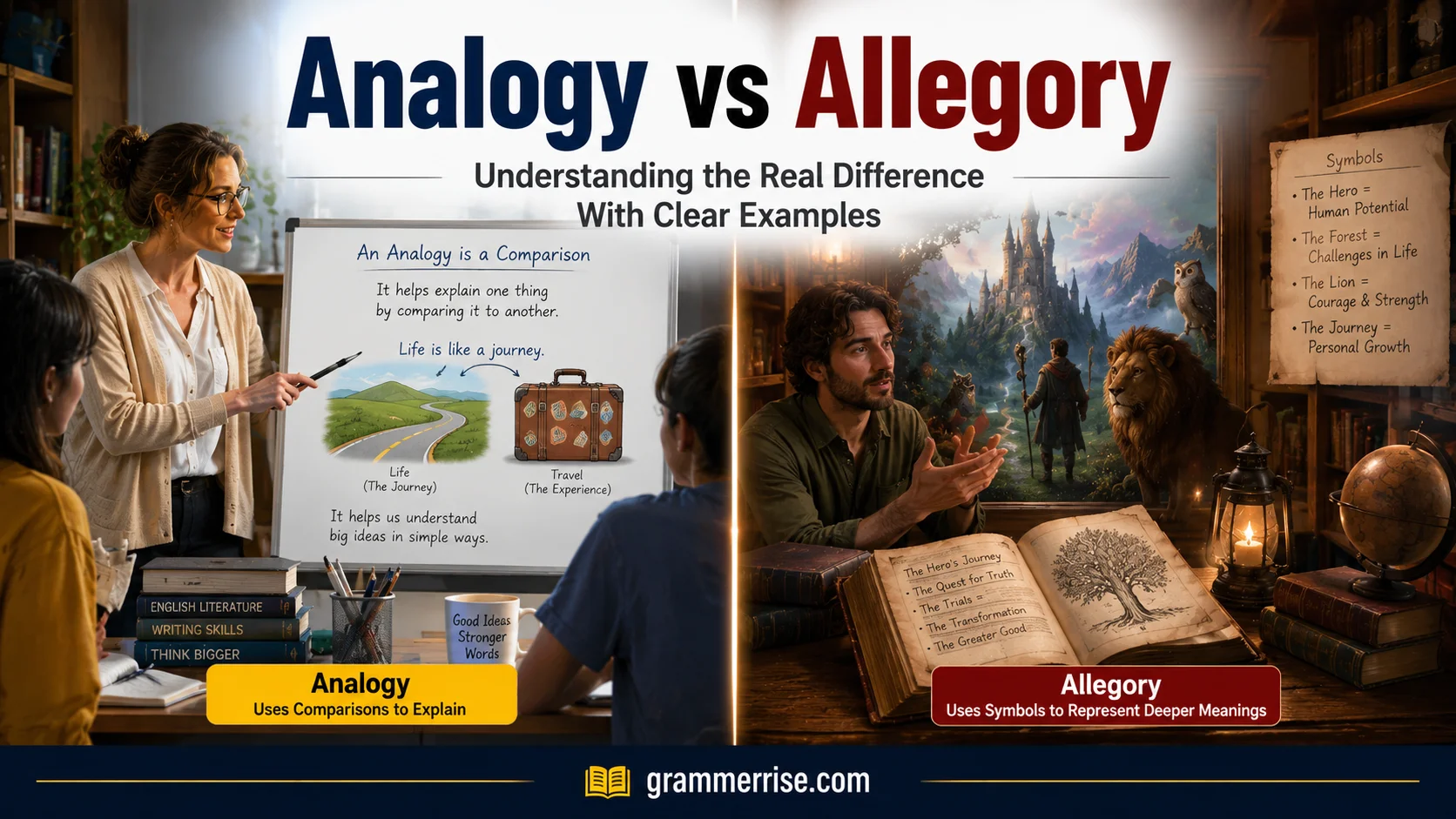
Analogy vs Allegory helps writers, students, and readers understand comparison, meaning, structure, and the different purposes of literary tools. Many professionals become confused because both seem similar at first glance, but they connect an idea to complex concepts in different ways. An analogy is a tool that compares familiar things to explain a difficult concept with a clear purpose and practical structure, while an allegory uses a story where characters, events, and settings symbolize a larger meaning, moral, or lesson. These literary terms help people understand how metaphor, symbolic representation, and figurative techniques add depth to writing and communication.
When I guide learners who want to improve their writing skills, I often see them search for ways to learn the difference through real-world examples, practice, and exercises. Analogies use illustrative examples to make abstract thought more practical and relatable, while allegories build narratives with symbolism, relationships, and conceptual association.
Both devices serve unique purposes and are not interchangeable. Understanding historical origins, definitions, structural differences, and key features helps communicators avoid common mistakes, create stronger essays, speeches, and discussions, while developing accurate analysis without confusion. Mastering these literary devices improves clarity, credibility, academic arguments, teaching, and persuasive storytelling, allowing readers to interpret texts with confidence and accuracy.
Quick Answer
An analogy is a comparison used to explain an idea by connecting it to something familiar. For example, saying “the brain is like a computer” helps people understand how the brain processes information.
An allegory is a story where characters, events, or objects represent deeper meanings, such as moral lessons, political ideas, or social issues. For example, Animal Farm uses farm animals to represent political systems and historical events.
In simple terms:
- Analogy = explains an idea through comparison.
- Allegory = teaches a message through a symbolic story.
What Is an Analogy?
An analogy is a comparison between two different things that helps explain, clarify, or illustrate an idea.
Instead of simply stating information, an analogy connects a new concept to something familiar. This makes complex ideas easier to understand.
For example:
“Learning to ride a bicycle is like learning a new language. At first, everything feels awkward, but practice gradually builds confidence.”
This comparison helps explain the learning process by connecting it to a familiar experience.
Why Writers and Speakers Use Analogies
Analogies make communication more effective because they bridge the gap between unfamiliar and familiar concepts.
People use analogies to:
- Simplify difficult ideas
- Teach complex subjects
- Strengthen arguments
- Improve understanding
- Make information memorable
- Increase audience engagement
Scientists, teachers, marketers, lawyers, and public speakers regularly rely on analogies because they help people visualize concepts quickly.
Key Characteristics of an Analogy
An analogy usually includes several important features:
| Characteristic | Description |
| Comparison | Connects two different ideas |
| Explanation | Clarifies a concept |
| Simplicity | Makes difficult topics easier |
| Flexibility | Can be short or extended |
| Educational Purpose | Focuses on understanding |
Unlike stories, analogies typically focus on explaining a specific point.
Common Types of Analogies
Literal Analogy
A literal analogy compares things with similar characteristics.
Example:
A puppy is to a dog as a kitten is to a cat.
Figurative Analogy
A figurative analogy compares unlike things for explanation.
Example:
The brain works like a computer.
Functional Analogy
This type compares objects that perform similar functions.
Example:
A heart pumps blood just as a water pump moves water.
Cause-and-Effect Analogy
This analogy compares relationships involving causes and outcomes.
Example:
Exercise strengthens muscles just as studying strengthens knowledge.
Proportional Analogy
Proportional analogies highlight relationships.
Example:
Bird is to sky as fish is to water.
Real-World Examples of Analogies
Analogies appear everywhere.
Science
Teachers often compare atoms to miniature solar systems.
Business
Managers describe a company as a machine where each department acts like a gear.
Technology
Cybersecurity experts compare firewalls to security guards protecting a building.
Sports
Coaches explain teamwork by comparing players to parts of an engine.
These comparisons help audiences understand unfamiliar concepts through familiar experiences.
Famous Analogy Examples
Martin Luther King Jr. frequently used analogies in speeches to make complex social issues more understandable.
Albert Einstein reportedly used simple comparisons when explaining scientific theories to non-scientists.
Strong analogies transform abstract concepts into relatable ideas.
What Is an Allegory?
An allegory is a story in which characters, events, settings, and actions symbolize deeper meanings.
Unlike an analogy, an allegory is not just a comparison. It is a complete narrative with hidden layers of significance.
Readers enjoy the surface story while also discovering a symbolic message beneath it.
Purpose of Allegory in Writing
Writers use allegory to explore:
- Morality
- Politics
- Religion
- Philosophy
- Human nature
- Social issues
Allegories allow authors to discuss difficult topics indirectly while creating engaging stories.
Core Characteristics of an Allegory
Several features distinguish allegories from ordinary narratives.
| Feature | Allegory |
| Narrative Structure | Yes |
| Symbolism | Extensive |
| Hidden Meaning | Central |
| Multiple Layers | Common |
| Educational Purpose | Often |
Every major element typically represents something beyond itself.
Types of Allegory
Moral Allegory
Teaches ethical lessons.
Example:
The Pilgrim’s Progress by John Bunyan.
Religious Allegory
Explores spiritual concepts.
Example:
Many medieval religious texts.
Political Allegory
Critiques governments and political systems.
Example:
Animal Farm.
Historical Allegory
Represents historical events symbolically.
Philosophical Allegory
Examines ideas about existence, knowledge, and truth.
Example:
Plato’s Allegory of the Cave.
Famous Allegory Examples in Literature
Animal Farm
Animal Farm
George Orwell’s classic novel uses farm animals to represent the Russian Revolution and the rise of Soviet authoritarianism.
The Pilgrim’s Progress
The Pilgrim’s Progress
The protagonist’s journey symbolizes spiritual growth and salvation.
The Chronicles of Narnia
The Chronicles of Narnia
Many readers interpret the series as containing Christian allegorical themes.
Plato’s Allegory of the Cave
The Republic
Perhaps the most famous philosophical allegory ever written.
Allegory Beyond Literature
Allegories appear in:
- Movies
- Paintings
- Video games
- Political cartoons
- Advertising campaigns
Many modern films use allegorical themes to discuss social issues, technology, and human behavior.
Analogy vs Allegory: The Core Difference
At first glance, analogies and allegories seem similar because both communicate deeper meanings.
However, their purposes differ dramatically.
Quick Comparison Table
| Feature | Analogy | Allegory |
| Primary Goal | Explain | Symbolize |
| Length | Usually short | Often lengthy |
| Structure | Comparison | Story |
| Characters | Not required | Usually required |
| Symbolism | Minimal | Extensive |
| Educational Function | Clarification | Interpretation |
The Simplest Way to Remember
A helpful memory trick:
Analogy explains. Allegory symbolizes.
If you’re looking at a comparison designed to clarify something, it’s likely an analogy.
If you’re reading a story where characters and events represent larger ideas, it’s likely an allegory.
Quick Example
Analogy:
Running a business is like steering a ship.
Allegory:
A story about a captain navigating dangerous waters where every storm represents economic challenges.
The first explains.
The second symbolizes.
Side-by-Side Examples of Analogy and Allegory
Learning a New Skill
Analogy
Learning guitar is like planting a tree. Growth takes time and patience.
The comparison directly explains the learning process.
Allegory
Imagine a story about a gardener tending a fragile sapling through years of storms.
The gardener represents perseverance.
The tree symbolizes personal growth.
The entire narrative conveys a deeper lesson.
Leadership Example
Analogy
A leader is like a lighthouse guiding ships through fog.
Allegory
A tale about a lighthouse keeper protecting sailors from hidden dangers.
The lighthouse symbolizes leadership.
The sailors represent society.
The fog symbolizes uncertainty.
How to Identify an Analogy
Spotting an analogy becomes easier when you know what to look for.
Ask yourself:
- Is one thing being compared to another?
- Does the comparison explain an idea?
- Is the purpose clarification?
Common Signals
Look for phrases such as:
- Like
- Similar to
- Just as
- Think of it as
- In the same way
These expressions often introduce analogies.
Example
Managing money is like maintaining a garden.
The purpose is explanation.
Therefore, it’s an analogy.
How to Identify an Allegory
Allegories require deeper interpretation.
Ask yourself:
- Does the story have a hidden meaning?
- Do characters represent abstract concepts?
- Is symbolism consistent throughout the narrative?
Signs of Allegory
- Repeated symbolic elements
- Moral lessons
- Political commentary
- Religious themes
- Multi-layered storytelling
Example
In Animal Farm, the animals symbolize political figures and social classes rather than functioning solely as fictional animals.
That symbolic framework makes the novel an allegory.
Analogy, Allegory, Metaphor, and Symbolism
Many readers confuse these literary devices.
Analogy vs Metaphor
| Feature | Analogy | Metaphor |
| Length | Longer | Shorter |
| Purpose | Explain | Compare |
| Detail | Expanded | Condensed |
Example metaphor:
Time is a thief.
Example analogy:
Time is like a thief because it gradually takes away opportunities.
Read more: Shiny vs Shiney: Meaning, Examples and Common Mistakes
Allegory vs Symbolism
A symbol is a single object representing an idea.
An allegory is an entire narrative built on symbolic meaning.
Allegory vs Parable
Parables are usually shorter and teach a direct lesson.
Allegories often contain multiple symbolic layers.
Allegory vs Fable
Fables commonly use animals and end with explicit morals.
Allegories may be more complex and open to interpretation.
When Should You Use an Analogy?
Analogies work best when explaining concepts.
Academic Writing
Teachers frequently use analogies to simplify difficult topics.
Example:
DNA functions like an instruction manual for the body.
Business Communication
Executives use analogies to explain strategies.
Example:
Market expansion is like opening new roads to reach more destinations.
Public Speaking
Great speakers rely on analogies because audiences remember comparisons.
Marketing
Brands often compare products to familiar experiences.
Tips for Creating Effective Analogies
- Use familiar examples
- Keep comparisons relevant
- Avoid forced connections
- Focus on clarity
- Match audience knowledge
When Should You Use an Allegory?
Allegories excel when exploring deeper themes.
Fiction Writing
Novelists use allegory to add layers of meaning.
Children’s Literature
Stories often contain symbolic lessons beneath entertaining narratives.
Political Commentary
Allegories help authors critique systems indirectly.
Social Criticism
Writers can address controversial topics through symbolism.
Tips for Writing a Strong Allegory
- Create consistent symbolism
- Avoid excessive complexity
- Develop meaningful characters
- Maintain narrative quality
- Ensure symbols support the theme
Common Mistakes Writers Make
Treating Every Comparison as an Analogy
Not all comparisons qualify as analogies.
Some are simple metaphors or similes.
Confusing Symbolism With Allegory
A story containing one symbol does not automatically become an allegory.
Creating Forced Analogies
Weak comparisons confuse readers instead of helping them.
Writing Obvious Allegories
Heavy-handed symbolism can feel artificial.
Subtlety often creates stronger allegories.
Ignoring the Audience
Both analogies and allegories should match the reader’s knowledge level.
Case Study: Why Animal Farm Remains a Classic Allegory
George Orwell’s Animal Farm offers one of history’s clearest examples of allegory.
Surface Story
Animals rebel against a farmer and establish their own government.
Hidden Meaning
The story mirrors:
- Russian Revolution events
- Soviet political leadership
- Totalitarian power structures
- Corruption of revolutionary ideals
Why It Works
The novel succeeds because readers can enjoy it as a simple story while uncovering deeper political commentary.
That dual purpose defines powerful allegorical writing.
“All animals are equal, but some animals are more equal than others.”
This famous line captures the novel’s critique of political hypocrisy.
Analogy vs Allegory in Education
Students frequently confuse these concepts because both involve meaning beyond the literal level.
Why the Confusion Happens
Both devices:
- Encourage critical thinking
- Go beyond surface meaning
- Use indirect communication
However, their structures differ significantly.
Quick Test Strategy
Ask:
Is it explaining or storytelling?
If it explains, it’s probably an analogy.
If it tells a symbolic story, it’s probably an allegory.
Classroom Example
Analogy:
The internet is like a giant library.
Allegory:
A story about travelers wandering through an endless city of knowledge where every street represents information.
One clarifies.
The other symbolizes.
FAQs
1. What is the main difference between analogy and allegory?
The main difference is their purpose and structure. An analogy compares two different things to explain an idea more clearly, often using a familiar example to simplify a complex concept. An allegory, on the other hand, tells a complete story where characters, events, and settings represent deeper meanings, moral lessons, or symbolic ideas.
2. Can an analogy and allegory be used in the same piece of writing?
Yes, writers can use both in the same work, but they serve different roles. An analogy usually appears as a direct comparison to explain a thought, while an allegory develops through an entire narrative. A story may contain analogies inside an allegorical structure to make certain ideas easier to understand.
3. Why do students often confuse analogy and allegory?
Students often confuse these terms because both involve comparison and deeper meaning. However, an analogy focuses on explaining similarities between two ideas, while an allegory uses symbolism throughout a story. Learning their definitions, structures, and examples helps students identify the correct term during reading and analysis.
4. What are some examples of analogy and allegory?
An example of an analogy is saying, “The human brain is like a computer because both process and store information.” An example of an allegory is a story where animals represent different types of people or social groups to communicate a hidden message or moral lesson.
5. How can understanding analogy vs allegory improve writing skills?
Understanding the difference helps writers choose the right technique for their purpose. Using analogies can make explanations clearer and more relatable, while using allegories can add symbolism, depth, and emotional impact to storytelling. This knowledge improves communication, creativity, and literary analysis skills.
6. Are analogies and allegories only used in literature?
No, they are used in many areas beyond literature. Analogies appear in education, science, business, and everyday conversations to explain difficult ideas. Allegories are common in books, movies, speeches, and art because they allow creators to share complex messages through symbolic stories.
Conclusion
Understanding Analogy vs Allegory becomes much easier when you recognize the purpose behind each literary device. An analogy focuses on comparison, helping readers understand unfamiliar ideas by connecting them with something familiar. An allegory goes deeper by using characters, events, and symbols to communicate hidden meanings, values, or lessons through a complete narrative.
Both techniques are powerful tools for writers, students, and communicators. Choosing the right one can make your explanations clearer, your stories more meaningful, and your arguments more effective. Whether you are analyzing a novel, preparing an essay, teaching a concept, or improving your writing skills, knowing the difference between analogy and allegory allows you to communicate with greater accuracy and confidence. Once you understand how each device works, you can use them creatively to express ideas in a stronger and more memorable way.