Offense or Offence is a common spelling question where English learners, students, bloggers, and writers ask which spelling fits their audience.
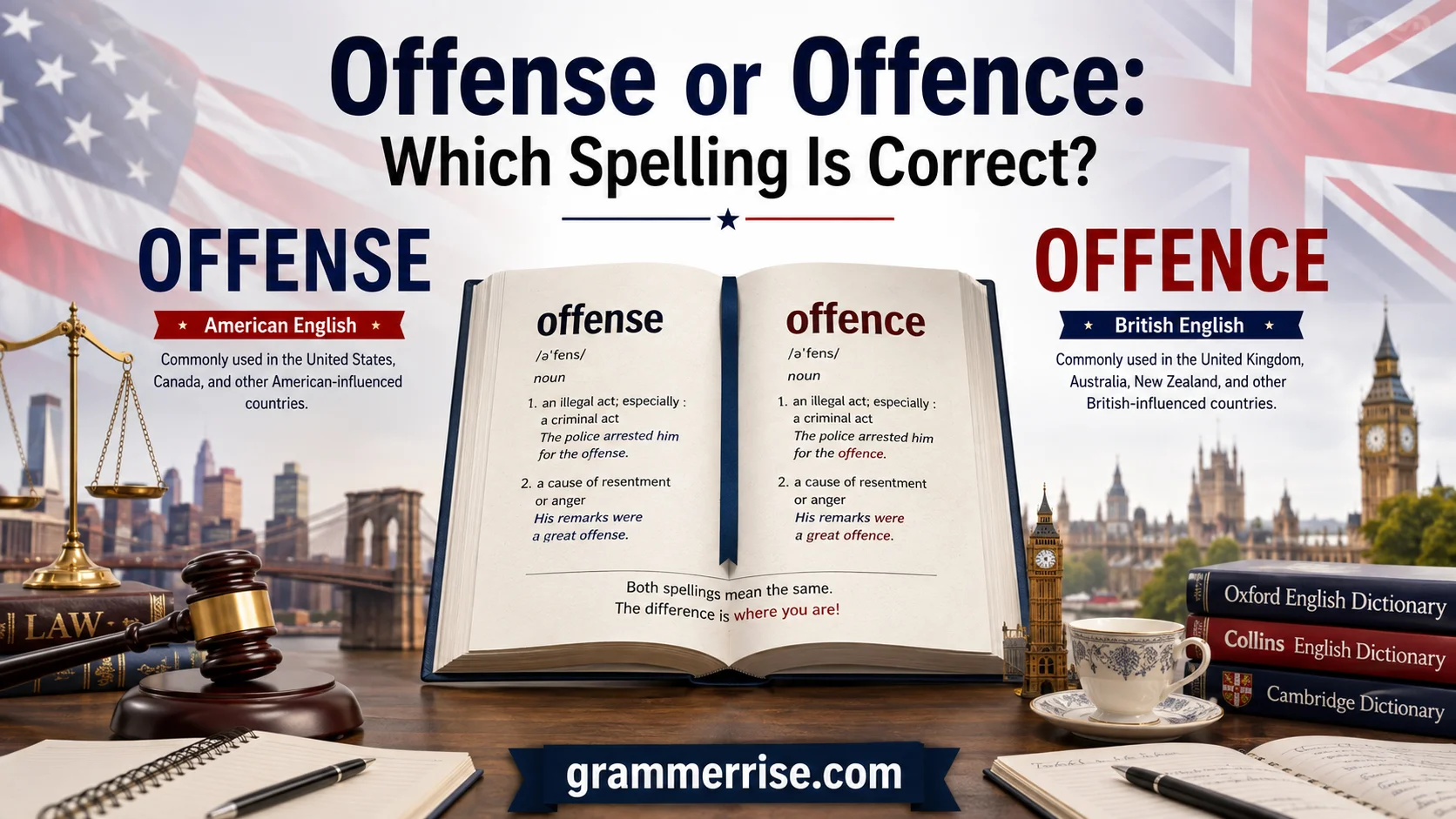
Many professionals also search for the correct form because both words look right and are used by native English speakers. The difference comes from the type of English you follow. Offense is the standard spelling in American English, while offence is preferred in British English and other countries using British spelling.
This language variation happens because spelling rules change by region, creating regional differences in books, news articles, online posts, articles, and posts. Understanding these differences improves writing accuracy, communication, and readability, helping readers avoid confusion and select the right spelling for their audience.
The meaning, pronunciation, and usage of both spellings remain the same word and are pronounced alike. This guide in simple English explains how to use each spelling with real-life examples and examples of correct usage. Both forms can describe an act that causes resentment, anger, or displeasure, including a violation of a moral code, law, or rule violation and a crime. In sports, offense means tactics used to make a score.
Quick Answer
Here’s the short version:
| Spelling | Region | Correct? |
| Offense | American English | ✅ Yes |
| Offence | British English | ✅ Yes |
| Offense | Common in the United States | ✅ Yes |
| Offence | Common in the UK, Australia, and New Zealand | ✅ Yes |
Key takeaway: The spelling changes depending on the type of English you’re using. The meaning remains exactly the same.
For example:
- American English: The driver committed a traffic offense.
- British English: The driver committed a traffic offence.
Both sentences communicate the same idea.
What Does Offense or Offence Mean?
The word offense or offence has several meanings depending on context.
In general, it refers to:
- A violation of a law or rule
- An act that causes hurt or insult
- An attack in sports
- A military operation against an opponent
Everyday Meaning
In daily conversation, the word often refers to behavior that upsets, insults, or offends someone.
Examples:
- No offense intended.
- She took offense at the comment.
- His joke caused offense among coworkers.
In these situations, the word relates to emotional reactions rather than legal issues.
Legal Meaning
In law, an offense is a violation of a legal rule.
Examples include:
- Traffic offenses
- Criminal offenses
- Tax offenses
- Cybercrime offenses
Courts use the term regularly when classifying unlawful behavior.
Sports Meaning
In sports, offense refers to the side attempting to score points.
Examples:
- Football offense
- Basketball offense
- Hockey offense
The offense attacks while the defense protects.
Military Meaning
Military planners use the term to describe operations designed to attack an enemy position.
Examples:
- Offensive campaigns
- Strategic offensives
- Counteroffensive operations
Although the spelling changes regionally, the meaning remains identical.
Understanding the Origins of Offense and Offence
The story behind these spellings stretches back hundreds of years.
The word originates from the Latin word offensa, meaning injury, attack, or wrongdoing.
Later, it passed through Old French before entering Middle English.
Like many English words, spelling wasn’t standardized during the early centuries of the language. Writers often spelled the same word several different ways.
How the Spellings Split
The distinction emerged more clearly during the late eighteenth and early nineteenth centuries.
British English retained many traditional spellings ending in -ce, including:
- Defence
- Offence
- Pretence
Meanwhile, American English gradually adopted simplified versions ending in -se:
- Defense
- Offense
- Pretense
This shift became popular largely because of the influence of American lexicographer Noah Webster.
Noah Webster’s Influence
Noah Webster believed American English should have its own identity.
His dictionaries promoted simplified spellings that were easier to learn and more consistent.
Examples include:
| British English | American English |
| Offence | Offense |
| Defence | Defense |
| Pretence | Pretense |
| Licence (noun) | License |
Many of Webster’s recommendations eventually became standard in the United States.
Offense vs Offence: Side-by-Side Comparison
The easiest way to understand the difference is through direct comparison.
| Feature | Offense | Offence |
| Meaning | Same | Same |
| Pronunciation | Same | Same |
| American English | Standard | Rare |
| British English | Less Common | Standard |
| Australian English | Less Common | Standard |
| New Zealand English | Less Common | Standard |
| Legal Usage | Same Meaning | Same Meaning |
| Sports Usage | Same Meaning | Same Meaning |
Notice something important.
The pronunciation never changes.
Whether you write offense or offence, people say the word the same way.
Offense in American English
In the United States, offense is the accepted spelling.
You’ll find it in:
- Government documents
- Newspapers
- Court records
- Academic papers
- Business communication
Examples of American Usage
- Criminal offense
- Federal offense
- First offense
- Repeat offense
- Serious offense
Major American dictionaries such as Merriam-Webster recognize offense as the standard spelling.
Example Sentences
- Speeding is considered a traffic offense.
- The defendant was charged with a federal offense.
- His remarks caused offense among audience members.
If you’re writing for an American audience, use offense consistently.
Offence in British English
In the United Kingdom, offence remains the standard form.
You’ll see it throughout:
- UK legislation
- British newspapers
- University publications
- Government websites
Common British Examples
- Criminal offence
- Driving offence
- Serious offence
- First offence
- Minor offence
Example Sentences
- The suspect committed a criminal offence.
- Using a mobile phone while driving is an offence.
- The remarks caused offence among attendees.
British dictionaries such as Oxford and Cambridge list offence as the preferred UK spelling.
Offense and Offence in Legal Writing
Legal professionals use the word constantly.
An offense or offence refers to conduct prohibited by law.
Types of Legal Offenses
Criminal Offenses
These involve violations of criminal law.
Examples:
- Theft
- Assault
- Fraud
- Burglary
Traffic Offenses
These involve road and driving regulations.
Examples:
- Speeding
- Reckless driving
- Running a red light
Regulatory Offenses
These involve violations of government regulations.
Examples:
- Tax violations
- Environmental breaches
- Licensing violations
Legal Terminology Comparison
| United States | United Kingdom |
| Criminal offense | Criminal offence |
| Federal offense | Criminal offence |
| First offense | First offence |
| Repeat offense | Repeat offence |
Why Consistency Matters
Legal documents require precision.
Mixing American and British spellings in the same legal document can appear careless and unprofessional.
A law firm serving American clients should generally use offense.
A law firm serving British clients should generally use offence.
Read more: Aluminum or Aluminium: Meaning, History and Usage Guide
Offense in Sports: Meaning and Usage
Sports fans encounter the word almost daily.
In athletics, offense refers to the team or players attempting to score.
Football
The offense controls the ball and advances toward the end zone.
Key offensive positions include:
- Quarterback
- Running back
- Wide receiver
- Tight end
Basketball
The offense attempts to create scoring opportunities through:
- Passing
- Shooting
- Fast breaks
- Pick-and-roll plays
Hockey
The offensive unit focuses on:
- Creating shots
- Maintaining possession
- Applying pressure
Sports Terminology
| Term | Meaning |
| Offense | Team trying to score |
| Defense | Team trying to stop scoring |
| Offensive play | Attack-focused strategy |
| Offensive player | Scoring-oriented athlete |
Sports commentators in the United States almost always use offense because American English dominates sports broadcasting there.
Common Expressions Using Offense or Offence
Several popular expressions include the word.
Take Offense
Meaning: To become upset or insulted.
Example:
She took offense at the criticism.
No Offense
Meaning: A phrase used before potentially sensitive comments.
Example:
No offense, but I think there’s a better solution.
Mean No Offense
Meaning: The speaker does not intend harm.
Example:
I meant no offense with my observation.
Give Offense
Meaning: To offend someone.
Example:
The advertisement gave offense to some viewers.
Cause Offense
Meaning: To upset or insult others.
Example:
Certain jokes may cause offense depending on the audience.
Common Mistakes People Make
Even experienced writers make errors when using offense and offence.
Assuming One Spelling Is Wrong
Many people think only one version is correct.
In reality, both spellings are accepted.
The correct choice depends on your audience.
Mixing Spellings
A common mistake occurs when writers switch between offense and offence in the same article.
For example:
❌ The criminal offense was serious. The offence carried a prison sentence.
Choose one spelling and use it consistently.
Ignoring Audience Expectations
Readers notice regional spelling differences.
An American audience expects offense.
A British audience expects offence.
Confusing Offense With Offensive
These words are related but not identical.
| Word | Function |
| Offense | Noun |
| Offence | Noun |
| Offensive | Adjective |
| Offend | Verb |
| Offender | Noun |
Examples:
- The comment was offensive.
- He intended to offend nobody.
- The offender received a fine.
Related Word Forms You Should Know
Understanding related words improves both writing and comprehension.
Offend
Verb meaning to insult or upset.
Example:
The statement offended several people.
Offensive
Adjective describing something insulting or attacking.
Example:
Many considered the joke offensive.
Offender
A person who commits an offense.
Example:
The offender received probation.
Offensively
Adverb describing offensive behavior.
Example:
The article was written offensively.
Word Family Table
| Word | Part of Speech | Example |
| Offense/Offence | Noun | Criminal offense |
| Offend | Verb | Don’t offend readers |
| Offensive | Adjective | Offensive language |
| Offender | Noun | Repeat offender |
| Offensively | Adverb | Spoke offensively |
Offense vs Offence vs Defense vs Defence
The spelling difference follows a larger pattern.
American English
- Offense
- Defense
- Pretense
British English
- Offence
- Defence
- Pretence
Easy Memory Trick
Think of American English as favoring -se endings.
Think of British English as favoring -ce endings.
Although there are exceptions throughout English, this pattern works for many common words.
How to Remember Which Spelling to Use
If you frequently switch between US and UK writing styles, these tips can help.
Know Your Audience
Ask yourself:
- Who will read this?
- Where are they located?
- Which style guide applies?
Use Regional Spell Check
Most writing programs allow language settings.
Choose:
- English (United States)
- English (United Kingdom)
- English (Australia)
This prevents unnecessary corrections.
Follow Publication Standards
Many organizations publish style guides.
Examples include:
- Associated Press (AP)
- Chicago Manual of Style
- Oxford Style Guide
Always follow the preferred spelling of the publication.
Why Spell Check Flags Offense or Offence
People often wonder why software marks one spelling as incorrect.
The answer usually involves language settings.
Common Causes
- US dictionary selected
- UK dictionary selected
- Browser language mismatch
- Mixed language settings
How to Fix It
- Open language settings.
- Select the appropriate English version.
- Recheck the document.
- Maintain consistency.
A simple setting adjustment often solves the issue.
Real-World Examples From Major Publications
Different publications consistently follow regional conventions.
American Publications
You’ll commonly see:
- Criminal offense
- Drug offense
- Federal offense
British Publications
You’ll commonly see:
- Criminal offence
- Driving offence
- Serious offence
Neither side considers the other spelling wrong.
They simply follow different language standards.
Case Study: An International Company Website
Imagine a company operating in both the United States and the United Kingdom.
The marketing team publishes one article using offense throughout.
British readers notice the American spelling immediately.
Now imagine the article uses offence instead.
American readers notice that too.
Many global organizations solve this challenge by:
- Creating regional versions of content
- Using separate language settings
- Following localized style guides
This small detail improves user trust and professionalism.
Dictionary Comparison: Offense vs Offence
| Dictionary | American Form | British Form |
| Merriam-Webster | Offense | Listed Variant |
| Oxford English Dictionary | Offense (US) | Offence (UK) |
| Cambridge Dictionary | Offense (US) | Offence (UK) |
| Collins Dictionary | Both | Both |
Major dictionaries agree on one important point:
Both spellings are correct.
Quick Reference Cheat Sheet
| Question | Answer |
| Is offense correct? | Yes |
| Is offence correct? | Yes |
| Same meaning? | Yes |
| Same pronunciation? | Yes |
| Used in America? | Offense |
| Used in Britain? | Offence |
| Used in legal writing? | Both |
| Used in sports? | Both |
| Should you mix them? | No |
FAQs
1. Is offense or offence the correct spelling?
Both offense and offence are correct spellings. The choice depends on the type of English being used. Offense is common in American English, while offence is preferred in British English and many countries that follow British spelling rules.
2. Do offense and offence have different meanings?
No, offense and offence have the same meaning. Both words can refer to a crime, a rule violation, an action that causes anger or displeasure, or something that hurts someone’s feelings. The difference is only in spelling, not meaning.
3. Why do Americans write offense instead of offence?
American English often uses different spelling patterns from British English. Over time, American spelling simplified certain words, which is why offense became the standard form in the United States.
4. How is offense used in sports?
In sports, offense refers to the team or players trying to score points. For example, a football team’s offense focuses on attacking strategies and creating opportunities to make a score.
5. Should writers use offense or offence in online content?
Writers should choose the spelling based on their target audience. If the readers are mainly from the United States, offense is usually the better choice. For British audiences, offence is more suitable.
6. Are offense and offence pronounced differently?
No, both offense and offence have the same pronunciation. Only the spelling changes depending on regional English preferences.
Conclusion
Understanding the difference between offense or offence makes writing easier and more accurate. Both spellings are correct, but the choice depends on whether you are using American English or British English. Offense is widely used in the United States, while offence is common in the UK and other regions that follow British spelling rules.
Knowing this small spelling difference helps students, writers, bloggers, and professionals communicate more clearly with their intended audience. Whether you are writing an article, creating online content, or completing an assignment, choosing the right form shows attention to detail. Once you understand the regional variation, you won’t need to second-guess whether to use offense or offence again.

Hussain Abid is an English language writer with over 10 years of experience in grammar, spelling, vocabulary, and writing. He specializes in creating clear, well-researched content that helps readers improve their English with confidence. At GrammarRise, Hussain writes practical guides, grammar explanations, and word comparison articles based on trusted language sources and real-world usage. His mission is to make English learning simple, accurate, and accessible for everyone