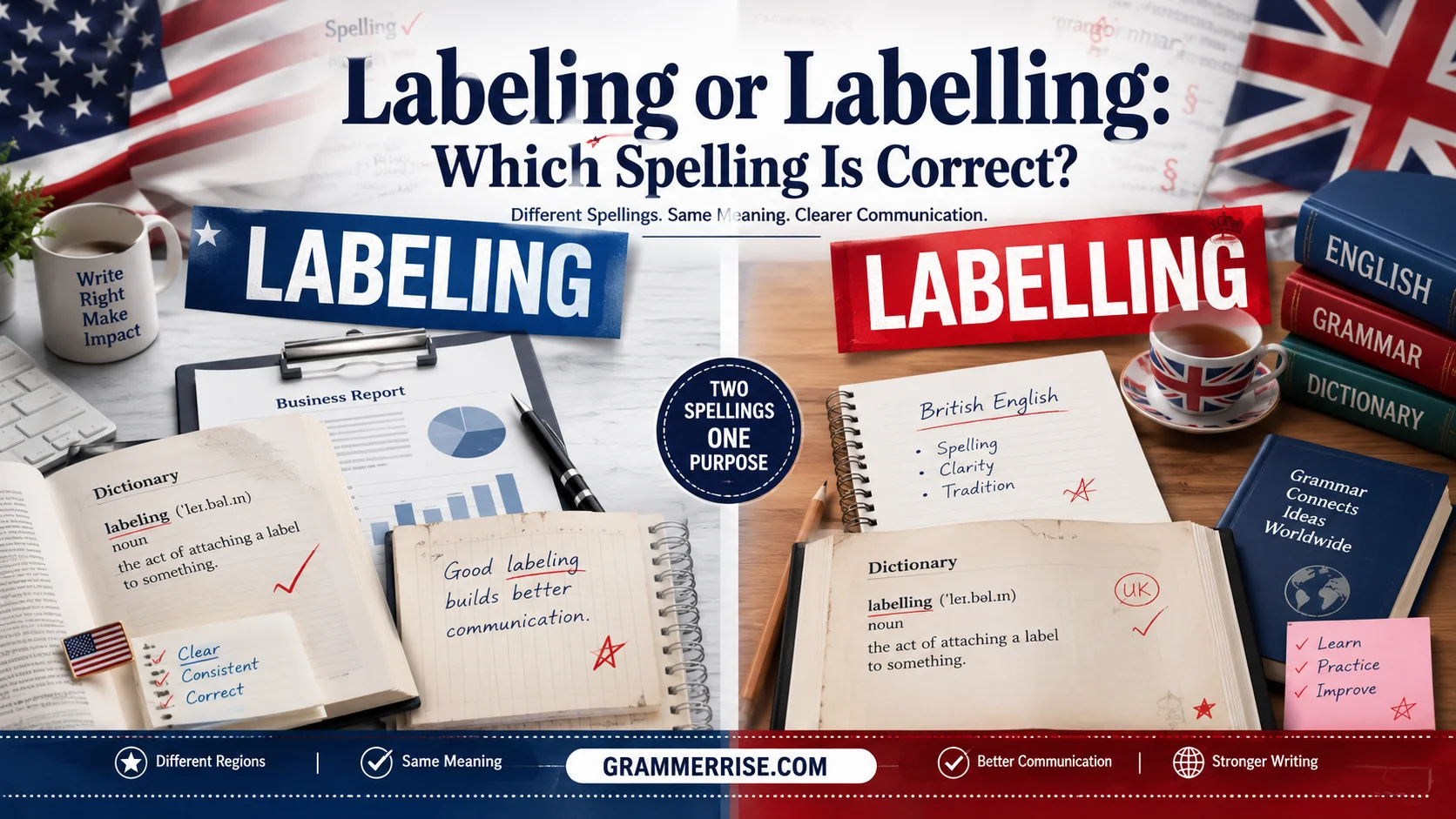
Labeling or Labelling helps writers understand spelling differences between American and British English and choose the right form for their audience.
Many English students, writers, teachers, designers, marketers, and professionals have paused or stopped while writing and wondered if they are alone in this common spelling question. Both spellings appear everywhere, including product packaging, academic work, emails, websites, and online articles. Many people search for the answer because both versions create confusion, especially when spellcheck tools, style guides, and different rules provide unclear direction. Global writers who publish for US and international audiences may hesitate because an extra L can affect their grammar skills and confidence.
The quick answer is that Labeling and labelling are the same word with the same meaning, grammatical uses, and pronunciation. The difference comes from regional spelling patterns, where Labeling is the standard form in American English and labelling is mainly used by British and UK readers. This spelling change also appears in past-tense, past-participle, and other forms of the verb label, including labeled and labelled.
Quick Answer
Both labeling and labelling are correct spellings. The difference depends on the type of English you’re using. Labeling is the standard spelling in American English, while labelling is preferred in British English, Australian English, and most other Commonwealth countries. They have the same meaning and pronunciation. To avoid mistakes, simply use the spelling that matches your audience and stay consistent throughout your writing.
Labeling or Labelling: What’s the Difference?
The difference between labeling and labelling is purely a matter of regional spelling conventions.
| Word | Preferred Region | Meaning |
| Labeling | American English | The act of attaching, naming, categorizing, or identifying something |
| Labelling | British English | The act of attaching, naming, categorizing, or identifying something |
Both words have identical meanings and pronunciation.
For example:
American English
- The company is labeling all new products.
- Teachers are labeling classroom materials.
British English
- The company is labelling all new products.
- Teachers are labelling classroom materials.
The action described remains the same. Only the spelling changes.
Which Spelling Is Correct?
A common misconception is that one spelling must be wrong. That isn’t true.
Both spellings are accepted by major dictionaries and language authorities.
Correct Usage by Region
| Region | Preferred Spelling |
| United States | Labeling |
| United Kingdom | Labelling |
| Australia | Labelling |
| New Zealand | Labelling |
| Ireland | Labelling |
| Canada | Usually Labelling |
If you’re writing for an American audience, use labeling.
If you’re writing for readers in the United Kingdom or most Commonwealth countries, use labelling.
The key is consistency. Avoid switching between the two spellings within the same document.
Why Does American English Use “Labeling” While British English Uses “Labelling”?
The answer lies in spelling conventions that developed over time.
British English often doubles the final l before adding suffixes such as:
- -ing
- -ed
- -er
As a result:
- label → labelling
- label → labelled
American English tends to simplify many spellings.
Therefore:
- label → labeling
- label → labeled
This difference isn’t unique to the word “label.”
Similar Examples
| American English | British English |
| Traveling | Travelling |
| Canceled | Cancelled |
| Modeling | Modelling |
| Counseling | Counselling |
| Fueled | Fuelled |
| Jewelry | Jewellery |
This pattern explains why both spellings exist today.
What Does Labeling Mean?
The word labeling refers to the act of attaching a label, assigning a name, classifying something, or identifying a person, object, concept, or category.
The term is widely used across many industries and fields.
Common Meanings of Labeling
- Naming something
- Organizing information
- Categorizing products
- Identifying items
- Classifying data
- Describing characteristics
Example Sentences
- The warehouse staff is labeling every shipment before delivery.
- Scientists are labeling research samples for testing.
- The teacher is labeling parts of the human body diagram.
- The software uses labeling to organize customer information.
Although the spelling changes between countries, the definition remains identical.
What Does Labelling Mean?
Labelling has the same meaning as labeling.
The only difference is spelling preference.
British English Examples
- The company is labelling products before export.
- Nurses are labelling medical specimens carefully.
- Researchers are labelling images for machine learning projects.
Whether you write labeling or labelling, readers will understand the same action.
How Labeling Is Used in Everyday Life
Most people use labeling every day without realizing it.
Product Packaging
Food products, cosmetics, medicines, and electronics all require labels.
Examples include:
- Ingredient lists
- Warning notices
- Expiration dates
- Brand names
- Usage instructions
Proper labeling helps consumers make informed decisions.
Office Organization
Businesses rely on labeling systems to manage:
- Files
- Folders
- Storage boxes
- Inventory
- Customer records
Without labels, information quickly becomes difficult to find.
Education
Teachers frequently use labeling to:
- Identify classroom supplies
- Mark diagrams
- Organize student work
- Improve learning materials
Students often label maps, charts, and scientific illustrations.
Healthcare
Accurate labeling is critical in healthcare.
Medical professionals label:
- Prescriptions
- Blood samples
- Laboratory specimens
- Patient records
A simple labeling error can create serious consequences.
Read more: Offense or Offence: Meaning, Differences, Usage and Examples
Labeling in Psychology and Sociology
One of the most interesting uses of the word appears in social sciences.
What Is Labeling Theory?
Labeling theory suggests that society’s labels can influence a person’s behavior and identity.
For example:
If a child is repeatedly labeled as “troublemaker,” they may begin to believe that description and act accordingly.
The concept became influential in sociology during the twentieth century.
Common Social Labels
- Gifted
- Athletic
- Introverted
- Extroverted
- Delinquent
- Successful
Researchers continue studying how labels shape human behavior.
Case Study
Imagine two students receiving the same grades.
One is labeled “high potential.”
The other is labeled “average.”
Teachers may unknowingly give more encouragement to the first student, leading to better long-term outcomes.
This example demonstrates the power of labeling beyond simple identification.
Labeling in Business and Marketing
Businesses invest heavily in labeling because labels directly affect customer decisions.
Why Labels Matter
Consumers often decide whether to purchase a product within seconds.
Labels communicate:
- Brand identity
- Product benefits
- Ingredients
- Safety information
- Pricing details
A clear label can increase trust and improve sales.
Essential Elements of Product Labels
| Element | Purpose |
| Brand Name | Builds recognition |
| Product Name | Identifies item |
| Ingredients | Provides transparency |
| Instructions | Explains usage |
| Warnings | Improves safety |
| Contact Information | Builds credibility |
Effective labeling combines compliance, clarity, and marketing.
Labeling in Technology and Artificial Intelligence
Modern technology relies heavily on labeling systems.
Data Labeling
Data labeling involves tagging information so machines can learn from it.
Examples include:
- Labeling images
- Labeling videos
- Labeling speech recordings
- Labeling customer feedback
Machine learning systems depend on labeled data to recognize patterns.
Example
If thousands of images are labeled “dog” and “cat,” an AI model can learn to distinguish between the two.
Without proper labeling, machine learning accuracy drops significantly.
Industries Using Data Labeling
- Healthcare
- Finance
- Retail
- Manufacturing
- Transportation
Data labeling has become a major part of modern AI development.
Labeling vs. Labelling Around the World
English spelling varies across regions.
Global Usage Comparison
| Country | Preferred Form |
| United States | Labeling |
| United Kingdom | Labelling |
| Canada | Labelling |
| Australia | Labelling |
| New Zealand | Labelling |
| South Africa | Labelling |
American publications almost always use labeling.
British and Commonwealth publications generally prefer labelling.
When Should You Use Labeling?
Choose labeling when writing for:
- American readers
- US businesses
- American universities
- US government agencies
- AP Style publications
Examples
- American product descriptions
- US marketing campaigns
- American news articles
- Academic papers following APA style
This spelling aligns with American conventions.
When Should You Use Labelling?
Choose labelling when writing for:
- British audiences
- UK companies
- Australian publications
- New Zealand organizations
- Commonwealth institutions
Examples
- British newspapers
- UK government documents
- Australian educational resources
- Commonwealth business reports
Using local spelling improves professionalism and credibility.
Labeling vs. Labelling in Major Style Guides
Professional writers often follow specific style guides.
Style Guide Comparison
| Style Guide | Preferred Spelling |
| AP Style | Labeling |
| APA Style | Labeling |
| MLA Style | Labeling |
| Chicago Manual of Style | Labeling |
| Oxford Style | Labelling |
| UK Government Style | Labelling |
The preferred spelling depends on the guide’s regional standards.
Common Mistakes People Make
Even experienced writers sometimes make mistakes.
Mixing Spellings
Incorrect:
- The company is labeling products and labelling packages.
Correct:
- The company is labeling products and labeling packages.
Or:
- The company is labelling products and labelling packages.
Choose one style and stay consistent.
Assuming One Version Is Wrong
Many people incorrectly believe British spelling mistakes American spelling or vice versa.
In reality, both forms are standard.
Ignoring Audience Expectations
Readers generally expect spelling conventions that match their region.
Using the wrong variant may appear inconsistent or unprofessional.
Labeling in Academic Writing
Academic writing requires consistency and accuracy.
Research Papers
Universities often require a specific style guide.
Examples:
- APA → labeling
- Chicago → labeling
- Oxford → labelling
Scientific Research
Scientists frequently use labeling when:
- Identifying samples
- Categorizing variables
- Marking research materials
Accurate labeling ensures reliable results and reproducibility.
Academic Example
A biology researcher may spend hours labeling hundreds of samples before beginning analysis.
One incorrect label can affect an entire study.
Frequently Used Forms of Label
The word “label” appears in several forms.
Word Family Table
| Form | American English | British English |
| Base Verb | Label | Label |
| Present Participle | Labeling | Labelling |
| Past Tense | Labeled | Labelled |
| Adjective | Labeled | Labelled |
| Noun | Label | Label |
Understanding the entire word family helps writers avoid mistakes.
Easy Trick to Remember the Difference
A simple memory trick can help.
Remember This Rule
One L for America. Two Ls for Britain.
Think of it this way:
- America prefers simpler spellings.
- Britain often doubles the final “l.”
Examples:
| US | UK |
| Labeling | Labelling |
| Traveling | Travelling |
| Canceled | Cancelled |
| Modeling | Modelling |
This shortcut works surprisingly well.
Real-World Examples of Labeling and Labelling
Everyday Life
- Parents are labeling school supplies.
- Stores are labeling shelves for customers.
Workplace
- Employees are labeling storage containers.
- Managers are labeling confidential files.
Education
- Students are labeling maps.
- Teachers are labeling diagrams.
Healthcare
- Nurses are labeling medicine bottles.
- Technicians are labeling test samples.
Technology
- Engineers are labeling training data.
- Developers are labeling software components.
The context changes, but the meaning remains consistent.
Labeling vs. Labelling: Side-by-Side Comparison
| Feature | Labeling | Labelling |
| Correct Spelling | Yes | Yes |
| Meaning | Same | Same |
| Pronunciation | Same | Same |
| American English | Preferred | Rare |
| British English | Less Common | Preferred |
| Formal Writing | Yes | Yes |
| Business Usage | Yes | Yes |
| Academic Usage | Yes | Yes |
The table makes the distinction easy to understand at a glance.
FAQs
1. Are labeling and labelling the same word?
Yes, labeling and labelling are the same word with the same meaning. The only difference is the spelling style used in different regions. American English uses labeling, while British English uses labelling.
2. Why do Americans write labeling instead of labelling?
American English spelling rules usually do not double the final consonant before adding endings like -ing. That is why Americans write labeling with one “L” instead of labelling.
3. Which spelling is correct: labeling or labelling?
Both spellings are correct. The right choice depends on the type of English you are using. Choose labeling for American English and labelling for British English.
4. Does labelling have a different pronunciation than labeling?
No, both words have the same pronunciation. The extra “L” in labelling does not change how the word sounds when spoken.
5. Should I use labeling or labelling in my writing?
You should choose the spelling that matches your readers or the English style you follow. The most important thing is to use one spelling consistently throughout your writing.
6. Are labeled and labelled also different spellings?
Yes, they follow the same regional pattern. Labeled is used in American English, while labelled is used in British English. Both forms are correct.
Conclusion
Choosing between labeling or labelling does not have to be confusing. Both spellings are correct, and the only real difference is the region where they are used. American English prefers labeling, while British English follows labelling.
The most important thing is to understand your audience and stay consistent with your chosen spelling style. Whether you are writing a blog, academic paper, product description, or professional document, using the correct regional form will make your content appear clear, polished, and reliable. Once you know the difference, you can confidently choose between labeling and labelling every time.

Hussain Abid is an English language writer with over 10 years of experience in grammar, spelling, vocabulary, and writing. He specializes in creating clear, well-researched content that helps readers improve their English with confidence. At GrammarRise, Hussain writes practical guides, grammar explanations, and word comparison articles based on trusted language sources and real-world usage. His mission is to make English learning simple, accurate, and accessible for everyone