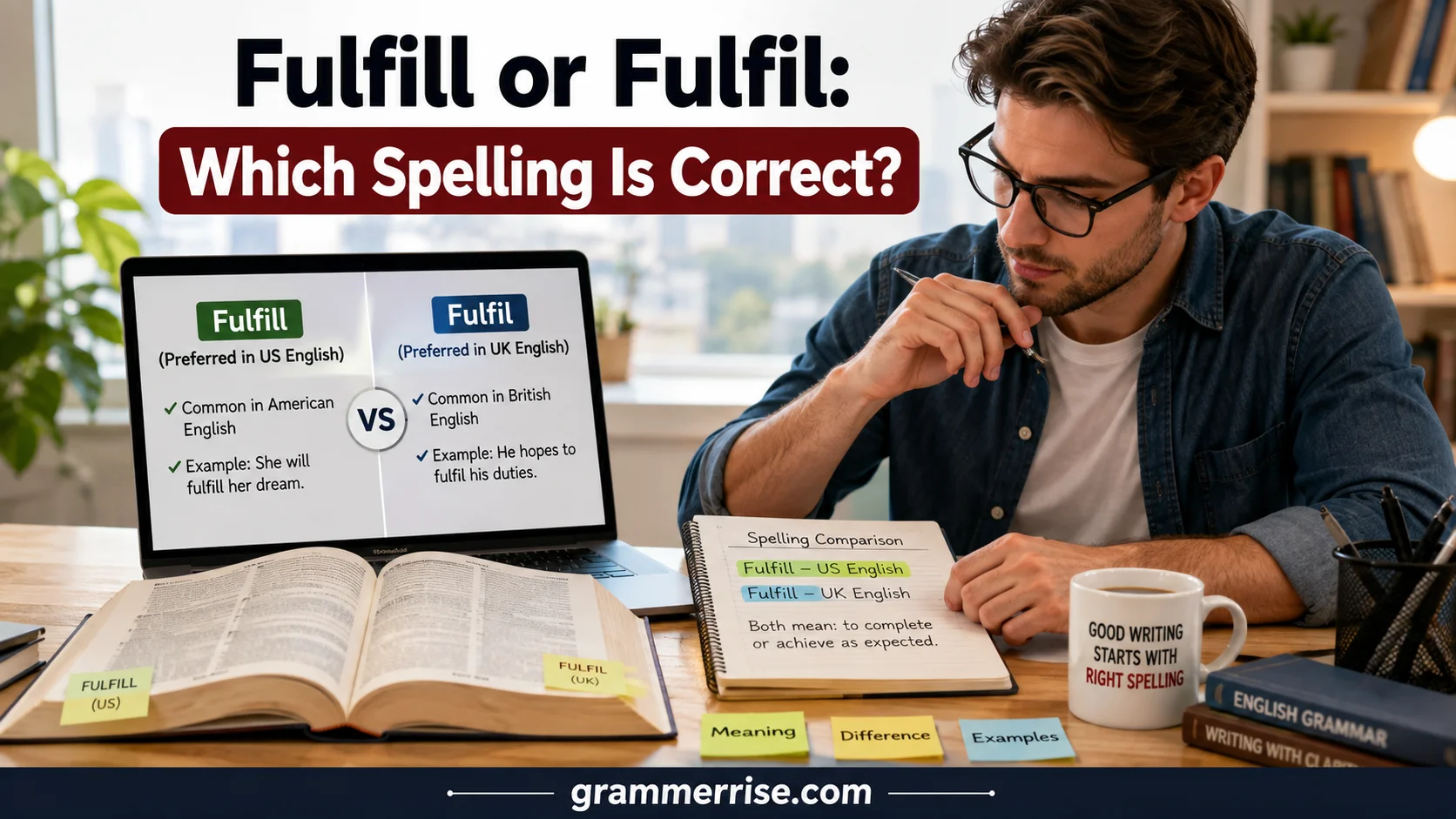
Fulfill or Fulfil is a common spelling confusion in the English language. Both forms share the same meaning, origin, and historical usage, but British English prefers Fulfil while American English uses Fulfill.
Many writers, students, bloggers, and professionals pause during email writing, blog writing, academic writing, or professional writing because they want the correct spelling for their audience, region, and context. From my personal experience, checking a dictionary, style guide, and credible guides helped improve understanding, language learning, and spelling accuracy.
For publishing content, business communication, and professional communication, the best recommendation is to make one choice and keep it throughout your writing style. Good examples, practical guidance, and usage rules show that both spellings are widely used, but matching the expected professional audience creates clear communication, stronger writing credibility, and better writing consistency. Paying attention to regional spelling, language rules, and word choice helps avoid mistakes, prevents inconsistent writing, and keeps your work polished, credible, authoritative, and suitable.
Quick Answer
The answer depends on your audience and the English style you follow.
| Spelling | English Style | Common Usage |
| Fulfill | American English | United States, US businesses, American publications |
| Fulfil | British English | United Kingdom, Australia, New Zealand, India, and many Commonwealth countries |
Both spellings have the same pronunciation and meaning.
Examples:
American English:
The company promised to fulfill all customer orders before the holiday season.
British English:
The company promised to fulfil all customer orders before the holiday season.
The important rule is consistency. If you start writing in American English, continue using American spelling throughout your content. The same applies to British English.
Mixing styles can make your writing feel uneven.
For example:
❌ The organisation wants to fulfill its mission.
✅ The organization wants to fulfill its mission.
The first sentence combines British spelling (organisation) with American spelling (fulfill). The second sentence follows American English consistently.
What Does Fulfill or Fulfil Mean?
The word fulfill or fulfil means to complete, achieve, satisfy, or carry out something successfully.
It comes from the idea of making something “full” or complete. When you fulfill something, you bring it to completion.
The word can appear in many situations, including personal goals, business responsibilities, promises, and requirements.
Meaning of Fulfill or Fulfil: To Complete Something
One common meaning is to complete a task, duty, or responsibility.
Examples:
- The company fulfilled the customer’s order within two days.
- She fulfilled all the requirements for the scholarship.
- The employee fulfilled his responsibilities during the project.
In these examples, the word shows that something expected was completed successfully.
Meaning of Fulfill or Fulfil: To Satisfy a Need
The word can also describe meeting an emotional, personal, or practical need.
Examples:
- Helping others fulfills her desire to make a difference.
- The new job fulfilled his need for creativity.
- Traveling around the world fulfilled her curiosity about different cultures.
Here, the word is not about finishing a physical task. Instead, it describes satisfaction.
Meaning of Fulfill or Fulfil: To Achieve a Dream or Goal
People often use this word when talking about ambitions.
Examples:
- He fulfilled his childhood dream of becoming an author.
- Winning the championship fulfilled years of hard work.
- She hopes to fulfill her goal of starting a successful business.
A dream becomes fulfilled when it becomes reality.
Fulfill vs Fulfil: The Main Spelling Difference
The only difference between fulfill and fulfil is the spelling of the letter L.
American English usually writes:
fulfill
British English usually writes:
fulfil
The pronunciation and meaning remain unchanged.
| Feature | Fulfill | Fulfil |
| Meaning | Same | Same |
| Pronunciation | Same | Same |
| Main Region | American English | British English |
| Extra Letter | Double “l” | Single “l” |
This spelling difference follows a broader pattern between American and British English.
For example:
| American English | British English |
| traveled | travelled |
| canceled | cancelled |
| labeled | labelled |
| fulfillment | fulfilment |
However, spelling rules can vary depending on the word. Not every English word follows the same pattern.
Why Does American English Use “Fulfill”?
American English often prefers a doubled consonant in certain words.
The spelling fulfill follows this pattern:
- fulfill
- fulfilled
- fulfilling
The extra “l” helps maintain the original pronunciation and appearance of the word.
Examples:
- She wants to fulfill her responsibilities.
- The company is fulfilling customer expectations.
- They fulfilled every promise they made.
American dictionaries, including major US style guides, recognize fulfill as the standard spelling.
Why Does British English Use “Fulfil”?
British English traditionally uses:
fulfil
The spelling removes one “l” in the base form.
Examples:
- The organization aims to fulfil its mission.
- He worked hard to fulfil his duties.
- They managed to fulfil the agreement.
However, British English usually doubles the “l” when adding endings:
- fulfil → fulfilled
- fulfil → fulfilling
This happens because the stress and pronunciation patterns require the consonant change.
Fulfill or Fulfil Pronunciation
Many people assume the pronunciation changes because the spelling changes. It does not.
Both words sound exactly the same.
Pronunciation: /fʊlˈfɪl/
You can think of it as:
Full + fill
The word has two parts:
- Full
- Fill
Whether you write fulfill or fulfil, the sound remains identical.
Examples:
- “I want to fulfill my purpose.”
- “I want to fulfil my purpose.”
Both sentences are pronounced the same way.
Fulfill or Fulfil Examples in Sentences
Seeing examples makes the difference easier to understand.
Examples Using Fulfill (American English)
- The company worked hard to fulfill customer expectations.
- She finally fulfilled her dream of opening a bakery.
- He promised to fulfill his responsibilities.
- The product fulfills an important need in the market.
- They fulfilled all legal requirements.
Examples Using Fulfil (British English)
- The student worked hard to fulfil the course requirements.
- The organization wants to fulfil its social responsibilities.
- She hopes to fulfil her ambition of becoming a writer.
- The team fulfilled its promise to supporters.
- The project aims to fulfil community needs.
The meaning remains unchanged. Only the spelling style changes.
Fulfill/Fulfil Verb Forms
Like most verbs, this word changes depending on tense and usage.
| Form | American English | British English |
| Base Form | fulfill | fulfil |
| Past Form | fulfilled | fulfilled |
| Present Participle | fulfilling | fulfilling |
| Noun Form | fulfillment | fulfilment |
Examples:
- Present: She wants to fulfill her dream.
- Past: She fulfilled her dream.
- Continuous: She is fulfilling her dream.
- Noun: The achievement brought personal fulfillment.
Fulfillment or Fulfilment: Which One Is Correct?
The noun form follows the same spelling difference.
American English:
fulfillment
British English:
fulfilment
Both mean the feeling or result of achieving something.
Examples:
American:
Personal fulfillment often comes from meaningful work.
British:
Personal fulfilment often comes from meaningful work.
Common uses include:
- personal fulfillment
- career fulfillment
- customer fulfillment
- emotional fulfillment
Businesses also use the term order fulfillment to describe the process of preparing and delivering customer orders.
Example:
The company improved its order fulfillment system to reduce delivery delays.
Common Mistakes With Fulfill and Fulfil
Even though the difference seems small, writers often make mistakes.
Mistake: Thinking One Spelling Is Wrong
A common misconception is that fulfil is incorrect because many people see fulfill more often online.
That is not true.
Both spellings are accepted. The correct choice depends on your English style.
Mistake: Mixing American and British Spellings
Consistency matters.
Incorrect combination:
- colour
- organise
- fulfill
Better options:
American English:
- color
- organize
- fulfill
British English:
- colour
- organise
- fulfil
Mistake: Using Fulfill When You Mean Finish
Although the meanings overlap, they are not always identical.
Compare:
Finish:
I finished my homework.
This means the task ended.
Fulfill:
I fulfilled my promise.
This means you completed something expected or meaningful.
The word fulfill often carries a deeper sense of responsibility, purpose, or satisfaction.
Fulfill or Fulfil: Which Spelling Should You Use?
Choosing the correct spelling depends on your readers.
Use Fulfill When Writing For:
- United States audiences
- American companies
- US customers
- American schools and universities
- US-based websites
Examples:
- fulfill a promise
- fulfill an order
- fulfillment center
Use Fulfil When Writing For:
- United Kingdom audiences
- British publications
- Commonwealth countries using British English
Examples:
- fulfil a responsibility
- fulfil a requirement
- fulfil an ambition
Countries that commonly use British spelling include:
- United Kingdom
- Australia
- New Zealand
- India
- South Africa
However, many organizations create their own style preferences. Always follow the required style guide.
Read more: Lying or Lieing: Meaning, Rules and Examples
Memory Trick to Remember Fulfill vs Fulfil
A simple trick can help:
Fulfill = American English = Full spelling with extra “l”
Think:
“America gives fulfill a full extra letter.”
Fulfil = British English
Think:
“British spelling often trims letters.”
This small reminder can prevent spelling mistakes.
Fulfill or Fulfil in Different Contexts
The word appears in many areas of everyday life.
Business Context
Companies often use the word when discussing responsibilities.
Examples:
- fulfill customer orders
- fulfil contracts
- fulfill business goals
A delivery company, for example, fulfills an order when it successfully prepares and delivers a customer’s purchase.
Personal Development Context
People often connect the word with happiness and purpose.
Examples:
- fulfill your potential
- fulfill your dreams
- fulfill your purpose
Many people believe success is not only about money. It is also about finding meaningful work and personal satisfaction.
Legal Context
Legal documents frequently use the word.
Examples:
- fulfill contractual obligations
- fulfil legal requirements
A company that signs an agreement must fulfill its responsibilities according to the contract.
Education Context
Schools and universities use the word for requirements.
Examples:
- fulfill graduation requirements
- fulfil academic criteria
Students often need to complete specific courses, credits, or exams before graduating.
Real-Life Examples of Fulfill and Fulfil
Understanding how people use these words in everyday situations makes the difference clearer.
Workplace Example
Imagine a company promises to deliver 5,000 products before a holiday sale.
If the company completes the task, you could say:
American English:
The company fulfilled its delivery promise.
British English:
The company fulfilled its delivery promise.
Notice something interesting: the past tense is spelled the same in both styles.
The difference mainly appears in the base form:
- fulfill
- fulfil
Personal Goal Example
Someone dreams of becoming a professional musician.
After years of practice, they achieve that goal.
You could say:
She fulfilled her lifelong dream of becoming a musician.
The word shows that a long-term goal became reality.
Customer Service Example
Businesses often focus on fulfilling customer needs.
Examples:
- A restaurant fulfills a special dietary request.
- A store fulfills an online order.
- A service provider fulfills customer expectations.
The word suggests more than simply completing a task. It often shows that a promise or expectation was successfully met.
Fulfill or Fulfil: Related Words and Alternatives
Sometimes another word may fit better depending on the situation.
| Word | Meaning | Example |
| Complete | Finish something | I completed my assignment. |
| Achieve | Reach a goal | She achieved her dream. |
| Accomplish | Successfully finish something difficult | He accomplished a major task. |
| Satisfy | Meet a need or condition | The product satisfied customer needs. |
| Perform | Carry out an action | The employee performed his duties. |
However, fulfill has a unique meaning because it often combines completion with satisfaction.
Compare:
Complete:
He completed the project.
This only means the project ended.
Fulfill:
He fulfilled his responsibility.
This suggests he completed something expected of him.
Why Correct Spelling Matters in Professional Writing
Small spelling choices can influence how readers view your work.
Imagine reading a company report filled with inconsistent spelling. Even if the information is accurate, the writing may feel less professional.
Correct spelling helps you:
- Build credibility
- Communicate clearly
- Match your audience
- Maintain a professional tone
For businesses operating internationally, choosing the correct spelling style becomes even more important.
A website targeting American customers should usually use:
- fulfillment
- organization
- customer service
A website targeting British customers may prefer:
- fulfilment
- organisation
- customer service
The goal is not to choose one “better” spelling. The goal is to choose the spelling that fits your readers.
FAQs
1. Is Fulfill or Fulfil the correct spelling?
Both are correct. Fulfill is the standard spelling in American English, while Fulfil is preferred in British English.
2. Why are there two spellings of the same word?
The difference comes from regional spelling conventions. English developed differently in the United States and the United Kingdom, creating spelling variations like Fulfill and Fulfil.
3. Do Fulfill and Fulfil have different meanings?
No. Both words have the same meaning: to complete, achieve, carry out, or satisfy a requirement, goal, or promise.
4. Which spelling should I use in professional writing?
Use the spelling that matches your audience. Choose Fulfill for American readers and Fulfil for British readers, then stay consistent throughout your document.
5. Will using the wrong regional spelling cause mistakes?
It usually won’t change the meaning, but it can make your writing look inconsistent and less polished, especially in academic or business content.
6. How can I remember which spelling to use?
A simple trick is to associate Fulfill with American English and Fulfil with British English. Checking your style guide or dictionary can also help maintain consistency.
Conclusion
Choosing between Fulfill or Fulfil is easier once you understand the regional difference. Both spellings are correct, carry the same meaning, and have been used for many years in English. The key is not deciding which one is “better,” but selecting the version that matches your audience and sticking with it throughout your writing.
Whether you are drafting an email, publishing a blog, preparing academic work, or creating professional content, consistency helps your writing appear clear, credible, and polished. When in doubt, follow the spelling style of your target readers, and you’ll communicate your message with confidence and accuracy.

Hussain Abid is an English language writer with over 10 years of experience in grammar, spelling, vocabulary, and writing. He specializes in creating clear, well-researched content that helps readers improve their English with confidence. At GrammarRise, Hussain writes practical guides, grammar explanations, and word comparison articles based on trusted language sources and real-world usage. His mission is to make English learning simple, accurate, and accessible for everyone