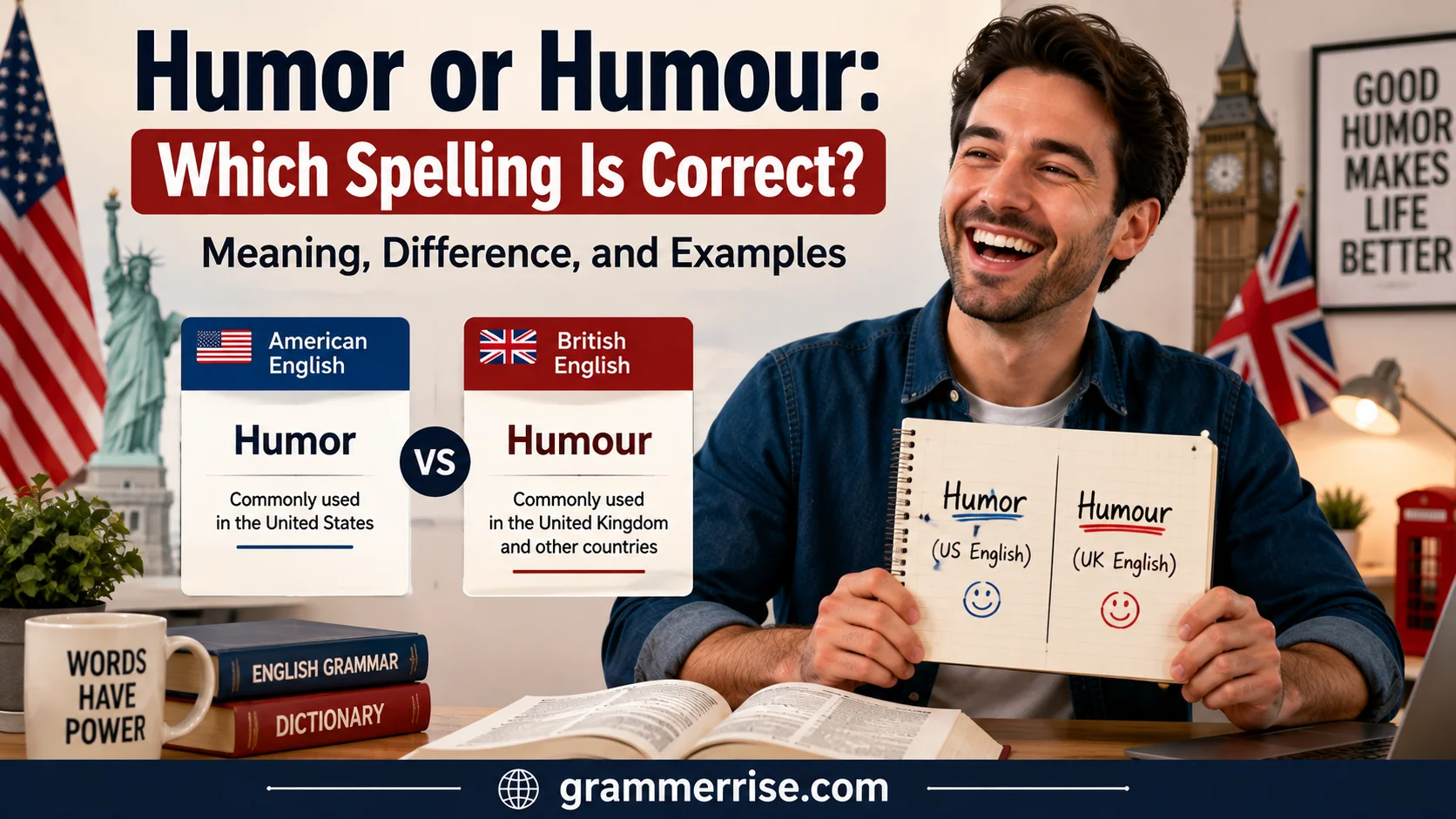
The guide explains Humor or Humour spelling choices as correct forms, showing how English regions create spellings in writing.
Have you ever stopped while typing a sentence and found yourself wondering about the correct spelling? This common question creates confusion among students, writers, bloggers, editors, and English learners because both spellings appear in books, websites, dictionaries, articles, and online content. The truth is that both versions have the same meaning and pronunciation, but the spelling choice depends on the type of English you use. American English follows the preferred spelling humor, while British English, Canadian English, Australian English, and Commonwealth countries commonly use humour.
The main reason people search for humor vs humour, which spelling is correct, American vs British spelling, and why does British English use humour is because English spelling differs across regions. This guide helps you discover, learn, and understand the history, origin of the word, meanings, spelling differences, and rules behind both forms. These two versions share the same idea of the quality of being funny, the ability to enjoy funny things, create laughter, entertainment, amusement, and comedy. As a verb, humor can also mean to indulge someone.
Quick Answer
Both “humor” and “humour” are correct spellings. The difference is based on English style:
- Humor ✅ — American English
- Humour ✅ — British English and many other countries
They have the same meaning: the ability to make people laugh or enjoy something funny.
Example:
- US: He has a great sense of humor.
- UK: He has a great sense of humour.
Choose the spelling that matches your audience and stay consistent.
Humor or Humour: Which Spelling Is Correct?
The simple answer is that both humor and humour are correct spellings.
The difference comes from regional variations in English.
| Spelling | Commonly Used In | Example |
| Humor | United States | The comedian’s humor attracts millions of fans. |
| Humour | United Kingdom, Canada, Australia, New Zealand, and many other regions | Her humour makes every conversation enjoyable. |
American English usually removes the extra “u” from words that originally came from French spelling patterns.
British English often keeps the traditional spelling.
This same pattern appears in many other words:
| American English | British English |
| Color | Colour |
| Favorite | Favourite |
| Honor | Honour |
| Labor | Labour |
| Behavior | Behaviour |
| Humor | Humour |
The spelling changes, but the meaning remains the same.
Think of it like two different roads leading to the same destination. The spelling looks different, but the message arrives at the same place.
Meaning of Humor or Humour
The word humor/humour describes the ability to recognize, create, or enjoy things that make people laugh.
It can refer to jokes, comedy, personality, writing style, or even a person’s attitude toward life.
Humor as the Ability to Make People Laugh
A person with a good sense of humor can make others feel relaxed and happy.
For example:
“Sarah always finds a funny side to difficult situations because she has a great sense of humor.”
Here, humor describes Sarah’s ability to create amusement.
Humor as a Form of Entertainment
Many types of entertainment use humor to connect with audiences.
Examples include:
- Comedy movies
- Stand-up performances
- Funny books
- Cartoons
- Memes
- Television shows
- Social media content
A funny scene in a movie uses humor to create an emotional reaction from viewers.
Humor as a Personality Trait
Sometimes humor describes someone’s overall personality.
A person may have:
- A playful sense of humor
- A sarcastic sense of humor
- A dark sense of humor
- A clever sense of humor
- A gentle sense of humor
For example:
“His dry humor makes ordinary conversations surprisingly funny.”
The History and Origin of Humor/Humour
The story behind the word humor is much older than modern comedy.
The word comes from the Latin term “umor,” which originally meant “moisture” or “fluid.”
Ancient doctors believed the human body contained four important fluids called humors:
- Blood
- Yellow bile
- Black bile
- Phlegm
According to ancient medical theories, these fluids influenced a person’s personality and emotions.
Someone with balanced humors was considered healthy and emotionally stable. Someone with an imbalance was believed to develop certain moods or behaviors.
Over time, the meaning changed.
The word moved from describing body fluids to describing:
- Mood
- Temperament
- Personality
- Emotional state
Eventually, it became connected with laughter and comedy.
Today, when people talk about humor, they usually mean something entertaining or funny rather than an ancient medical belief.
Why Does Humor Become Humour in British English?
The spelling difference between humor and humour comes from the history of English.
English borrowed many words from French after the Norman influence on England. French spelling often included combinations like -our.
British English kept many of these traditional spellings.
American English later changed several words to create simpler spelling patterns.
This spelling reform was strongly influenced by American dictionary writer Noah Webster, who wanted American English to have clearer and more practical spelling rules.
Examples include:
| Traditional/British Style | American Style |
| Colour | Color |
| Honour | Honor |
| Humour | Humor |
| Centre | Center |
| Theatre | Theater |
These changes were not about making one version correct and another incorrect. They simply created different spelling traditions.
Humor vs Humour: Main Differences Explained
Although the two words look different, they share the same meaning.
The differences are mainly related to spelling and geography.
Meaning Difference
There is no meaning difference.
Both words refer to:
- Comedy
- Amusement
- Fun
- Wit
- The ability to make people laugh
Example:
- “I love his humor.”
- “I love his humour.”
Both sentences communicate the same idea.
Spelling Difference
The only spelling difference is the missing or included letter “u.”
- Humor → American spelling
- Humour → British spelling
Regional Difference
Different countries prefer different versions.
| Region | Preferred Spelling |
| United States | Humor |
| United Kingdom | Humour |
| Canada | Humour |
| Australia | Humour |
| New Zealand | Humour |
However, some writers and organizations may choose a different style depending on their audience.
Examples of Humor and Humour in Sentences
Seeing the words in real sentences makes the difference easier to understand.
American English Examples Using Humor
- Her humor helped everyone feel comfortable during the meeting.
- The comedian uses clever humor instead of simple jokes.
- A little humor can make stressful situations easier.
- His sense of humor is one of his best qualities.
- The movie combines action with lighthearted humor.
British English Examples Using Humour
- Her sense of humour makes her popular among coworkers.
- The writer uses dark humour to explore serious topics.
- British comedy often includes subtle humour.
- His dry humour makes people laugh without obvious jokes.
- The novel contains a mixture of drama and humour.
The spelling changes, but the message does not.
Common Mistakes When Using Humor or Humour
Many people make mistakes because they assume one spelling must be wrong.
Here are common problems and how to avoid them.
Mixing American and British Spellings
One of the biggest mistakes is using both styles in the same piece of writing.
Incorrect example:
The movie had great humor, but the actor’s sense of humour was even better.
This sentence mixes two spelling systems.
Better:
The movie had great humor, but the actor’s sense of humor was even better.
Or:
The movie had great humour, but the actor’s sense of humour was even better.
Consistency creates professional-looking content.
Assuming Humor Is Always Correct
Some writers believe humor is the only correct spelling because it is common online.
That is not true.
If you write for a British audience, humour is often the better choice.
Assuming Humour Is More Formal
Some people think the extra “u” makes the word more professional.
It does not.
The spelling only shows the English style being used.
Using the Wrong Style for Your Audience
A US company publishing content for American customers should usually use American spelling.
A UK newspaper should usually follow British spelling.
The audience decides the preferred style.
Read more: Skull or Scull: Difference, Meaning and Correct Usage
Humor and Humour in Different Types of Writing
The spelling choice becomes especially important in professional writing.
Academic Writing
Students should follow the style required by their school, university, or instructor.
For example:
- American universities usually prefer American spelling.
- British universities usually prefer British spelling.
Consistency matters more than the specific choice.
Blogging and Online Content
Bloggers should consider their readers.
A website targeting American visitors should usually use:
- Humor
- Color
- Favorite
A website targeting British visitors should usually use:
- Humour
- Colour
- Favourite
Search engines understand both versions, but matching your audience improves readability.
Business Communication
Companies should maintain consistent spelling across:
- Websites
- Marketing materials
- Emails
- Product descriptions
- Reports
A brand using mixed spelling styles can appear less polished.
Creative Writing
Authors can choose either spelling depending on their target readers.
A novel written for Americans will likely use:
- Humor
A novel written for British readers will likely use:
- Humour
The key is consistency.
Humor vs Humour: Similar American and British Spelling Differences
The humor/humour difference belongs to a larger spelling pattern.
Here are other common examples:
| American English | British English |
| Color | Colour |
| Favorite | Favourite |
| Honor | Honour |
| Flavor | Flavour |
| Neighbor | Neighbour |
| Behavior | Behaviour |
| Humor | Humour |
These differences often appear in words ending with:
- -or
- -our
American English often uses the shorter version.
British English often keeps the older spelling.
How to Remember the Difference Between Humor and Humour
Remembering the difference does not need to be complicated.
Try these simple tricks:
Remember the Location
Humor = United States
Think:
“American spelling removes extra letters.”
Humour = British style
Think:
“British English keeps the traditional spelling.”
Use Similar Words
If you remember:
- Color vs Colour
Then you can remember:
- Humor vs Humour
They follow the same pattern.
Match Your Audience
Ask yourself:
“Who will read this?”
If your readers are mostly American, choose humor.
If your readers are mostly British, choose humour.
Real-Life Example: Choosing Between Humor and Humour
Imagine two websites publishing articles about comedy.
Website A: American Audience
The website targets readers in New York, California, and Texas.
The writer uses:
- Humor
- Color
- Favorite
This matches the audience.
Website B: British Audience
The website targets readers in London and Manchester.
The writer uses:
- Humour
- Colour
- Favourite
This feels natural to those readers.
Neither website is wrong. Both simply follow different spelling traditions.
FAQs
1. Is humor or humour the correct spelling?
Both humor and humour are correct spellings. The difference depends on the type of English being used. Humor is the standard spelling in American English, while humour is preferred in British English and many Commonwealth countries.
2. Why do Americans spell it humor instead of humour?
American English often removes certain extra letters from words compared to British English. Over time, humor became the accepted spelling style in the United States, while British English continued using humour.
3. Do humor and humour have different meanings?
No, both words have the same meaning. They describe the ability to make people laugh, enjoy funny situations, or understand something amusing. The only difference is the regional spelling.
4. Should I use humor or humour for my website content?
Choose the spelling based on your target audience. If your readers are mainly from the United States, use humor. For audiences in the UK, Canada, Australia, or Commonwealth regions, humour may be more suitable.
5. Is the pronunciation different between humor and humour?
No, both humor and humour are pronounced the same. The difference appears only in spelling and regional language preferences.
6. How can I remember the difference between humor and humour?
A simple trick is to connect humor with the United States and humour with British-style English. Remembering your audience and writing style will help you choose the correct version.
Conclusion
Understanding the difference between humor and humour is simple once you know that both words share the same meaning but follow different English spelling styles. Humor is commonly used in American English, while humour is preferred in British English and many Commonwealth regions. The choice depends on your audience, writing purpose, and the type of English you want to follow.
Whether you are creating content, writing professionally, studying English, or communicating online, using the correct spelling helps your writing feel clear and consistent. Instead of seeing these words as a confusing rule, think of them as two regional versions of the same idea bringing laughter, entertainment, and connection through language.