Were or Was can confuse students and writers because both forms describe the past, but the correct choice depends on the subject and context.
When I explain these forms to students, writers, ESL learners, and professionals, I start with the basic verb to be. It is an irregular verb, so its verb forms do not always follow one simple pattern. In the past tense, was works as the regular form for a singular subject, including the first person, first-person singular, and third person, as in “I was” and “he was.” Were is used with the second person, second-person singular, and plural subjects, including “you were,” “they were,” and “we were.” These past tense forms become easier to understand through verb conjugation, conjugation, and conjugation rules.
When you conjugate the verb, first check the subject of the sentence, sentence subject, and sentence structure. The main difference also depends on singular form, plural form, person, tense, point of view, and grammatical point of view. In my English grammar writing, I have found that checking the subject and context before choosing a correct form helps prevent the wrong form from making a sentence sound awkward.
The real challenge often comes from context, grammatical context, and certain situations, especially hypothetical situations, an imaginary situation, or wishful thinking instead of an actual situation or something that happened. Here, the grammatical mood may be the subjunctive mood, which affects normal usage. Expressions such as “if I were”, “if I was”, “If I was”, “If I were”, and “If I was/were a dog” can cause confusion because was and were are not always interchangeable. The terms if, wish, wishes, and as though often introduce a hypothetical idea. Whether you choose one depends on when the situation is real or imagined.
Quick Answer
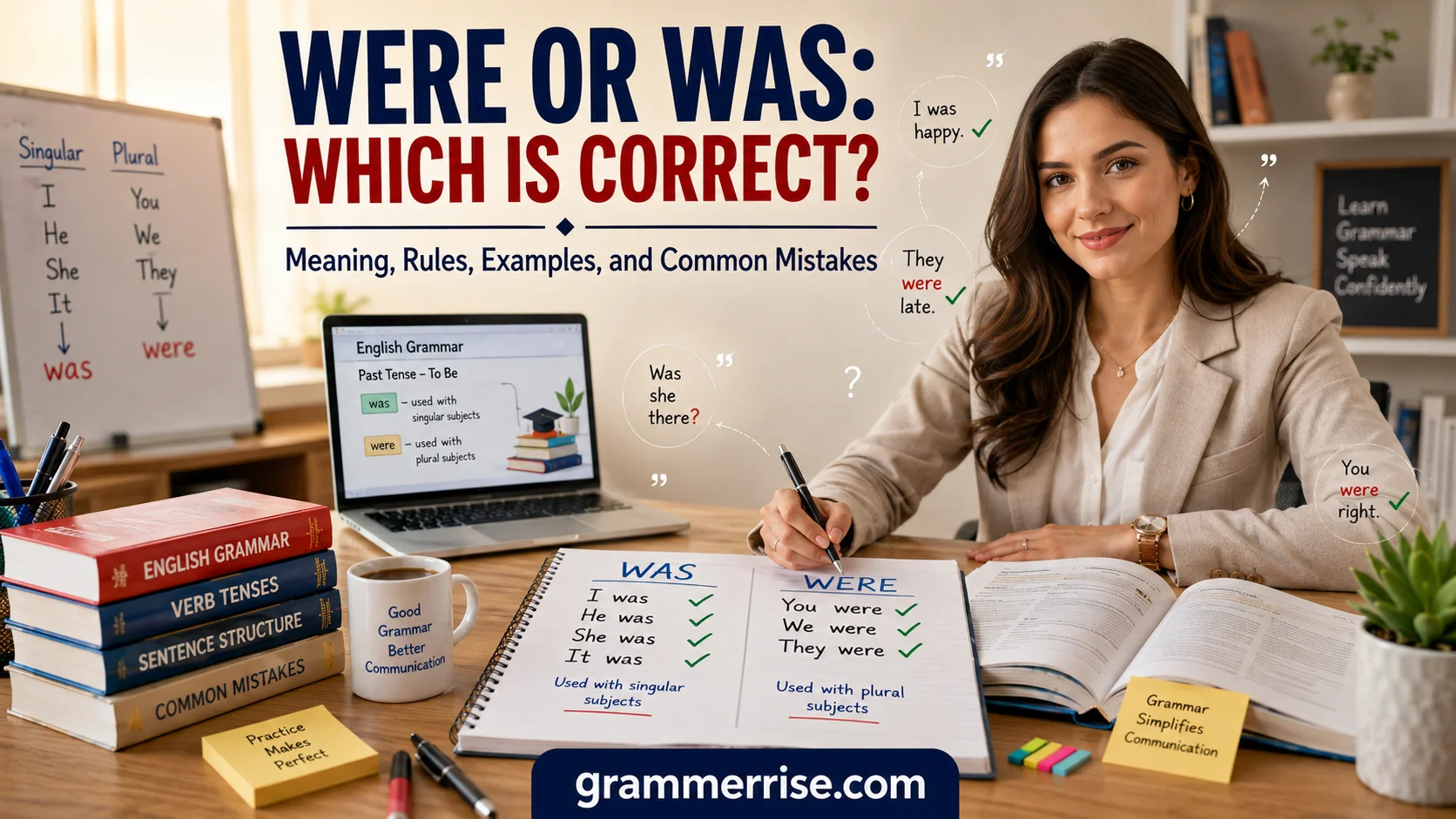
From everyday conversations and writing, one mistake appears again and again: people aren’t sure whether to use were or was. A simple trick is to look at the subject. Use was with singular subjects like I, he, she, and it, and use were with you, we, they, and plural nouns.
For example, you would say “I was tired after work” but “They were tired after work.” In my experience, the biggest source of confusion is phrases like “If I were you.” Even though I is singular, were is correct because the sentence describes an imaginary or hypothetical situation rather than a real event.
If you’re ever unsure, remember this: real past events usually use was with singular subjects, while were is used with plural subjects and hypothetical situations. That one rule will help you get it right most of the time.
What Is the Difference Between Were and Was?
At their core, was and were are both past-tense forms of the verb to be.
The main difference comes down to subject-verb agreement.
- Was is usually used with singular subjects.
- Were is usually used with plural subjects.
- Were is also used in certain hypothetical situations, even with singular subjects.
Quick Comparison Table
| Subject | Correct Form | Example |
| I | Was | I was tired yesterday. |
| He | Was | He was at work. |
| She | Was | She was happy. |
| It | Was | It was cold outside. |
| You | Were | You were right. |
| We | Were | We were excited. |
| They | Were | They were ready. |
Quick Example
Correct:
- I was hungry.
- She was late.
- We were busy.
- They were excited.
Incorrect:
- I were hungry.
- She were late.
- They was excited.
A simple way to remember the rule is that was usually goes with one person or thing, while were usually goes with more than one person or thing.
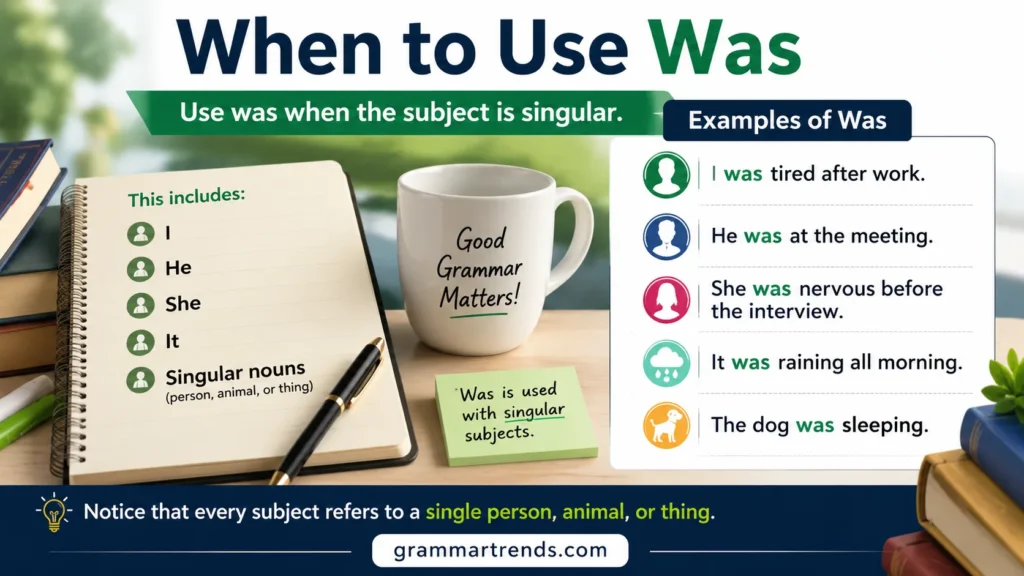
When to Use Was
Use was when the subject is singular.
This includes:
- I
- He
- She
- It
- Singular nouns
Examples of Was
- I was tired after work.
- He was at the meeting.
- She was nervous before the interview.
- It was raining all morning.
- The dog was sleeping.
Notice that every subject refers to a single person, animal, or thing.
Was in Positive Statements
Positive statements simply tell what happened.
Examples:
- I was excited about the trip.
- She was the best player on the team.
- The movie was interesting.
Was in Negative Statements
To make a sentence negative, add not.
Examples:
- I was not ready.
- She wasn’t feeling well.
- The package wasn’t delivered.
Was in Questions
Examples:
- Was he at home?
- Was she happy with the results?
- Was the restaurant open?
The structure is straightforward:
Was + subject + rest of sentence?
Real-Life Example
Imagine you’re telling a friend about yesterday:
“I was at the library. It was quiet. The weather was nice, and the staff was helpful.”
Each sentence refers to a real event that happened in the past, so was is the correct choice.
When to Use Were
Use were with plural subjects and the pronoun you.
Subjects That Use Were
- You
- We
- They
- Plural nouns
Examples
- You were correct.
- We were surprised.
- They were excited.
- The students were attentive.
Were in Positive Statements
Examples:
- We were ready for the challenge.
- They were waiting outside.
- The children were playing soccer.
Were in Negative Statements
Examples:
- We weren’t prepared.
- They weren’t interested.
- You weren’t late.
Were in Questions
Examples:
- Were you busy?
- Were they invited?
- Were the lights on?
Why “You Were” Is Always Correct
Many learners wonder why we say you were even when talking to one person.
Examples:
- You were very helpful.
- You were late today.
English uses the same form for both singular and plural you.
Whether you’re talking to one person or a group, were remains the correct choice.
The Special Rule: Why We Say “If I Were”
This is where many people get confused.
Consider these sentences:
- If I were rich, I’d travel the world.
- If I was rich, I’d travel the world.
Most grammar guides recommend the first sentence.
Why?
Because it uses the subjunctive mood.
What Is the Subjunctive Mood?
The subjunctive mood expresses:
- Wishes
- Hypothetical situations
- Imaginary conditions
- Things contrary to fact
Examples:
- If I were taller, I’d play basketball.
- If she were here, she’d help us.
- If he were president, things would change.
These situations are not real. They are imagined.
Because they’re hypothetical, English traditionally uses were instead of was.
Famous Examples
Many famous phrases follow this rule:
- If I were you…
- I wish I were there.
- As if it were magic.
- If she were my teacher…
These expressions sound natural because they follow standard grammar.
Is “If I Was” Ever Correct?
Yes.
When referring to something that may actually have happened, was can be correct.
Example:
- If I was rude yesterday, I apologize.
In this sentence, the speaker isn’t imagining something impossible. They’re referring to a real possibility.
That’s why was works here.
Quick Rule
| Situation | Correct Form |
| Real past event | Was |
| Imaginary situation | Were |
Examples:
- If I was late, I’m sorry.
- If I were late, what would happen?
The first refers to reality.
The second imagines a scenario.
Was vs. Were in Questions
Questions follow the same rules as statements.
Questions Using Was
Examples:
- Was he at school?
- Was she upset?
- Was the meeting canceled?
Questions Using Were
Examples:
- Were they happy?
- Were you listening?
- Were the guests invited?
Comparison Table
| Subject | Question Form |
| I | Was I? |
| He | Was he? |
| She | Was she? |
| It | Was it? |
| You | Were you? |
| We | Were we? |
| They | Were they? |
Learning these patterns helps improve both speaking and writing.
Was vs. Were in Negative Sentences
Negative sentences are common in everyday communication.
Using Wasn’t
Examples:
- I wasn’t tired.
- She wasn’t ready.
- It wasn’t expensive.
Using Weren’t
Examples:
- We weren’t prepared.
- They weren’t available.
- You weren’t wrong.
Quick Reference Table
| Positive | Negative |
| I was | I wasn’t |
| He was | He wasn’t |
| She was | She wasn’t |
| It was | It wasn’t |
| You were | You weren’t |
| We were | We weren’t |
| They were | They weren’t |
Contractions make writing sound more natural and conversational.
Common Mistakes People Make With Was and Were
Even fluent English speakers occasionally mix them up.
Let’s look at the most common errors.
Using Were With Singular Subjects
Incorrect:
- She were happy.
- He were tired.
Correct:
- She was happy.
- He was tired.
Using Was With Plural Subjects
Incorrect:
- They was excited.
- We was ready.
Correct:
- They were excited.
- We were ready.
Forgetting the Subjunctive Rule
Incorrect:
- If I was you, I’d leave.
Preferred:
- If I were you, I’d leave.
Mixing Singular and Plural Subjects
Incorrect:
- The students was waiting.
Correct:
- The students were waiting.
Incorrect vs. Correct Examples
| Incorrect | Correct |
| She were late. | She was late. |
| We was tired. | We were tired. |
| They was angry. | They were angry. |
| If I was you. | If I were you. |
| The team were winning.* | The team was winning.* |
*In American English, collective nouns often take singular verbs.
Was and Were in American vs. British English
Most rules remain the same in both versions of English.
However, collective nouns create a small difference.
American English
Americans often treat collective nouns as singular.
Examples:
- The team was winning.
- The government was planning reforms.
British English
British English may treat collective nouns as plural.
Examples:
- The team were winning.
- The government were discussing reforms.
Both forms are grammatically acceptable depending on the variety of English being used.
Read more: Cosy or Cozy: Meaning, Difference, Examples & Usage Guide
Was vs. Were in Everyday Conversation
Native speakers don’t always follow textbook grammar perfectly.
You might hear:
- If I was you…
- I wish I was there.
These phrases are common in casual speech.
However, formal writing usually prefers:
- If I were you…
- I wish I were there.
Professional Writing Tip
For essays, reports, academic papers, and business communication, using were in hypothetical situations is generally the safer choice.
Memory Tricks to Remember Was and Were
Grammar rules become easier when you have simple shortcuts.
Trick #1: One vs. Many
Think:
- One person or thing = was
- More than one = were
Examples:
- The cat was sleeping.
- The cats were sleeping.
Trick #2: The “You” Exception
Even one person uses were.
Example:
- You were right.
Trick #3: The Dream Test
Ask yourself:
“Is this real or imaginary?”
If it’s imaginary:
- If I were rich…
- If she were here…
Use were.
Trick #4: Replace the Subject
If you’re unsure, substitute the subject.
Example:
“The manager ___ busy.”
Replace with “he.”
“He was busy.”
Therefore:
“The manager was busy.”
Practice Exercises
Try these before checking the answers.
Fill in the Blank
- She ___ excited about the concert.
- They ___ waiting outside.
- If I ___ a millionaire, I’d buy a yacht.
- We ___ not informed.
- You ___ correct.
Choose the Correct Option
- The students (was/were) ready.
- If he (was/were) here, he’d help.
- I (was/were) tired yesterday.
- They (was/were) invited.
- She (was/were) late.
Rewrite Correctly
- They was happy.
- He were busy.
- If I was you, I’d apologize.
- We was excited.
- She were waiting.
Answers to Practice Exercises
Fill in the Blank
- was
- were
- were
- were
- were
Choose the Correct Option
- were
- were
- was
- were
- was
Rewrite Correctly
- They were happy.
- He was busy.
- If I were you, I’d apologize.
- We were excited.
- She was waiting.
Quick Summary Cheat Sheet
| Use Was | Use Were |
| I was | You were |
| He was | We were |
| She was | They were |
| It was | The students were |
| Singular noun | Plural noun |
| Real past events | Hypothetical situations |
One-Minute Rule
Remember these three points:
- Use was with singular subjects.
- Use were with plural subjects and you.
- Use were for hypothetical situations such as “If I were you.”
My Personal Experience as an English Specialist
As an English specialist, I’ve noticed that was and were can confuse even people who are otherwise comfortable with English. I remember seeing this mistake often in everyday writing, especially in sentences like “If I was you” and “They was happy.” The interesting part is that the basic rule is actually quite simple once you slow down and look at the subject. Over time, I’ve learned that checking whether the situation is real or hypothetical also makes a big difference. That’s why I always recommend focusing on the sentence’s meaning instead of trying to memorize too many complicated grammar rules. Once you understand that difference, choosing between was and were becomes much more natural.
FAQs
1. Should I Say “I Was” or “I Were”?
Use “I was” for a real past situation. Use “I were” mainly in hypothetical expressions such as “If I were you.”
2. Is “Were” Always Used With Plural Subjects?
No. Were is also used with singular you, as in “You were right.” It can also appear with singular subjects in the subjunctive mood.
3. Is “If I Was” Grammatically Wrong?
Not always. “If I was” can refer to a possible real event, while “If I were” usually describes an unreal or hypothetical situation.
4. Why Do People Confuse Was and Were?
The confusion happens because both are past forms of to be, but their use changes according to the subject and meaning.
5. Which Is Correct: “If He Was” or “If He Were”?
Both can be correct. “If he was” usually refers to a real possibility, while “If he were” commonly presents a hypothetical idea.
6. How Can I Quickly Remember Was vs. Were?
First check the subject, then ask whether the situation is real or hypothetical. This simple habit makes the correct choice much easier.
Conclusion
Learning was and were becomes much easier when you stop trying to memorize every sentence and start looking at the subject and meaning. Was usually fits singular subjects in the past, while were works with plural subjects, you, and many hypothetical expressions. From my experience with English writing, the biggest improvement comes from noticing the context before choosing a verb. If a sentence describes something real that happened, was may be the natural choice; if it expresses an unreal idea, wish, or condition, were is often the better option. With a little practice, these two forms stop feeling confusing, and your everyday writing becomes clearer, smoother, and more confident.

Hussain Abid is an English language writer with over 10 years of experience in grammar, spelling, vocabulary, and writing. He specializes in creating clear, well-researched content that helps readers improve their English with confidence. At GrammarRise, Hussain writes practical guides, grammar explanations, and word comparison articles based on trusted language sources and real-world usage. His mission is to make English learning simple, accurate, and accessible for everyone