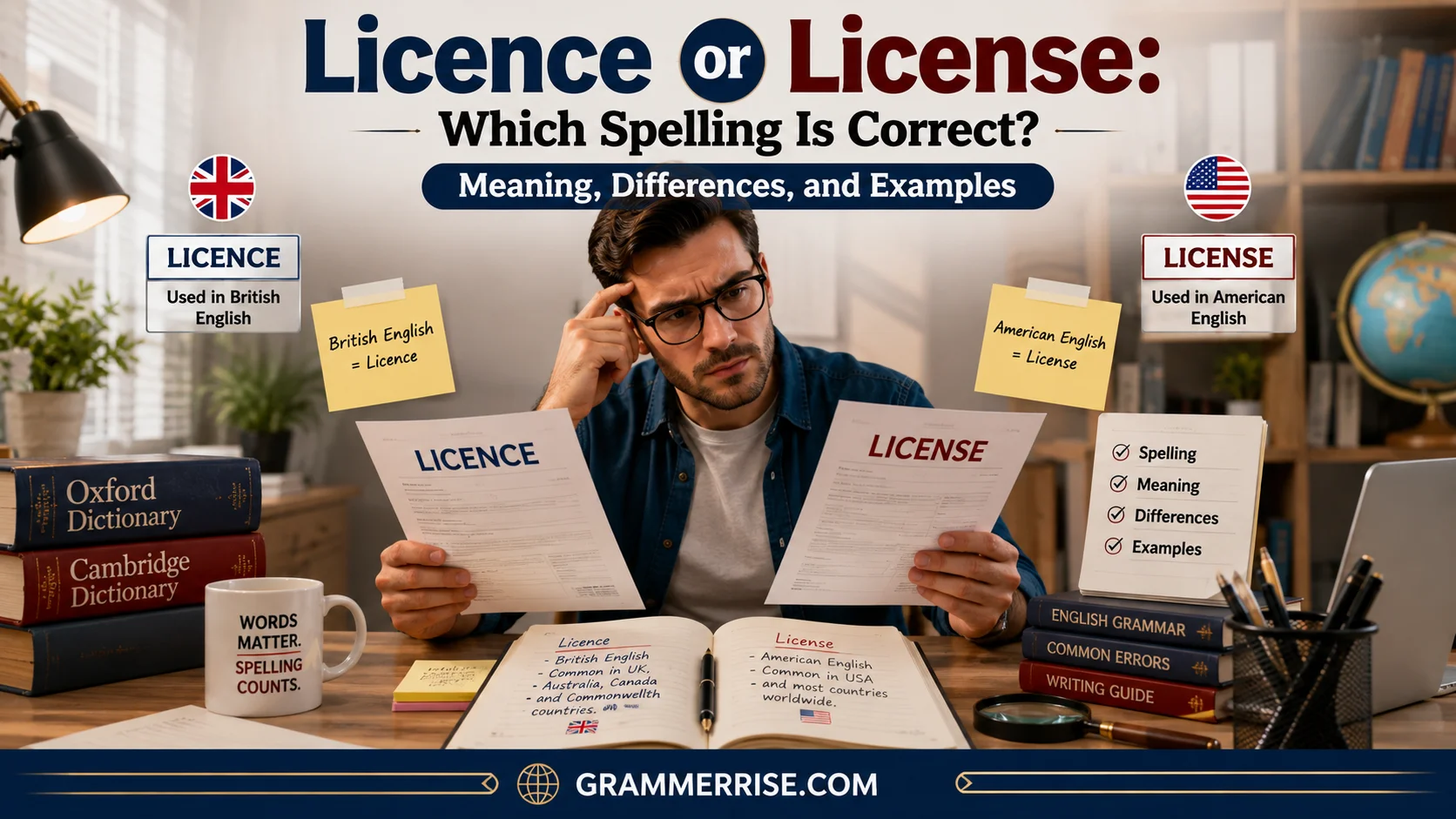
Licence or License explains why English learners confuse these terms, as British and American English follow spelling rules and usage in writing.
Many people struggle with the correct usage because both words appear similar, but their meaning changes depending on the variety of English. In British English, including Malaysia, licence is the noun for something you hold, while license is the verb related to the act of granting approval or permission. In American English, license is used as both the noun form and verb form. This spelling difference often causes common mistakes in legal documents, business communication, academic papers, and formal writing.
Understanding the difference becomes easier when you learn the origin, pronunciation, spelling rules, and definitions behind these terms. Many writers mix them up in emails, forms, WhatsApp messages, official documents, apps, contracts, and websites because they assume both versions are interchangeable. However, the context, region, and location matter when choosing the right word choice.
This guide clears up the licence and license confusion with real-world examples, usage tips, and simple tricks to remember the correct spelling. Whether you are a student, content writer, or professional communicating with international audiences, these regional differences can improve your writing skills, clarity, and credibility. Learning British vs American English conventions helps you avoid wrong spelling, writing mistakes, and errors that may appear careless or legally incorrect in professional settings.
Quick Answer
The short answer is:
Licence and license have the same basic meaning: official permission to do something. The difference comes from spelling conventions.
| Word | Usage | Common English Style | Example |
| Licence | Noun | British English | She renewed her driving licence. |
| License | Noun | American English | He renewed his driver’s license. |
| License | Verb | American and British English | The company will license the software. |
A simple rule can help:
- US English: Use license for everything.
- UK English: Use licence for a thing or document and license for an action.
Think of it like this:
A licence is the permission you hold.
To license means to give that permission.
What Does Licence Mean?
The word licence is mainly used as a noun in British English. It refers to an official document, approval, or permission granted by an authority.
A licence allows someone to legally do something that might otherwise require approval.
For example:
- A driver needs a driving licence to operate a vehicle.
- A restaurant needs a food licence to serve certain products.
- A business may need a trade licence to operate legally.
The word often appears in situations involving government rules, professional qualifications, and legal permissions.
Examples of Licence in Sentences
Here are some real-world examples:
- “She passed her driving test and received her driving licence.”
- “The restaurant renewed its food licence before reopening.”
- “The company applied for a broadcasting licence.”
- “You need a fishing licence before catching fish in this area.”
In each example, licence represents the permission or document itself.
What Does License Mean?
The word license has two major uses:
- As a noun meaning official permission.
- As a verb meaning to give permission or authorization.
American English uses license for both purposes.
British English also uses license as a verb.
License as a Noun
When used as a noun, license refers to permission, approval, or an official document.
Examples:
- “My professional license expires next year.”
- “The software license allows five users.”
- “The company received a business license.”
In American English, these are the standard forms.
License as a Verb
As a verb, license means to officially allow someone to use something or perform an activity.
Examples:
- “The company licensed its technology to another manufacturer.”
- “The artist licensed the song for a television advertisement.”
- “The government licenses medical professionals.”
The verb form stays the same in both American and British English.
Licence vs License: The Main Difference Explained
The biggest difference between licence and license depends on where you write and how you use the word.
British English Rule
British English makes a clear distinction:
| Function | Correct Spelling |
| Noun | Licence |
| Verb | License |
Examples:
- “I lost my driving licence.”
- “The government will license the company.”
The first sentence talks about a document. The second sentence describes an action.
American English Rule
American English simplifies the spelling:
| Function | Correct Spelling |
| Noun | License |
| Verb | License |
Examples:
- “I renewed my driver’s license.”
- “The state will license the business.”
American writers do not change the spelling between noun and verb forms.
Why Do Licence and License Have Different Spellings?
English spelling differences often develop because different countries adopt their own writing habits over time.
British English traditionally kept more spelling distinctions, while American English simplified many words during spelling reforms.
Similar differences appear in words like:
| British English | American English |
| Defence | Defense |
| Centre | Center |
| Colour | Color |
| Practise | Practice |
| Licence | License |
These differences do not mean one version is more correct. They simply reflect different language traditions.
A writer in London and a writer in New York may spell the same word differently while both following accepted rules.
Licence or License in British and American English
The spelling you choose should match your audience.
If you write for American readers, use license.
If you write for British readers, follow the noun and verb distinction.
| Country or Region | Common Usage |
| United States | License (noun and verb) |
| United Kingdom | Licence (noun), License (verb) |
| Australia | Licence (noun), License (verb) |
| New Zealand | Licence (noun), License (verb) |
| Canada | Licence (noun), License (verb) |
Example: Driving Licence vs Driver’s License
This is one of the most common differences.
British English:
“I need to renew my driving licence.”
American English:
“I need to renew my driver’s license.”
Both sentences are correct. The difference comes from regional spelling preferences.
Common Uses of Licence and License
The words appear in many industries and situations.
Driving Licence or Driver’s License
A driving licence/license proves that a person has permission to operate a vehicle.
Examples:
- “The officer checked his driver’s license.”
- “She applied for a new driving licence after moving.”
Driving documents usually include:
- Personal identification details
- Photograph
- Expiration date
- Vehicle categories allowed
Business Licence or Business License
Businesses often need official approval before operating.
Examples include:
- Restaurant licenses
- Construction licenses
- Professional licenses
- Retail licenses
A business license helps authorities confirm that a company follows required laws and regulations.
Read more: Modeling or Modelling: Which Is Correct Meaning?
Software Licence or Software License
Technology companies use licenses to control how people use software.
A software license may define:
- Number of users allowed
- Duration of access
- Permission to modify software
- Restrictions on copying or distribution
Examples:
- “The software license allows installation on three computers.”
- “The developer licensed the program to schools.”
Common Mistakes With Licence and License
Even experienced writers sometimes confuse these words. Here are the mistakes you should avoid.
Using Licence as a Verb
Incorrect:
“The company will licence the software.”
Correct:
“The company will license the software.”
The verb form is always license.
Mixing British and American Styles
Incorrect:
“The company renewed its business licence in the United States.”
Better:
“The company renewed its business license in the United States.”
The spelling should match your audience.
Assuming One Spelling Is Always Correct
Some people believe license is always correct because it is common online. Others believe licence is the only proper spelling because of British traditions.
Neither belief is accurate.
The correct spelling depends on:
- Location
- Audience
- Writing style
Licence or License in Professional Writing
Small spelling choices matter in professional communication.
Companies, universities, and organizations often follow specific style guides.
Using the correct spelling improves:
- Credibility
- Reader trust
- Brand consistency
- Professional appearance
For example, a UK-based company selling software may write:
“Software licence agreement”
An American company may write:
“Software license agreement”
Both are acceptable when used consistently.
How to Remember the Difference Between Licence and License
Remembering the rule becomes easier with a few tricks.
Memory Trick: C Means Certificate
For British English:
Licence = Certificate
A licence is something you possess.
Example:
- “I have a driving licence.”
Memory Trick: S Means Sending Permission
License = The action of giving permission
Example:
- “The company will license the product.”
Simple American English Rule
If you write American English:
Just use:
License
No extra thinking required.
Real-Life Examples of Licence and License
Example One: Vehicle Permission
British English:
“John forgot his driving licence at home.”
American English:
“John forgot his driver’s license at home.”
Example Two: Software
British English:
“Please read the software licence agreement.”
American English:
“Please read the software license agreement.”
Example Three: Business Authorization
British English:
“The shop received a trading licence.”
American English:
“The shop received a business license.”
Why Consistency Matters More Than Choosing One Style
Many writers focus too much on finding the “perfect” spelling. The bigger issue is consistency.
Imagine reading a website that uses:
- “driver’s license”
- “software licence”
- “business license”
The mixed spelling feels careless.
A professional writer chooses one style and follows it throughout the entire piece.
For example:
A US website should usually use:
- License
- Licensed
- Licensing
A UK website should usually use:
- Licence (noun)
- License (verb)
- Licensed
- Licensing
Consistency creates a smoother reading experience.
FAQs
1. Is licence or license the correct spelling?
Both licence and license are correct spellings, but the right choice depends on the type of English you use. In British English, licence is usually the noun, while license is used as a verb. In American English, license is used for both meanings.
2. What is the difference between licence and license in British English?
In British English, a licence refers to a document or permission you receive, such as a driving licence. License means the action of giving official permission or allowing something to happen.
3. Do Americans use licence or license?
Americans use license for both the noun and verb forms. For example, they write “driver’s license” and “the company will license the software.” The spelling licence is not commonly used in American English.
4. Is licence used in Malaysia?
Yes, Malaysia follows British English conventions, so licence is commonly used as the noun. For example, people write “driving licence” when referring to the official document they hold.
5. Can licence and license be used interchangeably?
They cannot always be used interchangeably. While the meaning is closely related, the spelling depends on the region and grammatical role. Using the wrong form may look incorrect in formal writing.
6. How can I remember the difference between licence and license?
A simple trick is to remember that in British English, the noun ending with -ce is the thing you have (licence), while the verb ending with -se is the action (license). In American English, use license for both.
Conclusion
Understanding the difference between licens or license becomes much easier once you know how regional English rules work. While both words share the same origin and meaning, their spelling changes depending on whether you follow British English or American English. In British usage, licence is the document or permission you hold, while license describes the act of giving permission. In American English, license is used for both forms.
This small spelling difference can make a big impact in professional writing, academic work, legal documents, and everyday communication. By paying attention to your audience, location, and writing style, you can choose the correct form with confidence. Whether you are writing an email, completing a form, creating online content, or preparing official documents, knowing when to use licence and license helps your writing look clear, accurate, and professional.