Omelet or Omelette creates confusion for many writers because both spellings look correct, especially when choosing words for recipes, menus, blogs.
When I started writing about food, I noticed that People often search for the difference because both spellings appear correct, but many native English speakers feel unsure about the right choice. A tiny word decision while typing a recipe, menu, blog, or post can create doubt when a red underline appears and makes the writer feel unprofessional for using the wrong version. The truth is that English is not a single system because different regions standardize spelling differently.
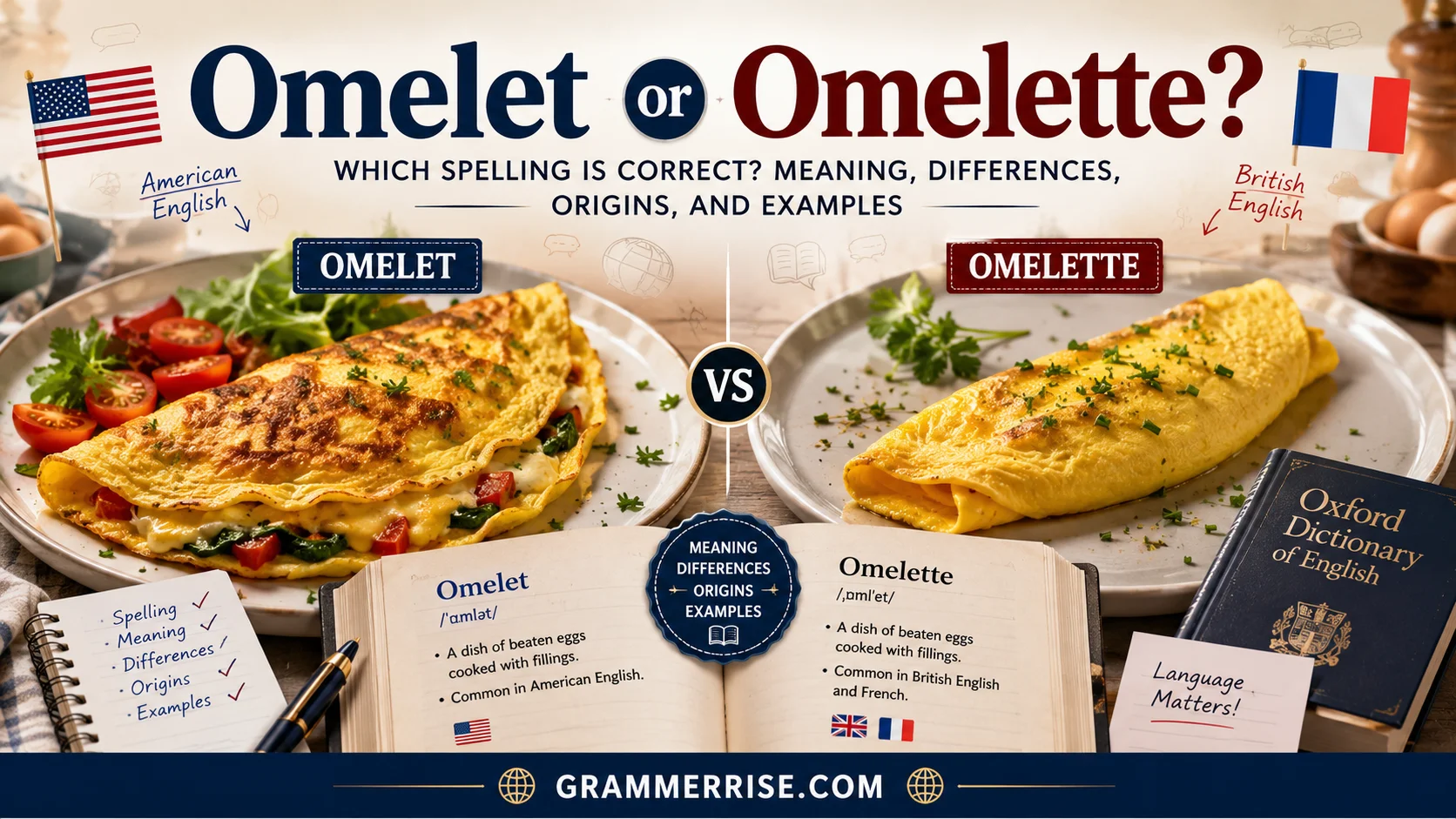
Many food words are borrowed from other languages, and this French influence creates a slightly messy situation with regional language standards and variation. The standard rule is that American English uses Omelet, which appears about twice as often in publications, while British English prefers Omelette. When choosing a spelling, always consider your audience, use the version they are familiar with, and stick to consistent writing.
The modern French spelling Omelette originated in France, and the word has changed through time with earlier versions such as amelette and alemette. The spelling used in the United States first appeared in the early seventeenth century, meaning it was not an American invention but a spelling adopted by Americans. The English-speaking world sometimes chose to stay true to French usage, which reveals the history, origin, evolution, vocabulary, and pronunciation of the term.
Quick Answer
Many people search online asking:
“Is omelet correct?”
“Is omelette the proper spelling?”
“Which spelling should I use?”
Here’s the simple answer.
| Word | Correct? | Common Region |
| Omelet | Yes | United States |
| Omelette | Yes | United Kingdom, Australia, France-influenced English |
Both spellings appear in major dictionaries and professional publications.
The choice depends primarily on your audience.
If you’re writing for American readers, omelet is usually preferred.
If you’re writing for British readers, omelette is generally expected.
What Is an Omelet or Omelette?
An omelet (or omelette) is a dish made by beating eggs and cooking them in a pan until they set. The eggs are often folded around fillings such as cheese, vegetables, herbs, seafood, or meat.
The dish is popular worldwide because it’s:
- Quick to prepare
- High in protein
- Easy to customize
- Suitable for breakfast, lunch, or dinner
- Found in countless culinary traditions
Basic Characteristics of an Omelet
An omelet typically includes:
| Feature | Description |
| Main Ingredient | Eggs |
| Cooking Method | Pan-cooked |
| Texture | Soft or firm |
| Shape | Folded or rolled |
| Fillings | Optional |
| Serving Time | Any meal |
Whether you write omelet or omelette, the dish itself doesn’t change.
Which Spelling Is More Common Today?
Although both versions are accepted, usage differs around the world.
Omelet in American English
In the United States, omelet dominates.
You’ll commonly find it in:
- Restaurant menus
- American cookbooks
- Food blogs
- Newspapers
- Cooking schools
American English often favors simplified spellings. That’s why words like:
- Color
- Honor
- Flavor
lost certain letters compared to British English forms.
The same simplification happened with omelet.
Omelette in British English
Across the United Kingdom, omelette remains the standard spelling.
British publications generally use:
- Omelette
- Colour
- Flavour
- Centre
This reflects a stronger preference for traditional spellings that remain closer to their historical roots.
Global Usage Trends
Many countries outside the United States prefer omelette, including:
- United Kingdom
- Australia
- New Zealand
- Ireland
- South Africa
Meanwhile, omelet remains dominant in:
- United States
- Many American publications distributed globally
Omelet vs. Omelette Comparison Table
| Feature | Omelet | Omelette |
| Meaning | Same dish | Same dish |
| Pronunciation | Same | Same |
| Correct Spelling | Yes | Yes |
| American English | Preferred | Accepted |
| British English | Less common | Preferred |
| French Influence | Reduced | Strong |
| Dictionary Recognition | Yes | Yes |
The Fascinating History of Omelet and Omelette
Language rarely stays still. Words evolve as cultures interact and languages borrow from one another.
The story of omelet and omelette stretches back centuries.
French Origins
Most language historians trace the word to French.
The modern French word is:
omelette
However, earlier forms existed before today’s spelling became standard.
Historical records show several spellings over time, including:
- Amelette
- Alemette
- Omelette
As French evolved, the modern version eventually became dominant.
Arrival in English
English speakers adopted the term as French cuisine gained prestige throughout Europe.
French cooking techniques heavily influenced:
- Fine dining
- Culinary schools
- Professional kitchens
As a result, many French food terms entered English.
Examples include:
- Soufflé
- Croissant
- Entrée
- Omelette
How Omelet Emerged
American English gradually simplified many imported spellings.
During the 18th and 19th centuries, publishers increasingly used omelet instead of omelette.
The simplified version matched broader trends in American spelling reform.
Timeline of Development
| Time Period | Development |
| Medieval France | Early word forms emerge |
| 1600s | Omelette becomes common in French |
| 1700s | English adopts the term |
| 1800s | Omelet gains popularity in America |
| Modern Day | Both spellings coexist |
Are Omelet and Omelette Pronounced Differently?
No.
This surprises many people.
Although the spellings differ, pronunciation remains essentially the same.
Common Pronunciation
/ˈɒm.lət/ or /ˈɑːm.lət/
In everyday speech, most people say:
“OM-let”
The extra letters in omelette do not create a different pronunciation.
Why the Pronunciation Stayed the Same
English often preserves pronunciation even when spellings change.
For example:
| Word Pair | Pronunciation Difference |
| Color / Colour | None |
| Theater / Theatre | None |
| Omelet / Omelette | None |
The spoken form remains consistent.
The spelling simply reflects regional writing preferences.
Why Do American and British English Use Different Spellings?
The answer lies in history.
As American English developed independently, spelling reformers pushed for simpler, more phonetic spellings.
One influential figure was Noah Webster, whose dictionaries helped standardize American English.
Webster favored simplified forms such as:
| American | British |
| Color | Colour |
| Honor | Honour |
| Catalog | Catalogue |
| Program | Programme |
| Omelet | Omelette |
These changes aimed to make spelling more straightforward.
British English largely retained traditional forms.
Neither approach is wrong.
They’re simply different conventions.
Read more: Authorized or Authorised: Which Is Correct Differences?
When Should You Use Omelet?
Choose omelet when writing for American audiences.
Ideal Situations
- American food blogs
- US restaurant menus
- American magazines
- US cookbooks
- Marketing aimed at Americans
Example Sentences
- I ordered a spinach and cheese omelet.
- The diner serves a classic Denver omelet.
- This fluffy omelet takes only ten minutes to prepare.
- Her mushroom omelet became the restaurant’s bestseller.
When Should You Use Omelette?
Choose omelette when writing for audiences that follow British English conventions.
Best Uses
- UK publications
- British food blogs
- Australian websites
- New Zealand audiences
- French-inspired menus
Example Sentences
- The café serves a French-style cheese omelette.
- She prepared a herb omelette for brunch.
- This classic omelette recipe uses fresh chives and butter.
- The chef perfected the traditional French omelette.
Culinary Branding
Many upscale restaurants use omelette because the spelling appears more French and sophisticated.
This doesn’t make the dish different. It simply influences perception.
Common Mistakes People Make
Believing One Spelling Is Wrong
This is the biggest misconception.
Both spellings are correct.
Major dictionaries recognize both forms.
Mixing Spellings in One Article
Consistency matters.
Avoid this:
Today’s omelet recipe is easy.
This omelette contains cheese.
Instead, choose one spelling and stick with it.
Ignoring Regional Expectations
Readers notice spelling choices.
A British audience may expect omelette.
An American audience may expect omelet.
Matching audience expectations improves credibility.
What Major Dictionaries Say
Leading dictionaries recognize both spellings.
Dictionary Comparison
| Dictionary | Omelet | Omelette |
| Merriam-Webster | Yes | Yes |
| Cambridge Dictionary | Yes | Yes |
| Collins Dictionary | Yes | Yes |
| Oxford English Dictionary | Yes | Yes |
| Dictionary.com | Yes | Yes |
This widespread acceptance confirms that neither spelling is incorrect.
Real-World Examples of Omelet and Omelette
Let’s look at how the terms appear in everyday writing.
Restaurant Menus
American menu:
Western Omelet
British menu:
Cheese and Herb Omelette
Cookbooks
American cookbooks often feature:
- Denver Omelet
- Ham Omelet
- Veggie Omelet
British cookbooks frequently include:
- French Omelette
- Cheese Omelette
- Mushroom Omelette
Food Journalism
Professional writers generally follow their publication’s style guide.
A US publication usually writes:
omelet
A UK publication usually writes:
omelette
Popular Types of Omelets Around the World
The dish itself appears in countless forms.
French Omelet
Characteristics:
- Soft center
- Minimal browning
- Smooth texture
Denver Omelet
Contains:
- Ham
- Onion
- Bell peppers
- Cheese
Spanish Tortilla
Although different from a classic omelet, it shares similarities.
Ingredients include:
- Eggs
- Potatoes
- Onions
Japanese Omurice
A unique variation featuring:
- Omelet
- Fried rice
- Ketchup-based sauce
Indian Masala Omelet
Popular ingredients:
- Green chilies
- Onions
- Tomatoes
- Fresh herbs
Omelet vs. Similar Egg Dishes
People often confuse omelets with other egg-based foods.
Comparison Table
| Dish | Folded | Fillings | Crust |
| Omelet | Yes | Often | No |
| Scrambled Eggs | No | Rarely | No |
| Frittata | No | Yes | No |
| Quiche | No | Yes | Yes |
| Spanish Tortilla | No | Yes | No |
Frittata
A frittata starts similarly but remains open-faced instead of folded.
Quiche
A quiche contains eggs baked inside a pastry crust.
Scrambled Eggs
Scrambled eggs remain broken into curds rather than forming a folded structure.
How Professional Writers Choose the Right Spelling
Professional editors typically follow three principles.
Follow Style Guides
Organizations maintain consistency through editorial standards.
Consider Audience
Audience expectations matter.
American readers often expect omelet.
British readers often expect omelette.
Stay Consistent
Consistency signals professionalism.
Choose one spelling and use it throughout the document.
Case Study: A Restaurant Menu Rebrand
A London café redesigned its menu to emphasize French-inspired cuisine.
Originally, the menu listed:
Cheese Omelet
After the rebrand:
Classic French Omelette
Customer surveys reported that diners perceived the dish as more authentic and upscale despite the recipe remaining unchanged.
This demonstrates how spelling can influence perception.
Fun Facts About Omelets and Omelettes
Ancient Roots
Egg dishes resembling omelets existed in ancient Persia long before modern spellings appeared.
World Record Omelet
Some of the world’s largest omelets have used tens of thousands of eggs.
International Popularity
Almost every major cuisine has its own version of an omelet.
Protein Powerhouse
A typical two-egg omelet provides approximately:
| Nutrient | Amount |
| Calories | 140–170 |
| Protein | 12–14g |
| Fat | 10–12g |
| Carbohydrates | Less than 2g |
Values vary based on ingredients.
Quick Memory Tricks
Need an easy way to remember?
Remembering Omelet
Think:
American English = Shorter Spelling
Omelet is shorter and simpler.
Remembering Omelette
Think:
French Style = Extra Letters
Omelette retains its French appearance.
FAQs
1. Is omelet and omelette the same thing?
Yes, omelet and omelette refer to the same dish made with beaten eggs cooked until firm, often filled with vegetables, cheese, meat, or herbs. The only difference is the spelling preference. Omelet is commonly used in American English, while omelette is preferred in British English.
2. Which spelling is correct: omelet or omelette?
Both spellings are correct. The right choice depends on your audience and the type of English you are using. If you are writing for American readers, omelet is usually the better option. For British readers, omelette is the more familiar spelling.
3. Why are there two spellings for omelet?
The two spellings exist because English developed different spelling standards in various regions. The word came from French, where omelette became the standard form. Over time, American English adopted the shorter spelling omelet.
4. Is omelet an American word?
No, omelet is not an American invention. Although Americans commonly use this spelling, the word has French origins. The American version developed as a spelling variation that became accepted in American English.
5. Should I use omelet or omelette in a recipe?
Use the spelling that matches your readers. For American cookbooks, websites, and recipes, omelet is usually preferred. For British publications or international audiences familiar with British English, omelette may be a better choice.
6. Does the spelling change the meaning of omelet or omelette?
No, the meaning does not change. Both words describe the same egg-based dish. The difference is only in spelling, pronunciation style, and regional language preference.
Conclusion
The difference between omelet or omelette may seem small, but it shows how interesting and flexible the English language can be. Both spellings are completely correct, and the choice mainly depends on regional spelling preferences. Omelet is the standard form used in American English, while omelette is more common in British English and keeps a closer connection to its French origin. Neither spelling changes the meaning, the recipe, or the way this popular egg dish is prepared.
Understanding these differences can help you write more confidently, whether you are creating a recipe, preparing a menu, publishing a blog post, or simply having a conversation about food. Language often changes as words move between countries, cultures, and generations, and omelet and omelette are a perfect example of that evolution. Instead of worrying about which spelling is “wrong,” focus on using the version that feels natural for your audience.
Once you know the background behind these two spellings, the confusion becomes much easier to solve. If you are writing for American readers, omelet is usually the best choice. If your audience follows British English, omelette will feel more familiar. The key is consistency, awareness, and understanding that both words have a valid place in the English language. Whether you enjoy a cheese-filled omelet, a classic French-style omelette, or simply want to improve your writing, knowing this difference helps you communicate clearly and confidently.