The term Infact or In Fact often confuses writers and English learners because the phrase sounds like one word when spoken quickly in everyday speech. Many people hesitate while typing because infact and in fact appear almost identical, creating confusion that leads them to combine the words while they write. This common mistake appears in emails, social media posts, school assignments, and professional documents.
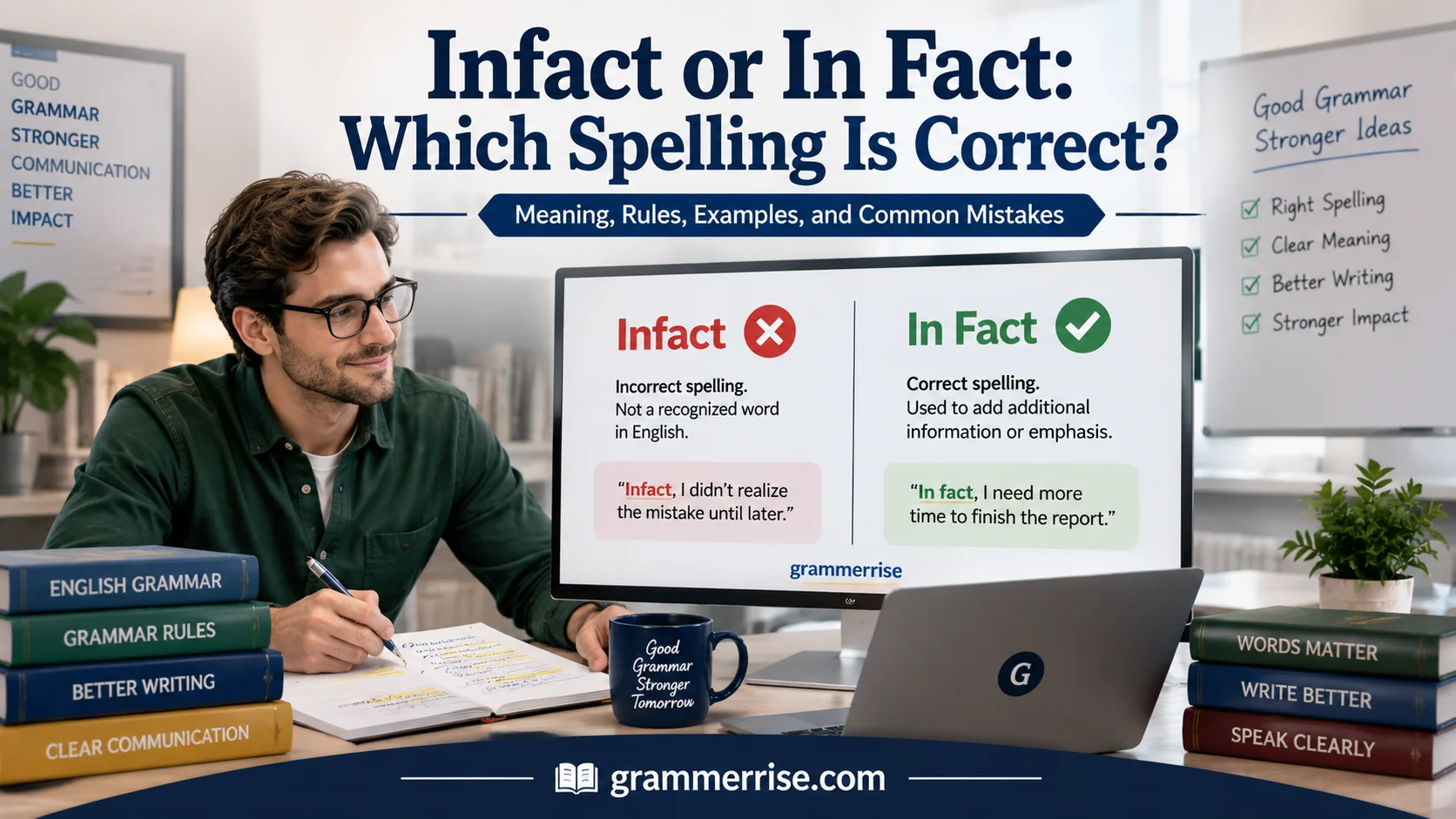
The simple rule is easy to understand: the correct form is written as two separate words. In fact is a fixed phrase used to emphasize a statement, provide correct information, or add clarification. The combined form infact is not accepted in standard English dictionaries and should be avoided in formal writing.
Many English learners need a clear explanation of this small difference and important difference to improve grammar, writing accuracy, and confidence in both formal communication and everyday communication. The English language depends on proper spelling, correct usage, separate words, and accurate sentence structure. When you type fast, hit send, and check later, an Infact use may appear as a small slip that hurts credibility. Although it seems harmless and minor, it can damage trust because strong writing proves that every detail counts.
Quick Answer
The correct form is in fact. It should always be written as two separate words. Infact is incorrect and is not accepted in standard English. Use in fact when you want to emphasize a statement, provide extra information, or clarify a point. For example: “She is talented; in fact, she won the competition.”
Infact or In Fact: Which One Is Correct?
The correct spelling is:
✅ In fact
❌ Infact
Although many writers use “infact,” standard English does not recognize it as a proper word. The phrase consists of two separate words:
- In = a preposition showing position, condition, or relation
- Fact = a noun meaning something true or real
Together, in fact means “actually,” “indeed,” or “the truth is.”
Examples:
❌ Infact, the movie was better than expected.
✅ In fact, the movie was better than expected.
❌ Infact, she already knew the answer.
✅ In fact, she already knew the answer.
The mistake does not usually happen because people misunderstand the meaning. Most writers understand what they want to say. The problem comes from treating the phrase like a single word.
What Does “In Fact” Mean?
The phrase “in fact” adds emphasis or introduces information that confirms, explains, or corrects something.
Think of it as a spotlight. It tells readers, “Pay attention because this next detail matters.”
For example:
“Many people think learning a language takes years. In fact, consistent practice can help beginners make progress within months.”
The phrase highlights the information that follows.
Common meanings of “in fact”
| Meaning | Explanation | Example |
| Actually | Shows the real situation | “I thought he was angry. In fact, he was just tired.” |
| Truly | Adds emphasis | “She is, in fact, one of the best players on the team.” |
| To correct information | Replaces a misunderstanding with truth | “The animal looks dangerous. In fact, it is harmless.” |
| To add details | Provides extra information | “The restaurant is popular. In fact, people travel hours to visit it.” |
Why Do People Write “Infact” Instead of “In Fact”?
The spelling mistake infact vs in fact happens for several reasons. Understanding these reasons can help you avoid making the same mistake.
People Write Words the Way They Hear Them
When people speak quickly, words often blend together.
For example:
- “In fact” can sound like “infact.”
- “A lot” can sound like “alot.”
- “At least” can sound like “atleast.”
However, spoken language and written language follow different rules.
A sentence may sound like one word when spoken but still require separate words when written.
Online Writing Encourages Shortcuts
Text messages, comments, and social media posts often move quickly. Many people type without proofreading, which allows incorrect spellings to spread.
A spelling mistake repeated thousands of times online can start looking familiar. Familiarity, however, does not make something correct.
English Has Many Compound Words
Another reason people confuse infact or in fact is because English contains many combined words.
Examples:
- Inside
- Instead
- Into
- Somehow
- Therefore
Because some words combine, writers may assume “in fact” should work the same way.
English does not always follow predictable patterns. That is why checking standard usage matters.
How to Use “In Fact” Correctly in Sentences
Using in fact correctly is simple once you understand its role.
The phrase usually introduces information that strengthens or explains a statement.
Using “In Fact” at the Beginning of a Sentence
This is the most common position.
When “in fact” starts a sentence, add a comma after it.
Correct examples:
- In fact, the company grew faster than expected.
- In fact, she had already completed the assignment.
- In fact, this method works better for beginners.
The comma creates a small pause and separates the introductory phrase from the main sentence.
Read more: Concave vs Convex: The Difference With Real-World Examples
Using “In Fact” in the Middle of a Sentence
You can also place “in fact” inside a sentence.
When it interrupts the main idea, commas usually surround it.
Examples:
- The plan was, in fact, much easier than we expected.
- The painting is, in fact, older than the building itself.
- She was, in fact, the first person to solve the problem.
Here, “in fact” acts like an interruption that adds extra emphasis.
Using “In Fact” at the End of a Sentence
Although less common, you can place the phrase at the end.
Examples:
- The results were surprising, in fact.
- The situation was more complicated, in fact.
This style often appears in conversations rather than formal writing.
Infact vs In Fact: Quick Comparison Table
| Feature | Infact | In Fact |
| Correct spelling | ❌ No | ✅ Yes |
| Dictionary recognition | Not accepted | Accepted |
| Word type | Incorrect combination | Two-word phrase |
| Meaning | None in standard English | Actually, truly, as a matter of fact |
| Used in formal writing | No | Yes |
| Example | Infact, he was right. | In fact, he was right. |
Common Mistakes With “In Fact”
Even when writers know that “in fact” is correct, they sometimes misuse it.
Understanding these mistakes can improve your writing.
Writing “Infact” as One Word
This is the biggest mistake.
Incorrect:
Infact, the results were impressive.
Correct:
In fact, the results were impressive.
The fix is simple: separate the two words.
Adding “In Fact” Without a Purpose
The phrase should introduce something meaningful. Adding it randomly can make writing feel repetitive.
Weak example:
I went to the store. In fact, I bought milk.
The second sentence does not provide much correction or emphasis.
Better:
I thought the store would be closed. In fact, it stayed open until midnight.
The phrase now introduces surprising information.
Overusing “In Fact”
Strong writers use phrases carefully. Repeating “in fact” in every paragraph can make your writing sound unnatural.
Instead, consider alternatives:
- Actually
- Indeed
- Truly
- The truth is
- As a matter of fact
- Surprisingly
Example:
Repeated:
In fact, the book was interesting. In fact, the characters were memorable. In fact, the ending was excellent.
Improved:
The book was surprisingly interesting. The characters were memorable, and the ending was excellent.
In Fact vs Actually: What Is the Difference?
Many people use in fact and actually interchangeably. They often have similar meanings, but they create slightly different tones.
| Phrase | Main Purpose | Example |
| In fact | Adds strong confirmation or detail | “The product is affordable. In fact, it costs less than competitors.” |
| Actually | Corrects information or expresses surprise | “Actually, the meeting starts tomorrow.” |
Example:
“I thought Sarah disliked coffee.”
You could say:
- Actually, Sarah loves coffee.
- In fact, Sarah drinks three cups every morning.
The first corrects the misunderstanding. The second adds supporting information.
In Fact vs Indeed
The word indeed also shows agreement or emphasis.
Examples:
- The results were impressive indeed.
- In fact, the results exceeded expectations.
However, “indeed” often sounds slightly more formal.
In Fact vs As a Matter of Fact
“As a matter of fact” has a stronger emphasis.
Compare:
- In fact, he owns two businesses.
- As a matter of fact, he owns five businesses.
The second sentence sounds like the speaker is strongly correcting or surprising someone.
Real-Life Examples of “In Fact” Usage
Everyday Conversation
People use “in fact” naturally when explaining something.
Example:
“I thought the restaurant was expensive. In fact, it was cheaper than most places nearby.”
Workplace Communication
Professional writing often uses “in fact” to support points.
Example:
“Customer satisfaction improved this year. In fact, reviews increased by 25%.”
Academic Writing
Researchers use the phrase to introduce evidence.
Example:
“Exercise improves overall health. In fact, several studies show that regular activity supports mental well-being.”
Online Content
Blog writers use it to make explanations clearer.
Example:
“Many people believe cats cannot be trained. In fact, cats can learn commands with consistent practice.”
Case Study: Why Small Grammar Errors Matter
Imagine two business emails.
Email A:
Infact, our team completed the project earlier than expected.
Email B:
In fact, our team completed the project earlier than expected.
The difference looks tiny. However, correct spelling affects how readers view your attention to detail.
In professional settings, small mistakes can influence credibility.
A reader may not consciously notice every error, but polished writing creates trust.
Grammar works like a clean window. When it stays clear, people focus on the message instead of the mistakes.
How to Remember the Correct Spelling of “In Fact”
A simple memory trick can help:
Remember that “fact” is a separate thing.
You do not put yourself “insidefact.” You say:
In + Fact = In Fact
Another helpful reminder:
If you can replace the phrase with “actually,” write it as two words.
Example:
In fact, she was correct.
Replace it:
Actually, she was correct.
The meaning remains similar.
FAQs
1. Is “infact” a correct word in English?
No, infact is not considered a correct word in standard English. The correct spelling is in fact, written as two separate words. Although many people write “infact” because the phrase sounds like one word when spoken, dictionaries and formal writing standards recognize only “in fact” as the correct form.
2. Why do people confuse “infact” and “in fact”?
People often confuse these two forms because in fact is commonly pronounced quickly in normal conversation. When words are spoken together, they can sound like a single unit, which makes writers combine them while typing. This mistake is especially common in casual messages, social media posts, and fast digital communication.
3. What does “in fact” mean?
In fact is a transitional phrase used to emphasize information, correct a previous statement, or introduce additional details. It often means “actually,” “indeed,” or “the truth is.” For example: “He thought the task was difficult. In fact, it was quite easy.”
4. Can I use “in fact” in formal writing?
Yes, in fact is completely acceptable in formal writing. It can be used in academic papers, professional reports, articles, and business communication. However, writers should use it naturally and avoid adding it unnecessarily in every sentence.
5. Does writing “infact” affect my writing quality?
Yes, using infact can negatively affect how readers view your writing. While the meaning may still be understood, incorrect spelling can make content appear less polished or careless. In professional and academic settings, small grammar mistakes may reduce credibility and trust.
6. How can I remember the correct form of “in fact”?
A simple way to remember it is to think about the meaning: in fact contains two separate ideas—“in” and “fact.” Since it introduces a fact or truth, keep the phrase separated. Practicing correct usage in sentences will also help make the spelling natural.
Conclusion
Understanding the difference between infact or in fact is a small but valuable step toward improving your English writing. The correct form is always in fact, written as two separate words. Even though the phrase may sound like a single word when spoken, combining it as “infact” creates a spelling mistake that should be avoided in standard English.
Good writing depends on attention to small details. Whether you are creating blog posts, sending emails, completing school assignments, or preparing professional documents, using the correct phrase shows accuracy and confidence. Remembering this simple rule will help you avoid confusion, strengthen your grammar skills, and make your communication clearer.
The easiest way to remember it is simple: whenever you want to emphasize a truth, add clarification, or correct information, use in fact. A small space between two words can make a big difference in how readers understand and trust your writing.