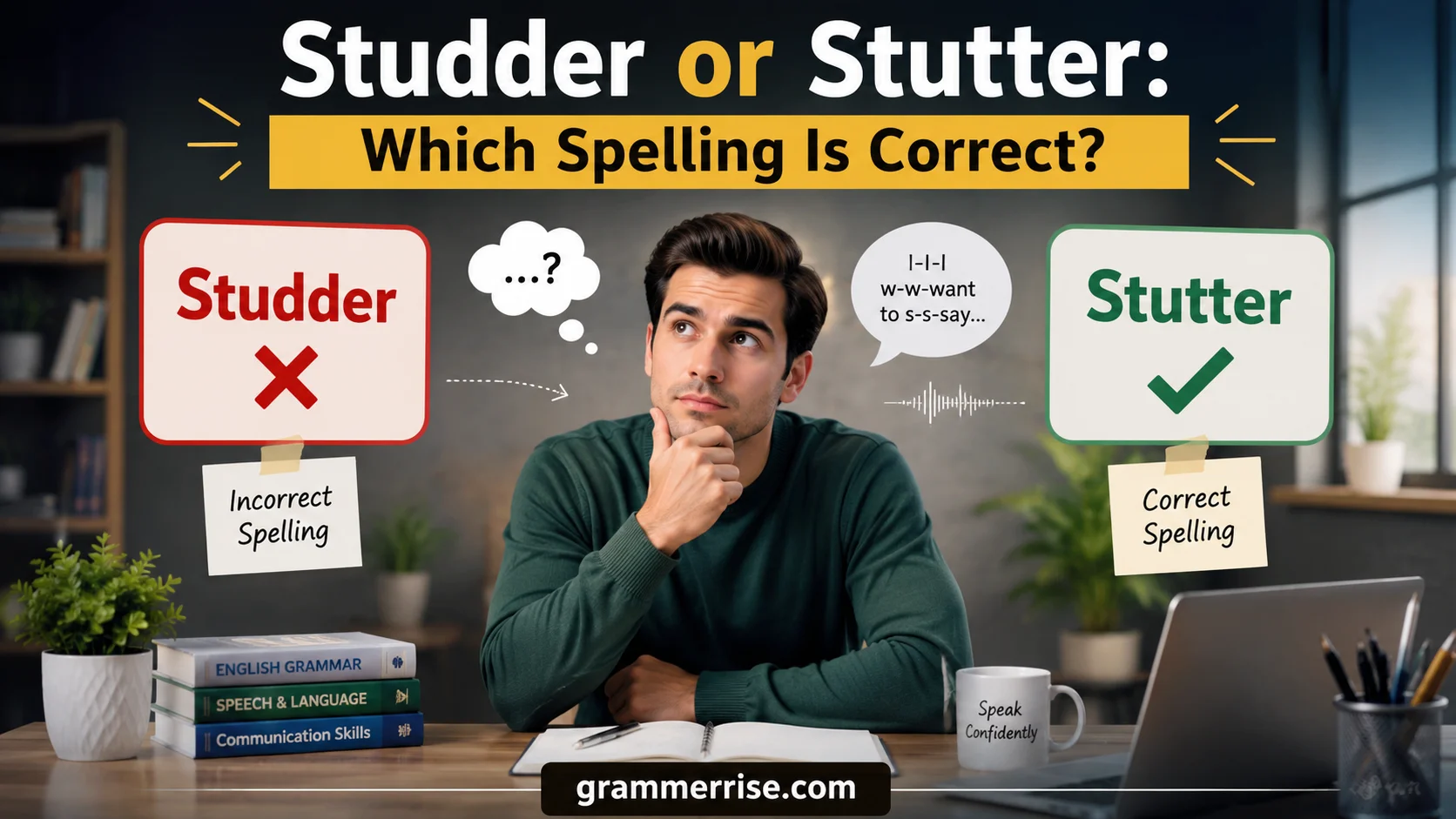
Studder or Stutter often confuses people, but Stutter is the correct spelling in standard English used by writers every day.
If you have ever stopped mid-sentence, paused, or questioned a word you typed because it did not looks right, you are not alone. Thousands of people, including students, parents, professionals, every writer, and many writers, make the same search every single month. Many searchers use studder, stutter, studder vs stutter, or studder / stutter as a search query because the pronunciation, speech sound, and sound are similar. In standard English, Stutter is the correct, recognized, correct form, correct term, and correct usage, while Studder is an incorrect, incorrect spelling, misspelling, and misspelled word.
A spellchecker, spell check, or dictionary can recognize the exact meaning, definition, word origin, origin, grammar, English grammar, grammar rules, language, vocabulary, context, language usage, standard usage, usage, and how to use the term correctly. This article and guide help English learners, language learners, and other learners understand, learn, compare, describe, and see the comparison with a clear answer and quick answer, making it easier to write with confidence, writing confidence, confidence in writing, clarity, clarity in writing, writing accuracy, and credibility.
Quick Answer
The correct spelling is stutter. ✅
Stutter means to speak with repeated sounds, pauses, or interruptions. Studder ❌ is a common misspelling. Always use stutter in standard English writing.
Studder or Stutter: Which Spelling Is Correct?
The simple answer is:
| Word | Correct Spelling | Meaning |
| Stutter | ✅ Yes | To repeat sounds, syllables, or words while speaking |
| Studder | ❌ No | A misspelling of “stutter” |
The correct word is stutter with two “t” letters in the middle:
S-T-U-T-T-E-R
The incorrect version, studder, replaces the second “t” with a “d.” Although it may look reasonable, dictionaries do not recognize it as the standard English spelling.
For example:
✅ Correct:
“He began to stutter when he felt nervous during the presentation.”
❌ Incorrect:
“He began to studder when he felt nervous during the presentation.”
The difference is small visually, but using the correct spelling matters. Whether you are writing an essay, email, article, or professional document, accurate spelling helps readers trust your writing.
What Does Stutter Mean?
The word stutter has several related meanings, but it most commonly refers to difficulty speaking smoothly.
A person who stutters may experience:
- Repeated sounds or syllables
- Longer pauses between words
- Difficulty starting a word
- Repetition caused by hesitation
For example:
“I-I-I don’t know the answer.”
The repeated “I” sound is an example of stuttering.
Stutter as a Verb
As a verb, stutter means to speak with interruptions or repeated sounds.
Examples:
- “She started to stutter when everyone looked at her.”
- “He stuttered during his first public speech.”
- “The child sometimes stutters when speaking quickly.”
Stutter as a Noun
As a noun, stutter refers to the speech pattern itself.
Examples:
- “His stutter became less noticeable over time.”
- “She learned techniques to manage her stutter.”
The word can also describe non-human actions.
Examples:
- “The old engine began to stutter before shutting down.”
- “The video stream started to stutter because of a slow internet connection.”
In these examples, stutter means something is not moving or working smoothly.
Why Do People Confuse Studder and Stutter?
The confusion between studder or stutter happens for several reasons. English has many words that sound different from how they are spelled.
Pronunciation Creates Spelling Confusion
When people hear the word stutter, the second “t” sound may not sound very sharp. In some accents, the “t” sound can become softer and resemble a “d” sound.
This happens in many English words.
For example:
- Water can sound like “wader” in some American accents.
- Butter can sound like “budder.”
- Better can sound like “bedder.”
Because of this pronunciation pattern, some people naturally write studder instead of stutter.
However, pronunciation does not change the official spelling.
English Spelling Is Full of Exceptions
English developed from many languages, including Latin, French, Germanic languages, and Old English. Because of this history, spelling rules are not always predictable.
Other commonly confused spellings include:
| Incorrect | Correct |
| Definately | Definitely |
| Seperate | Separate |
| Occured | Occurred |
| Recieve | Receive |
| Studder | Stutter |
The best way to avoid these mistakes is to learn the standard spelling and practice using it in sentences.
Online Writing Can Spread Mistakes
The internet moves quickly. A misspelled word can appear thousands of times through social media posts, comments, and informal messages.
When people repeatedly see studder, they may assume it is correct.
This is why checking reliable dictionaries and grammar sources remains important.
Stutter Definition, Pronunciation, and Word Forms
Understanding the different forms of stutter makes it easier to use correctly.
Stutter Pronunciation
The word stutter is usually pronounced:
STUT-er
Phonetic pronunciation:
/ˈstʌtər/
The first syllable sounds like “stut,” similar to the beginning of the word “study” but with a short “u” sound.
Different Forms of Stutter
| Word Form | Example |
| Stutter | “I sometimes stutter when I feel anxious.” |
| Stuttered | “He stuttered while answering the question.” |
| Stuttering | “She is practicing ways to control her stuttering.” |
| Stutterer | “The author described his experience as a stutterer.” |
Knowing these forms helps you avoid creating incorrect variations.
Examples of Stutter Used Correctly in Sentences
The best way to understand a word is to see how people use it naturally.
Everyday Examples
- “I tend to stutter when I speak too quickly.”
- “The student stuttered because he was nervous.”
- “Her stutter does not stop her from sharing ideas.”
Workplace Examples
- “He prepared carefully before the interview because he wanted to feel confident despite his stutter.”
- “Public speaking practice helped her become more comfortable.”
Emotional Situations
People often experience more speech difficulty during stressful moments.
Examples:
- “He started to stutter when he had to answer unexpectedly.”
- “She noticed her stutter became stronger when she felt pressured.”
Technology Examples
The word also applies to machines and digital systems.
Examples:
- “The game began to stutter after the graphics settings were increased.”
- “The audio started to stutter because of a weak connection.”
Studder vs Stutter: Common Mistakes to Avoid
Many spelling mistakes happen because writers rely only on sound.
Here are common errors and corrections:
| Incorrect Sentence | Correct Sentence |
| “I have a studder when I talk.” | “I have a stutter when I talk.” |
| “He studdered during the interview.” | “He stuttered during the interview.” |
| “She sometimes studders when nervous.” | “She sometimes stutters when nervous.” |
Remember this simple rule:
If you are talking about repeated speech sounds, use “stutter.”
There is no standard English situation where studder should replace stutter.
The History and Origin of the Word Stutter
The word stutter has been part of the English language for hundreds of years.
It developed from older Germanic language roots connected with repeated or interrupted speech. Historical forms of the word described someone who struggled to speak smoothly.
Over time, English speakers continued using the word to describe:
- Speech interruptions
- Hesitation
- Repeated sounds
- Broken movement
The spelling eventually became standardized as stutter.
Language changes over time, but modern dictionaries and writing standards continue to recognize stutter as the correct form.
Stutter as a Speech Condition
While many people use “stutter” casually, it can also describe a real speech condition.
A person who stutters may experience different types of interruptions.
Read More: Lying or Lieing: Meaning, Rules and Examples
Common Types of Stuttering
Repetitions
A person repeats a sound, word, or phrase.
Example:
“B-b-b-book”
Prolongations
A person stretches a sound.
Example:
“Mmmmmom”
Blocks
A person knows what they want to say but cannot produce the sound immediately.
Example:
“I want to … (pause) go.”
Stuttering affects people differently. Some people experience it occasionally, while others experience it more frequently.
A stutter does not indicate a person’s intelligence, creativity, or ability. Many successful speakers, performers, writers, and leaders have experienced stuttering.
“A person’s voice does not define the value of their ideas.”
Tips to Remember the Correct Spelling of Stutter
Spelling becomes easier when you connect words with simple memory tricks.
Remember the Double “T”
The correct spelling contains two “t” letters:
STUT + TER = STUTTER
Think of the repeated “t” as matching the repeated sounds in speech.
Use a Memory Sentence
Try remembering:
“My speech can stutter, but my spelling should not.”
Compare the Two Spellings
Stutter
- Starts with ST
- Contains TT
- Ends with ER
Studder
- Changes T to D
- Looks similar but is incorrect
Small spelling reminders can prevent common mistakes.
Stutter Synonyms and Related Words
Several words are connected to stutter, but they do not always mean exactly the same thing.
| Word | Meaning |
| Hesitate | Pause before speaking or acting |
| Falter | Lose confidence or strength temporarily |
| Stumble | Make mistakes while speaking |
| Pause | Stop briefly |
| Repeat | Say something again |
For example:
“I hesitated before answering” does not always mean “I stuttered.”
A person can hesitate without having a speech interruption.
Stutter vs Similar Words: Understanding the Difference
Hesitate vs Stutter
Stutter involves interrupted speech patterns.
Example:
“B-because I was nervous.”
Hesitate means pausing because you are unsure.
Example:
“I hesitated before choosing an answer.”
Stutter vs Stammer
In many regions, stammer and stutter mean the same thing.
However:
- “Stutter” is more common in American English.
- “Stammer” is often used more in British English.
Both words can describe interrupted speech.
Interesting Facts About Stuttering
- Stuttering can begin during childhood.
- Many children naturally improve their speech as they grow.
- Stress can sometimes make stuttering more noticeable.
- People who stutter can communicate effectively in many careers.
- Stuttering is not caused by a lack of intelligence.
FAQs
What is the correct spelling: Studder or Stutter?
The correct spelling is stutter. Studder is a common misspelling and is not accepted in standard English dictionaries.
Why do people write “studder” instead of “stutter”?
Many people rely on pronunciation when spelling words. Because the sounds are similar, they accidentally replace the t with a d, resulting in studder.
Is “studder” ever a correct English word?
No. Studder is not recognized as a standard English word. You should always use stutter in writing.
Does British English spell “stutter” differently?
No. Both British English and American English use the spelling stutter. There is no regional variation for this word.
What does the word “stutter” mean?
Stutter refers to a speech disorder in which a person repeats, prolongs, or struggles to say certain sounds or words, affecting the natural flow of speech.
How can I remember the correct spelling of “stutter”?
A simple trick is to remember that stutter contains a double t, just like the word letter. If you see studder, treat it as a spelling mistake and replace it with stutter.
Conclusion
Choosing between Studder or Stutter is easier once you know the rule. Stutter is the only correct spelling in standard English, while studder is simply a common misspelling caused by pronunciation and spelling confusion. Whether you’re writing an email, a school assignment, a professional document, or searching for the correct term online, using stutter will keep your writing accurate and credible. When in doubt, check a trusted dictionary, and you’ll avoid this mistake with confidence in the future.