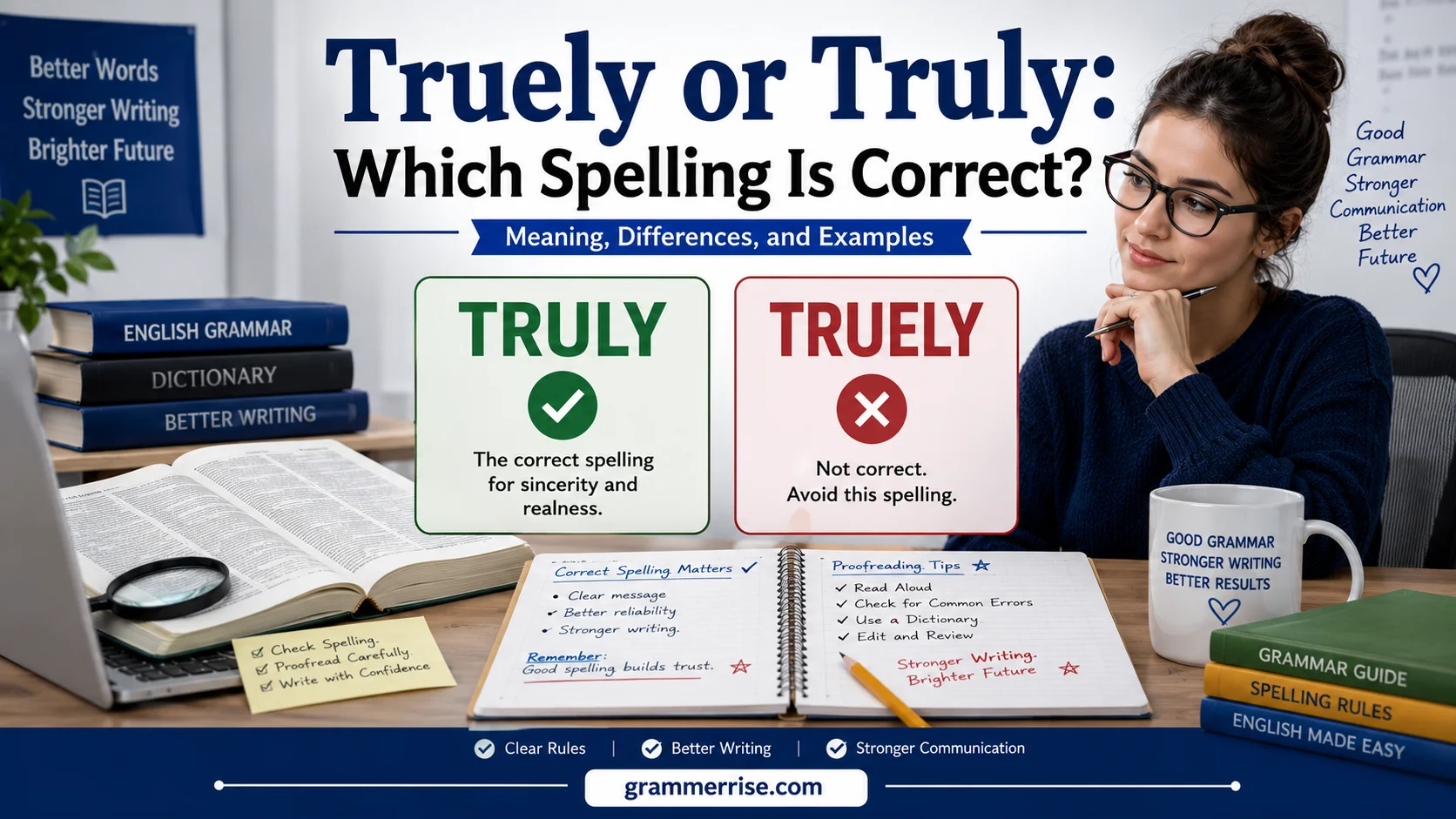
The Truely or Truly confusion affects writers because the correct spelling truly follows a grammar rule where true drops e before adding ly. Many people experience this confusion while writing, especially when checking an important email or other professional content. I once faced the same doubt during proofreading and felt unsure whether the word looked correct. After digging deeper, I learned that true changes to truly because it drops the letter e before adding ly.
This spelling rule explains why truely is a common misspelling and why it is not accepted in standard English writing. The origin of this pattern connects with how many English words change naturally, even when the extra e seems logical. Learners, student writers, teacher guides, blogger creators, and professional users often search these spelling questions because English pronunciation, silent letters, and phonetic spellings can create doubt.
The difference between these two versions becomes easier to understand through real-world usage and practical examples. Truly is the standard adverb form used to describe something real, genuine, or expressed in a sincere way with honesty, accuracy, and intensity. The word appears in emails, school assignments, social media posts, professional documents, and everyday communication where polished writing looks more trustworthy. While teaching English writing, I noticed this small spelling mistake often appears because many people follow simple patterns where words ending in -ly keep their base spelling.
Quick Answer
If you’re looking for a fast answer, here it is:
| Word | Correct? | Meaning |
| Truly | ✅ Yes | In a truthful, sincere, genuine, or complete way |
| Truely | ❌ No | Misspelling of truly |
Whenever you’re writing an email, essay, report, social media post, or professional document, you should always use truly.
Examples
Correct:
- I truly appreciate your support.
- She is truly talented.
- We are truly grateful for your help.
- This is a truly remarkable achievement.
Incorrect:
- I truely appreciate your support.
- She is truely talented.
- We are truely grateful.
Even though the incorrect version appears frequently online, dictionaries and style guides recognize only truly as the standard spelling.
What Does Truly Mean?
Before discussing spelling rules, it’s important to understand what the word actually means.
Truly is an adverb derived from the adjective true.
It describes something done in a truthful, sincere, genuine, or complete manner.
Dictionary Definition of Truly
According to major English dictionaries, truly can mean:
- In a truthful way
- Genuinely
- Honestly
- Sincerely
- Accurately
- Completely
The exact meaning depends on the context.
Common Meanings of Truly
Truthfully
When someone speaks honestly without deception.
Example:
He truly answered every question.
Genuinely
When feelings or actions are authentic.
Example:
She truly cares about her students.
Sincerely
When expressing heartfelt emotions.
Example:
I am truly sorry for the misunderstanding.
Completely
When emphasizing the extent of something.
Example:
The view was truly breathtaking.
Why Is Truely Incorrect?
This is where many writers become confused.
The adjective true ends with the letter e.
Naturally, people assume the adverb should be formed like this:
true + ly = truely
However, English spelling follows a different rule.
When forming certain adverbs, the silent e is dropped before adding -ly.
Therefore:
true → truly
Not:
true → truely
The Rule Explained
The final silent e disappears before the suffix -ly is attached.
| Base Word | Adverb |
| True | Truly |
| Due | Duly |
| Whole | Wholly |
The rule may seem unusual at first, but it has been part of standard English spelling for centuries.
The History Behind Truly
The word true comes from Old English triewe and treowe, which referred to faithfulness, honesty, and reliability.
As English evolved, the adverb form eventually became truly rather than truely.
Writers, publishers, dictionaries, and educational institutions have consistently used truly as the accepted form.
Today, every major style guide recognizes truly as the only standard spelling.
Why Do People Write Truely?
If truly is correct, why do so many people write truely?
The answer lies in human psychology and spelling patterns.
The Base Word Creates Confusion
People naturally see:
true
Then add:
-ly
Their brain expects:
truely
This seems logical because many English words keep their original spelling when suffixes are added.
Unfortunately, this particular word follows a special rule.
Pronunciation Doesn’t Help
Another reason is pronunciation.
Both spellings are pronounced exactly the same.
When spoken aloud, nobody can hear whether the word contains an extra e.
Because pronunciation offers no clue, writers often rely on visual memory instead.
Fast Typing Leads to Errors
Many spelling mistakes occur during quick writing.
Consider these situations:
- Writing emails rapidly
- Texting on mobile devices
- Posting on social media
- Drafting reports under pressure
In such cases, people often type truely without noticing.
The Grammar Rule Behind Truly
Understanding the grammar rule can help you avoid similar mistakes in the future.
How Adverbs Are Formed
Many English adverbs are created by adding -ly to adjectives.
Examples include:
| Adjective | Adverb |
| Quick | Quickly |
| Slow | Slowly |
| Happy | Happily |
| Careful | Carefully |
| True | Truly |
However, spelling adjustments sometimes occur before adding the suffix.
When the Final E Is Dropped
Several English words lose their final silent e before taking a suffix.
Examples:
| Word | Result |
| True | Truly |
| Due | Duly |
| Whole | Wholly |
These forms may look unusual, but they are standard English.
When the E Stays
Not every word drops the e.
Examples include:
| Word | Adverb |
| Extreme | Extremely |
| Polite | Politely |
| Accurate | Accurately |
English contains many exceptions, which is one reason spelling can feel challenging.
Truly in Everyday Conversation
The word truly appears regularly in daily speech.
People often use it to emphasize sincerity or authenticity.
Examples
- I truly enjoyed the movie.
- We truly appreciate your kindness.
- That was truly unforgettable.
- She truly understands the problem.
In conversation, truly often adds emotional depth.
Compare:
Thank you for helping me.
Versus:
Thank you. I truly appreciate your help.
The second sentence feels warmer and more sincere.
Truly in Professional Writing
Professional communication often relies on words that express respect and sincerity.
Truly works well in:
- Business emails
- Client communications
- Job applications
- Recommendation letters
- Corporate reports
Examples
- We truly value your feedback.
- Our team is truly committed to quality.
- I truly appreciate your time and consideration.
Because the word sounds polished without being overly formal, it fits many workplace situations.
Truly in Academic Writing
Academic writing generally favors precision.
While scholars avoid excessive emotional language, truly can still serve a purpose.
Examples
- The findings truly support the hypothesis.
- This discovery is truly significant.
- The evidence truly demonstrates the trend.
Writers should use it carefully. Too many intensifiers can weaken academic credibility.
Truly in Marketing and Advertising
Marketers frequently use truly because it conveys authenticity.
Consumers often look for genuine experiences rather than exaggerated promises.
Common Marketing Phrases
- Truly natural ingredients
- Truly premium quality
- Truly innovative technology
- Truly unforgettable experience
Brands use the word to build trust and strengthen emotional connections.
Read more: Since vs Sense: What’s the Difference?
Common Phrases That Use Truly
Many popular English expressions contain the word truly.
Understanding these phrases helps improve both comprehension and writing.
Yours Truly
Traditionally used in letters.
Example:
Yours truly,
Michael Smith
Although less common today, it remains recognizable.
Truly Grateful
Expresses deep appreciation.
Example:
We are truly grateful for your generosity.
Truly Remarkable
Highlights something exceptional.
Example:
Her performance was truly remarkable.
Truly Unique
Indicates genuine uniqueness.
Example:
The design is truly unique.
Truly Sorry
Shows sincere regret.
Example:
I am truly sorry for the inconvenience.
Truly Honored
Used in formal and ceremonial situations.
Example:
I am truly honored to receive this award.
Truly vs Really
Many people use truly and really interchangeably.
However, they are not always identical.
| Feature | Truly | Really |
| Primary Meaning | Genuine or truthful | Degree or emphasis |
| Tone | More sincere | More casual |
| Formality | Slightly formal | Informal |
| Common Use | Authenticity | Intensification |
Examples
Really
That movie was really good.
Truly
That movie was truly inspiring.
The first emphasizes quality.
The second emphasizes genuine emotional impact.
Truly vs Sincerely
Although similar, these words serve different purposes.
| Truly | Sincerely |
| Can modify many statements | Often relates to feelings or correspondence |
| Broader usage | Narrower usage |
| Common in conversation | Common in letters |
Example
I truly appreciate your support.
I sincerely appreciate your support.
Both work, but sincerely sounds slightly more formal.
Truly vs Honestly
These words overlap but aren’t identical.
Truly
Focuses on authenticity.
Example:
She truly loves her work.
Honestly
Focuses on truthfulness.
Example:
Honestly, I don’t know the answer.
The distinction is subtle but important.
Truly vs Genuinely
These words are close relatives.
Truly
General emphasis.
Genuinely
Specifically stresses authenticity.
Examples:
I am truly happy for you.
I am genuinely happy for you.
In many situations, either choice works.
Correct and Incorrect Usage Examples
Seeing examples side by side can make the difference crystal clear.
| Incorrect | Correct |
| I truely appreciate your help. | I truly appreciate your help. |
| She is truely talented. | She is truly talented. |
| We are truely grateful. | We are truly grateful. |
| That was truely amazing. | That was truly amazing. |
| He truely cares. | He truly cares. |
More Correct Examples
- The team truly deserved the victory.
- This book truly changed my perspective.
- She truly understands customer needs.
- We truly value long-term relationships.
- The landscape was truly stunning.
Mini Case Study: A Professional Email Mistake
Imagine a job applicant sending this message:
I am truely grateful for the opportunity.
A hiring manager immediately notices the misspelling.
The mistake doesn’t necessarily cost the applicant the job. However, it can create a negative first impression.
Now compare:
I am truly grateful for the opportunity.
The sentence appears polished and professional.
Small spelling details often influence how readers perceive credibility.
Lesson
Accurate spelling signals:
- Attention to detail
- Professionalism
- Strong communication skills
- Careful proofreading
Is Truely Ever Accepted?
A common question is whether truely is ever correct.
The answer is simple.
Standard English Says No
Major dictionaries recognize only truly.
Examples include:
- Merriam-Webster
- Cambridge Dictionary
- Oxford English Dictionary
- Collins Dictionary
None list truely as a standard spelling.
Why You Might See It Online
You may encounter truely in:
- Blog comments
- Social media posts
- Forums
- Draft documents
- User-generated content
These examples represent spelling mistakes rather than accepted usage.
How to Remember the Correct Spelling
Fortunately, remembering the correct form isn’t difficult.
Memory Trick
Think:
True loses E before LY.
Visualize it this way:
TRUE → TRULY
The e quietly disappears.
Another Helpful Trick
Compare:
- true → truly
- due → duly
- whole → wholly
All three follow a similar pattern.
Proofreading Tip
Whenever you write truely, ask yourself:
Did I leave an extra “e” behind?
That quick check can eliminate the mistake instantly.
Quick Reference Chart
| Question | Answer |
| Is truly correct? | ✅ Yes |
| Is truely correct? | ❌ No |
| What part of speech is truly? | Adverb |
| What does truly mean? | Truthfully, genuinely, sincerely |
| Can truly be used formally? | ✅ Yes |
| Do dictionaries recognize truely? | ❌ No |
Common Mistakes Related to Truly
Writers sometimes make additional errors involving the word.
Overusing Truly
Too many intensifiers can weaken writing.
Instead of:
The product is truly amazing and truly incredible and truly outstanding.
Write:
The product is outstanding and delivers exceptional value.
Using Truly Without Purpose
Every word should add value.
Ask yourself whether truly strengthens the sentence or merely fills space.
Confusing Truly With Really
While similar, they don’t always carry the same meaning.
Choose the word that best matches your intended tone.
Expert Writing Tip
Many professional editors recommend reading important documents aloud.
Why?
Your eyes often overlook familiar mistakes.
Your ears catch awkward phrasing.
Although reading aloud won’t reveal the spelling difference between truely and truly, it encourages slower proofreading and helps you notice errors before publication.
“Good writing is clear thinking made visible.”
That principle applies to spelling as much as style.
Key Takeaways
Before you leave, remember these essential points:
- Truly is the correct spelling.
- Truely is a misspelling.
- The silent e in true disappears before -ly is added.
- Truly means truthfully, sincerely, genuinely, or completely.
- The word works well in everyday conversation, professional writing, and academic contexts.
- Major dictionaries recognize only truly.
- A simple memory trick is: True loses E before LY.
FAQs
1. Is “truely” a correct spelling in English?
No, “truely” is not the correct spelling in standard English. It is a common spelling mistake that happens because people connect the word with “true” and think the letter e should remain. The correct spelling is “truly.”
2. Why does “true” become “truly” without the letter e?
The word “true” loses its final e when it changes into the adverb form “truly.” This follows an English spelling pattern where some words remove silent letters before adding suffixes like -ly.
3. What does “truly” mean?
Truly means in a real, genuine, honest, or sincere way. It is used when something is completely true, accurate, or deeply felt. For example, “She truly cares about her work” means her feelings are genuine.
4. Why do people often confuse truly and truely?
Many people confuse these words because English pronunciation does not always match spelling rules. The sound of “truly” can make the extra e in “truely” seem reasonable, but spelling follows grammar rules rather than only pronunciation.
5. Can I use “truely” in professional writing?
No. Using “truely” in emails, academic work, articles, or professional documents may make your writing appear less polished. Always use “truly” to maintain correct and professional English.
6. What is an easy way to remember the correct spelling?
A simple trick is to remember that true + ly = truly, not truely. When adding -ly to “true,” remove the final e first. This small rule can help you avoid similar spelling mistakes in everyday writing.
Conclusion
Understanding the difference between Truely or Truly helps you avoid a small but common spelling mistake that can affect the quality of your writing. While truely may look natural because it comes from the word true, the correct form is always truly. The spelling rule is simple: remove the final e from true before adding -ly.
Whether you are writing an email, article, assignment, or professional document, using truly shows attention to detail and strong language skills. Once you remember this simple pattern, you can confidently choose the correct spelling and avoid similar mistakes in the future. Clear spelling creates clearer communication, and even small improvements can make your writing look more polished and trustworthy.